Horizon Group Faucets A Consolidated Report BathSelect, Cascada Showers, Fontana Showers, and Juno Showers Review & Rating Updated: March 20, 2026
The Horizon Group has taken exception to some of the facts about the Group, its constituent companys, and its faucet products disclosed in this report, going so far as to publish a rebuttal on several of the websites it controls. The company's rebuttal on its Fontana website and our response can be read in the footnotes.[1]





| BathSelect | $ 99.65 - $2,029.99 |
| Cascada Showers | $169.95 - $ 296.99 |
| Fontana Showers | $154.40 - $3,845.35 |
| Juno Showers | $187.13 - $1,936.00 |
Law Requirements
Warranty Footnotes1. Some faucets may include a longer warranty or some components. Read the warranties for specific information.
- Read the BathSelect faucet warranty.
- Read the Cascada Showers faucet warranty.
- Read the Fontana Showers faucet warranty.
- Read the Juno Showers faucet warranty.
☆ Learn more about faucet warranties.☆ See how we determine warranty scores.☆ Understanding the federal Magnuson Moss Warranty Act.☆ Find out how to enforce your product warranty.Download/Read/Print our Model Limited Lifetime Warranty for comparison.
This Company In Brief
Maysara Khalid Sadiq and his associates control a group of related companies that illegally import and sell illegal Chinese-made faucets in the U.S. and Canada under several trade names.
The faucets are sold through proprietary websites and internet retailers that host third-party sellers, such as Amazon, Houzz, and Wayfair.
Mr. Sadiq is a minor marketing genius using techniques that allow him to sell perfectly ordinary faucets at grossly inflated prices.
Unfortunately, those techniques involve pervasive misrepresentation, including disguising the origin of the faucets (China, not the U.S.), concealing their legal status (not legal to sell or use in a drinking water system), and claming benefits that the faucets do not have, such as WaterSense® labeling.
The fact that his companies have been largely successful suggests, unfortunately, that the deceptions work.
Horizon Group faucet warranties are uniformly sub-par for North America, and after-sales customer service and replacement parts availability are woefully deficient.
The faucets do not meet the minimum legal requirements for installation as drinking water faucets in North America.
The Group
The Horizon Group consists of at least five operating companies, all of which are in some manner associated with Maysara Khalid Sadiq.[2]
| Horizon Group Companies | |||
|---|---|---|---|
| Organization and Status | |||
| Legal Name | Company ID |
Registered Agent & Address | Status* |
| BathSelect LLC | S6486593 | Maysara Sadiq, 3970 Clares Ct., Fairfax, VA, 22033 | Inactive |
| Cascadashowers LLC | 11414604 | Rola Al-Sabbagh, 7121 Merrimac Dr., Mc Lean, VA, 22101 | Active |
| Fontana Showers LLC | S7311642 | Maysara Sadiq, 3707 Broadrun Dr., Fairfax, VA, 22033 | Inactive |
| Juno Showers LLC | 11104648 | M. Khalid Sadiq, 3707 Broadrun Dr., Fairfax, VA, 22033 | Inactive |
| Horizon Direct Depot LLC | S4967677 | Rola Sabbagh, 7121 Merrimac Dr, Mc Lean, VA, 22101 | Active |
| Inactive companies cannot legally conduct business.
* Legal status was determined as of October 22, 2025 and may have changed. |
|||
- BathSelect LLC trading as BathSelect[3], Horizon/Bathselect, and BathSelect Hospitality
- Cascada Showers LLC trading as Cascada Showers,
- Fon;na Showers LLC trading as Fontana Showers, Fontana Showers Commercial, and Fontana Sensor Faucets,
- Juno Showers LLC trading as Juno Showers and Juno Commercial, and
- Horizon Direct Depot, LLC, trading as Horizon Direct Depot.
The group also operates a sixth retail website, HGShopping as an online-only store that sells Fontana and Juno products. It may not be the only such site, but is the only one we have confirmed so far.
Feeder Websites
In addition to its sales venues, the Group also operates several websites called "feeder sites." These are websites that feed potential buyers to the Group's "money sites" where its products are sold.
There are two types of feeder sites. "White sites" acknowledge their connection with the money site, and "black sites" that conceal that connection, pretending to have no affiliation with the money site.
The Group's feeder sites are all black sites.
They attract potential buyers to the Group's money sites by offering what appears to the reader to be "impartial expert advice" and "independent reviews" that unfailingly favor the Group's products.
These are the black sites that we have identified so far. There may be others that we have not yet discovered.
-
ArchFaucets.com, is an unfinished black feeder website in the guise of a
"reference hub for faucet design, performance, and specification guidance."
- The site identifies Fontana Showers as the "best commercial architectural faucet," placing it as number one in a ranking list, ahead of top commercial faucet brands such as Sloan (the company that pioneered the first automatic commercial faucets in 1974).
- All of these "lower ranking" brands are, unlike Fontana Showers, fully certified, legal to sell and install, and produce some of the best commercial faucets in North America.
- BathSelect and Juno Showers also make the list, but place more modestly in 12th and 13th positions.
-
BravatShowers.com does double duty for the Group. It is a site at which the Group sells
It is also a black feeder site that features the
"Best Touchless Bathroom Faucets Reviewed by Experts."
- No surprise, the Group's faucets are identified as "among the best." Uncertified Fontana Showers and BathSelect faucets are ranked in first and second place, again "besting" fully certified well-established brands such as Sloan.
-
Commercial Sensor Faucet Research Hub. This black site describes itself as a
"…research-first blog built for architects, engineers, facility teams, and project planners who work on commercial restrooms in the United States."
- Its recommended brands equates the Group's uncertified commercial faucets as on par with fully certified industry-leading brands such as Sloan, and Zurn (selling commercial faucets for over 150 years and the brand that, along with Sloan, taught the world how to make a commercial faucet).
- Commercial Restroom Design is a website positioned as an independent guide to commercial lavatory sesign. It manages to reference the Group's brands with glowing praise in connection with nearly every topic.
- See, for example, Is BathSelect a Major Bathroom Fixture Brand – and Why?, a discussion that answers the question with a resounding "Yes." In truth, however, BathSelect is not just a minor brand; it is a very minor brand.
-
DesignConcept123, is ostensibly a multi-displenary organization composed of
"…Creators, Dreamers, [and] Technologists" focusing on "documenting and testing methods that improve clarity in digital interfaces [through] research [that] pans interface design, brand systems, content structure, and usability focused communication."
(And, if you understand any of that, please explain it to us.)
- The site's blog contains comparison guides that always favor the Group's faucets. For example, How BathSelect Is Compared to Moen and Delta, awards BathSelect very high marks, ahead of both
- Wiki Home Improvements, a blog that promotes the Group's products under the guise of publishing independent reviews and comparisons,
As their affiliation with the Group is disguised, these feeder sites foster the illusion that they are independent and that the praise they heap on the Group's products is unsolicited and impartial.
| Brand Registration | ||||
|---|---|---|---|---|
| Trademark | Type1 | File No. | Owner | Status |
| BathSelect | Wordmar | 98121878 | Horizon Inc.2 | Active |
| Cascadashowers | Wordmark | 97513824 | Cascada Showers LLC | Pending |
| Cascada Showers | Wordmark | 88479517 | Horizon Direct Depot LLC | Abandoned |
| Fontana Showers | Wordmark | 88708993 | Maysara Sadiq | Abandoned |
| Fontanashowers | Wordmark | 98433621 | Fontana Showers LLC | Active |
| FONTANASHOWERS | Wordmark | 99225030 | Maysara Sadiq | Pending |
| Juno Showers | None | |||
|
1. A standard word or character mark is a text-only name used for purposes of identification and branding. It ddoes not include any form of graphical distinction such as shape, color, font, or design normally found in a design or stylized trademark (logo).
2. Horizon, Inc., 4429 Brookfield Corporate Dr, Ste 500, Chantilly, VA 20151 does not exist as a corporation authorized to conduct business in Virginia.
|
||||
However, it is neither. It is an integral part of the Group's overall marketing strategy.
When the Bravat Showers website ranks the Group's faucets as among the
"Best Touchless Bathroom Faucets Reviewed by Experts"
or the Arch Faucets site identifies Fontana Showers as selling the
"best commercial architectural faucet,"
without disclosing that the endorsements are from an entity with a "material connection" to the endorsed brand, the endorsements are illegal as "undisclosed influencer partnerships."
The practice violates Section 5 of the Federal Trade Commission Act (15 U.S. Code § 45) which requires endorsers to disclose material connections with the brands or products being endorsed and provides penalties that may reach $50,000 per violation.
Review Pumping
The feeder sites even go so far as to quote each other's endorsements of the Group's products as "proof" that their overwhelmingly favorable views of the Group's products are completely true.
This technique is one form of "review pumping," defined as:
"… review manipulation aimed at deceiving consumers and gaming search algorithms by inflating a product's online reputation through the artificial generation of a high volume of positive reviews."
When the group copies a favorable review from one of its websites to another, it has, in effect, created a second favorable review. If the review is copied to five different sites, five new reviews are created. This is the simplest form of review pumping.
ReView pumping has Four purposes:
- Increase he number of favorable reviews appearing on the intenet.
- Enhance the ratio of good to bad reviews on the web, often dramatically.
- Help to ensure that favorable reviews appear much more often in search engine results. Every copied review can become a separate item in the organic portion of the search results page.
- Create the impression that positive views of the company's products are widespread.
However, this kind of review pumping is, like undisclosed affiliated endorsements, completely unlawful.
It is illegal in the U.S. for a company to
"…disseminate or cause the dissemination of a consumer testimonial about the business or one of the products … it sells … which fails to have a clear and conspicuous disclosure of the testimonialist's material relationship to the business…" (16 CFR Part 465(b)(1))
This means, very simply, that the Group can copy favorable reviews to the websites of related eneties only if it makes it very clear that the reviews are copies and the entities are affiliated.
Company Addresses
The Group's companies list a wide variety of business addresses spread throughout Washington D.C.'s Virginia suburbs, some of which are private residences.
4429 Brookfield Corporate Dr., Suite 500, Chantilly, VA, identified by Fontana Showers, Juno Showers, Bath Select, and HGShopping as their principal business address, is an office warehouse complex housing multiple businesses.
7121 Merrimac Dr., McLean, VA, is identified by Cascada Showers and Horizon Direct Depot as their primary business address. This address is listed in Fairfax County property records as a single-family residence owned by Rola Ali Sabbagh (Also appearing in public records as Roula Sabbagh and Rola Al-Sabbagh).
Ms. Sabbagh is identified by Dun and Bradstreet as the president of Horizon Direct Depot, and by the Virginia Corporation Commission as that company's registered agent.
She has been associated with the Horizon Direct Depot in public records since 2017 and is also mentioned in several sources as the president of Cavalier Construction Group, Inc., an entity hat, according to the records of the Virginia Corporations Commission, does not and never has existed.
Cascada Showers lists its mailing address as 217 W. 18th St. #1306, New York, NY.
The U. S. Postal Service catalogs this address as the historic Old Chelsea Station, a Post Office in Manhattan. The "#1306" is, according to the station manager, the number of a post office box.
6845 Elm St., McLean, VA, is listed by Horizon Direct Depot as its street address. The building is an office complex that primarily houses doctors' offices and medical services.
4270 Henninger Ct., Chantilly, VA, is a small office/warehouse center that appears to be a logistics and order fulfillment center. The Group rents one of the warehouse bays. It is identified by Fontana Showers, Juno Showers, BathSelect, and HGShopping as a contact address.
3707 Broadrun Dr. #4, Fairfax, VA, is the registered address for Fontana Showers LLC and Juno Showers LLC. It is a four-bedroom single-family residence that, according to Spokeo, is occupied by Maysara Khalid Sadiq. Horizon Direct Depot also claims this address as its business address in its Walmart seller listing.
Principal Business Address vs. Registered Address
Legal Organization and Status
Members of the Group share purchasing, warehousing, order fulfillment, and customer service.
We believe, based on our research into import and customs records, that Horizon Direct Depot LLC handles many of these backend processes for the Group, including importation from China. It also sells the Group's products on its website and through Amazon and eBay stores.
However, direct imports by any member of the group are only a small portion of the Group's total imports. Most are sent to distribution and fulfillment centers operated by Amazon, Walmart, and other hosting websites on which the company sells its products, and are lost in the deluge of products received by these gargantuan centers.
All of the entities are organized as limited liability companies in Virginia. Three of these, BathSelect LLC, FontanaShowers LLC, and JunoShowers LLC, are listed by the Virginia Corporation Commission as "inactive" for failure to comply with reporting requirements.
| Retail Websites | |
|---|---|
| BathSelect | |
| Cascada Showers | |
| Fontana Showers | |
| Juno Showers | |
| Notice: Retail source information provided in this table does not imply that these contraband faucets should be purchased. | |
An inactive entity continues to exist as a legal company but is not in "good standing." It cannot buy, sell, or enter into a valid contract, and its owners are not shielded from personal liability for the company's deeds and misdeeds.[4]
Other business entities associated with Mr. Sadiq are defunct. The one still operating, Horizon Group FS LLC, organized in 2024 (Inactive), has no obvious connection to his plumbing products businesses. There may be a connection, but it's not apparent.
Fontana Showers claims on ots website to have been in business since 1991. We found nothing to support the claim.
There is little doubt that Mr. Sadiq was in business by 1991. We have found some of his business organizations dating from that period, including Horizon Kitchen & Bath Design, a local remodeling company at 13868 Metrotech Dr., Chantilly, Virginia, formed in 1988.
None of these early companies, however, sold faucets or other decorative plumbing products as its primary business. Nor does any public record support the claim by BathSelect to have started in business in 1990 or by Fontana Showers in 1991. Mr. Saadiq may have sold tile and other floor coverings as Horizon Floor & Tile Inc., but there is no record of any sale of plumbing products.
The first Sadiq company advertising "designer" faucets, glass sinks, showers, and shower panels for sale was BathSelect (doing business as "Horizon BathSelect" or "Horizon/BathSelect"). It began selling in 2005, but was not organized as a limited liability company until 2016. Mr. Sadiq did not file for registration of the name as a trademark until 2023 (an application deemed "abandoned" by the copyright office).
Fontana Showers launched in 2006. It was reorganized as a limited liability company in 2018, and a trademark registration application was filed by Mr. Sadiq on Jun. 19, 2019 (also "abandoned").
Horizon Direct Depot was formed in 2014, Juno Showers in 2015, and Cascada Showers in 2018.[5]
By 2012, according to information obtained from Archive.org, bathtubs, steam showers, tub fillers, and bath accessories such as towel bars and rings, robe hooks, and toilet paper holders had been added to the Group's product offerings.
Retail Sources and Pricing
The Group does not sell through a normal distributor network. A distributor would confirm the faucets' certifications, and most distributors will not sell contraband faucets, if only to avoid excessive warranty claims, possible legal liability, and damage to their reputations.
Faucet Price Comparison I
| Brand | Street Price* |
|---|---|
| Fontana Showers | |
| Fontana | $915.65 |
| Amazon | |
| Eugene Never | $245.52 |
| Home Depot | |
| AVITAS | $191.01 |
| Walmart | |
| Eugene Color | $174.22 |
| Aliexpress | |
| Trendyol | $161.12 |
Consequently, its faucets are not sold in any brick-and-mortar showrooms, plumbing supply houses like Ferguson Enterprises or Hajoca, big box lumber stores such as Lowe's or Home Depot, or in local hardware stores.
Online Sales Only
The Group sells primarily through a dozen websites that it owns and controls:
- BathSelect.com
- BathSelectHospitality.com
- BravatShowers.com
- CascadaShowers.com
- FontanaFaucets.com
- FontanaSensor
Faucets.com - FontanaShowers.com,
- FontanaShowers
Commercial.com - HGShopping.com
- HorizonDirectDepot.com
- Junocommercial.com
- Junoshowers.com
Two of Fontana's four websites, FontanaSensorFaucets.com and FontanaShowersCommercial.com, are directed more toward the than private residential buyers, as is BathSelect's BathSelect Hospitality website.
Faucet Price Comparison II
The Fontana faucet shown below is a very common Chinese design, produced by just about every Chinese manufacturer that makes faucets.
The table below compares the Group's prices to those of other companies that sell this design as of the date of this report.
| Brand Name | Retail Price |
|---|---|
| Horizon Group Faucets (Uncertified, Illegal) | |
| Fontana Showers | $365.78 |
| BathSelect | $324.48 |
| Certified (Legal) Faucets | |
| Aqua (by Kubebath) | $179.oo |
| Uncertified (Illegal) Faucets | |
| Rbrohant | $169.99 |
| Modland | $166.91 |
| Amfaucets | $149.99 |
| ATY Home Decor | $129.66 |
| Goldenwarm | $126.99 |
| Boyel Living | $125.86 |
| Homary | $110.10 |
| Emfurn | $75.00 |
| Geobella | $45.99 |
| Senlesen | $45.00 |
| Wellfor | $32.19 |
Faucets are also retailed over the internet on websites that host third-party sellers, including: Amazon.com, eBay.com, Houzz.com, and Walmart.com.
Hosting websites are preferred outlets for traffickers in contraband faucets. They rarely require faucet companies to show proof that their faucets are legal to sell and install. In consequence, hosting websites are flooded with black market faucets. At last count, for example, Amazon.com hosted nearly 1,000 contraband faucet brands selling over 90,000 illegal faucets.
Faucet Pricing
Compared to illegal Chinese-made faucets sold by other traffickers in black market faucets, prices for Horizon Group faucets are unaccountably high: as much as eight times the price at which the same or a very similar illegal faucet can be purchased elsewhere.
They are typically priced even higher than similar faucets that are fully certified and completely legal to sell and install. (See Price Comparison III, below.)
Price-to-Value Relationship
If the Group's faucets were certified and protected by a lifetime warranty combined with responsive and effective post-sale customer service – like – we could see some justification for the pricing.
But the faucets are
- Not certified,
- Illegal to sell under federal law,
- illegal to install in a drinking-water system,
- of a quality is no better than average, and
- supported by warranties that are substantially sub-par.
We have to conclude that Horizon Group faucets are hugely overpriced, and the overall price-to-value relationship is extremely poor.
Faucet Price Comparison III
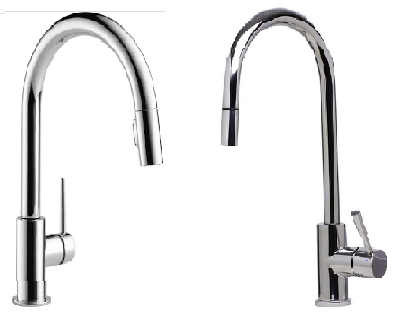
| Delta Trinsic pulldown kitchen faucet, | Fontana Banes Pulldown Kitchen Faucet |
|
• Made in U.S.A
• Fully certified, legal to use
• Proprietary valve cartridge enhanced with diamond coating
• Lifetime warranty
|
• Made in China
• Uncertified, illegal to use
• Chinese-made standard valve cartridge with no enhancements
• One-year warranty.
|
| $254.36 | $374.22 |
Non-sale street prices as of 03/06/26. Prices may have changed. | |
Bravat Faucets
In addition to its own brands, the Group sells faucets at BravatShowers.com.
Bravat is owned by Roman Dietsche GmbH, a company that also sells its faucets in the U.S. through its own website, Bravat.com and on sites, like Amazon that host third-party sellers.
Despite the German name and charter, Bravat is a Chinese trading company. (How that came about is a long story. (Find out more at our review: Bravat Faucets by Dietsch.)
The faucets are made by He Shan Aqua Gallery Kitchen & Bath Factory, one of the companies that also manufactures the Group's faucets, and like the Group's faucets, they are not certified to North American standards and are illegal to sell or use in Canada or the U.S.
The Manufacturers
Fontana Showers claims to be …
…a leading manufacturer and supplier of high-quality bathroom fixtures and fittings, specializing in a wide range of bathroom fixtures, including faucets, showers, bathtubs, and other bathroom accessories,…
and, further that,…
…Fontana Showers products are designed and assembled in our USA facility in Virginia,…
In-House Manufacturing
Our research, however, found no evidence of designing or manufacturing by Fontana Showers or any other member of the Group in Virginia or elsewhere in the U.S. or Canada.
Our conclusions are based on the following:
- A spokesperson for the Group was unable to identify any specific address at which faucets are purportedly manufactured.
- None of the Group's known facilities are zoned for manufacturing. Some are private residences, and most others are offices. The warehouses we found are zoned for light commercial but not for manufacturing.
- Metal manufacturing and finishing is a dirty business, requiring lots of potentially harmful materials that are strictly regulated by Virginia. Permits from the Virginia Department of Environmental Quality are required. We did not find permits for any of the Group's known locations.
- All of the randomly chosen faucets we acquired for examination and testing were marked "Made in China".
- Fontana Showers admits in its warranty document that its faucets are produced in "overseas factories."
We have asked the Group for any extrinsic evidence it can provide of ongoing manufacturing, but, having already waited months, we now suspect it might not be coming.
Our conclusion from the available evidence is that the faucets are manufactured in China and delivered as finished products, ready to sell, or as nearly finished faucets that may need a few minor additions before they can be sold.[6]
Known Suppliers
Not all of its suppliers are known outside of the Group, but those that are known to have supplied faucets to the Group in the past 24 months include:
- Jiangmen Anmei Industrial Co. Ltd. is a Chinese manufacturer of faucets sold worldwide under the Lanerdi brand. In addition to the faucets supplied to the Group, it also provides faucets to
- Changsha Angfa Information Tech Co., Ltd. is a Chinese trading company, not a manufacturer. It supplies faucets and other plumbing products, such as smart toilets, to the Group.
- The actual manufacturer or manufacturers of the faucets cannot be determined from the records to which we have access. However, as Changsha Angfa deals only in Chinese-made merchandise, we can be confident that the faucets are made in China.
- Fuzhou HDsafe Technologies Co., Ltd. is a Chinese manufacturer that supplies many of the automatic faucets sold by members of the Group.
- He Shan Aqua Gallery Kitchen & Bath Factory, trading as Aqua Gallery Home, is an bathwares manufacturer established in 2008 in Foshan, China. It supplies both manual and sensor faucets to the Group and manufactures faucets.
- Aqua Gallery specializes in suites of bathtubs, showers, vanities, sinks, and faucets all matched in coordinated sets. It manufactures almost entirely for export to the Americas, from which it derives 92% of its revenues.
- Zhejiang Slion Brassware Co., Ltd., founded in 1993, is one of the group of Slion companies in Zhejiang, China, manufacturing faucets and other plumbing products primarily for export. The Slion Group includes Zhejiang Slion Fluid Control Co., Ltd., another Horizon Group supplier.
- Wenzhou Haijun Sanitary Hardware Co., Ltd. has specialized in producing faucets for other companies as an manufacturer since its organization in 1999, At one time Haijun was a principal manufacturer of faucets for the Group, but does not appear in recent import records, so the relationship may have ended.
Construction & Materials
The faucets are constructed conventionally. The body and spout of the faucets, as well as being decorative, are the components that channel water within the faucet.
Chinese manufacturers have yet to widely adopt the newer Core and Shell construction, which divorces function from appearance.
The core component controls water flow while the shell hides the core and gives the faucet its distinctive appearance. Core and Shell construction has many advantages over conventional construction, including the most important: making faucets much less expensive without sacrificing durability, longevity, or appearance.
Most of the Group's faucets are fashioned from brass. A few touchless faucets, intended primarily for commercial use, and some kitchen faucets are in stainless steel.
Stainless Steel
The stainless steel, according to one of the Horizon companies, is 304 stainless, an alloy commonly referred to as "food grade" stainless. Nickel is added to give the steel a crystalline structure, which increases its strength. Chromium helps the steel resist corrosion.
Why Stainless Steel Does Not Rust: Properly alloyed stainless steel contains at least 10% chromium (which gives stainless its slight yellowish tinge) and a dollop of nickel. These form a coating of oxides and hydroxides on the outer surface of the steel that blocks oxygen and water from reaching the underlying metal, preventing rust from forming. The coating is very thin, only a few atoms thick, so thin that it is invisible to the eye under ordinary light, but thick enough to protect the faucet.
Steel is harder than brass. It can be made in thinner profiles that use less material and still have more than adequate strength.
The tradeoff, however, is that steel is more difficult to fabricate and generally requires heavier machinery, so there is usually very little, if any, actual cost savings over brass.
Brass
Brass is the preferred material for faucets for two reasons:
- Brass is strong but easy to work with. It casts, forges, and machines with relative ease.
- Brass is anti-microbial. The copper in brass kills bacteria and other nasty micro-criters on contact. Microbes can accumulate inside the faucet, leading to potential health problems. One of the purposes of independent testing and certification is to ensure that the design of a faucet does not allow it to harbor harmful pathogens.
But traditional brass has one serious drawback.
It contains metallic lead, and lead is now all but banned in North America in any drinking water component due to its toxicity to humans, particularly children.
The maximum lead content of those parts of a faucet that touch water is 0.25% (1/4 of 1%) – a bare trace. In fact, there may be more lead in the air you breathe than there is in a faucet that has been certified lead-free.
To comply with the restrictions on lead, today's faucet brass replaces lead with other additives to reduce brittleness during manufacturing without adding toxicity.
The most common is bismuth, which is similar to lead – right next to lead on the periodic table of elements – but not harmful to humans.
Bismuth, however, is 300 times rarer than lead, even rarer than silver, which is the reason that bismuth-brass alloys are considerably more expensive than ordinary leaded brass.
This increased cost has encouraged many faucet manufacturers to use substitute materials in their faucets where possible.
Are These Faucets Lead-Free?
Zinc & Zinc/Aluminum Alloys
Zinc or a zinc-aluminum (ZA) alloy is a common substitute for brass in faucet manufacturing.
Zinc is not as strong as brass and does not resist water pressure as well as brass. But its use in non-pressurized parts of a brass faucet, such as handles, base and wall plates, and is common even among manufacturers of luxury faucets.
It does no harm when used in these components and may save consumers a few dollars.
Plastics
Plastic is the other commonly used, but often controversial, substitute material.
It may be safely used in incidental parts like base plates and has been largely trouble-free in aerators, and as casings for ceramic cartridges, but otherwise, its use is suspect, especially if under water pressure.
Among those suspect uses is in the spray heads of kitchen faucets, and all of the Horizon Group's spray heads that we examined were plastic.
Plastic spray heads fail much more often than metal sprays. Unlike metal, the plastics used in faucets are vulnerable to chlorine and ultraviolet light, which will degrade the material over time.
Although engineers and chemists have made significant improvements to their reliability over the past decade, the problem has not been entirely solved.
Design & Styling
Fontana Showers describes its faucet designs as "Italian Inspired." The other companies in the group are silent as to the source of their design inspiration.
However, anyone familiar with Italian design would find almost none of Italy's design verve in Fontana's faucet styles.
For the most part, the faucets are common Chinese compositions, similar or identical to the styles sold by hundreds of other importers of Chinese faucets.
Design originality in China is rare.
China's faucet manufacturers have made their mark in the industry by making inexpensive faucets in vast quantities.
Their goal is to sell as many faucets as possible, which means keeping prices low and designs well within the mainstream to attract as many buyers as possible. They generally tweak existing styles rather than venturing too far from core design parameters.
Some of the Group's traditional styles, however, are a step above the usual run of Chinese designs, not a big step, but more than a baby step.
Designed by the Group? We Doubt It.
"FontanaShowers is a USA-based company with over three decades of experience and has built a formidable reputation for excellence in designing and manufacturing bathroom fixtures." (Emphasis supplied)
- A spokesperson for the Group was unable to identify any faucets designed in-house.
- The faucet styles we examined are sold by many other faucet companies – something that would not happen if the designs were actually proprietary and owned by the Group or any of its members.
- No company in the Group nor any individual identified as associated with the Group owns a design patent either in the U.S. or China. A design patent is the usual mechanism for protecting a proprietary design from copying by others.
These styles seem to have been influenced by the French Belle Epoque and English Edwardian periods of the late 19th and early 20th centuries. They started appearing in Chinese faucets about five years ago.
If the faucets were certified, we would certainly suggest a close look for a traditional bathroom. Unfortunately, however, none are certified.
We know because we checked every one of these faucets for Certificates of Listing and found none.
To learn more about faucet design and configuration, see Faucet Basics Part 4: Faucet Styles & Configurations.
Faucet Components
The critical faucet components are ceramic valve cartridges and aerators. The valve is the component that actually makes the faucet work. It turns water on and off and meters the flow rate. In single-handle faucets, it also controls water temperature. The modern aerator restricts water flow to the legally allowed maximum, shapes and softens the water stream, and prevents backflow contamination.
Buying Rule for Smart Faucet Buyers
The Faucet Cartridge
Never buy a faucet unless you know who made the valve cartridge.
Its valve is the most critical part of a faucet. It is the component that controls water flow. Without a working valve, a faucet is no longer a faucet.
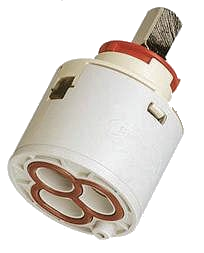
Companies that use good-quality valve cartridges in their faucets usually disclose the cartridge source on their websites. Those that don't will happily identify the cartridge in a call to customer service.
If the company declines to disclose the sources of its cartridges (because it is a "trade secret"), you can confidently assume it is not one of the better brands.
Replacement Cartridges: If a company no longer stocks the cartridge for your very old faucet, don't panic. The Group's cartridge are , so cartridges are probably available from one of the replacement parts sellers such as Faucets Parts Plus or Chicago Faucet Shoppe.
For more information about faucet valves and cartridges and the companies that make cartridges that are known to be reliable, see Faucet Valves & Cartridges.
Valve Cartridges
As far as we can tell, none of the Group's companies sells replacement cartridges for their faucets.
To learn more about faucet valves and cartridges, visit Faucet Basics Part 2: Faucet Valves & Cartridges.
However, cartridges are usually available from any number of replacement parts sellers, such as Danco, Chicago Faucet Shop, and Allora, so a replacement should not be hard to find should a cartridge ever fail.
Aerators
Dozens of Chinese companies make . None of the faucets we examined, however, included precision-engineered aerators like those made by the Swiss company, Neoperl,® considered the world's best, or the equally capable Amfag S.r.l. in Italy, but they did appear to be adequate.
Faucet aerators used to be simple devices that merely added a little air to soften the water stream so it would not splash out of the sink.
Today, however, they are also used to limit water volume to the lower flows required by federal and state water conservation laws, and in some cases, to prevent backflow that can result in the contamination of household drinking water.
It is important, therefore, that this little device, often smaller than a dime, works well and is completely reliable.
Faucet Finishes
None of these companies publishes a finish chart. The finishes are whatever their Chinese manufacturers can provide and change with some frequency.
A little research on various company websites, however, found the following finishes that seem to be common to all of the companies: Antique Brass, Black, Brushed Nickel, Chrome, Gold, and Oil-rubbed Bronze. Rose Gold, Stainless Steel, and White were available on a few faucets.
Some finishes are called by several names. Gunmetal, for example, is sometimes Gunmetal Gray or Graphite, depending on the company and a particular manufacturer's label for its finish.
Some of the faucets are available in in which a base finish is paired with an accent finish. We found split finishes that included, among others, Black with Chrome, Black with Nickel, and Black with Gold.
Stainless steel is available only on stainless steel faucets. It is usually not an applied finish, but the material of the faucet, buffed and brushed or polished to an attractive finish. Stainless steel shows fingerprints readily, so a brushed finish is commonly used to help hide both fingerprints and water spots.
The rest of the finishes are applied using one of three common processes: electroplating, physical vapor deposition (PVD), or powder coating.
None of the companies reveal the processes used to produce a particular finish, something they may well not know.
They do not finish their own faucets and may not be familiar with the processes used by theie Chinese manufacturers. However, the process affects the durability and longevity of the finish, and is information that is important to an informed faucet-buying decision.
Two of the finishes. Chrome and Brushed Nickel are almost certainly electroplated. Black, White, Gold, Rose Gold, and Oil-Rubbed Bronze are typically powder coatings, but could also be PVD finishes. In fact, a finish like Gold or Oil-Rubbed Bronze could be a powder coating from one manufacturer and a PVD finish from another.
Be careful of matching any finish other than chrome. One manufacturer's gold or oil-rubbed bronze is unlikely to perfectly match those from another manufacturer. Visible variation is common.
Electroplating
involves immersing the faucet and the metal to be used as plating in an acid bath, then applying an electrical charge to both objects so metallic ions are drawn from the plating metal to the faucet.
The process is potentially hazardous to the operator and the environment. It involves toxic and corrosive chemicals that must be disposed of safely. No other coating technology even comes close to the dangers involved in electroplating.
The top coat may be polished or brushed. Chrome, a relatively hard metal, is usually polished to a high shine. Nickel, a softer metal, is usually brushed to help hide the inevitable minor scratches.
Physical Vapor Deposition
, or PVD, is one of the latest space-age faucet finishing technologies and the gold standard of faucet finishing, rapidly replacing electroplating as the finish of choice.
Although the technology was discovered in the 19th century, it was not used in industry until the 1950s, and then only rarely due to its great expense. Its first use was inside nuclear reactors, where a very tough finish was necessary to withstand the hellish environment. Today, PVD technology is everywhere, and the machinery required is getting smaller, faster, and cheaper all the time.
Load a chamber with unfinished faucet components, remove all the air, and add back a carefully calculated mix of nitrogen or argon and reactive gases.
Add a rod of the metal to be used for the coating. Heat that rod to a temperature so high that the metal dissolves into individual atoms. The atoms mix with the various reactive gases to get the color and finish effects you want and are then deposited in a very thin layer – 2 to 5 microns – on the faucets.
Despite being just microns thick, a PVD coating is extremely dense and, in consequence, very hard and durable. By some estimates, it is up to 20 times more scratch-resistant than electroplated chrome.
From long experience, we know that PVD is nearly impossible to accidentally scratch or mar, never fades or changes color, and resists all forms of soiling.
A PVD finish can usually be maintained with just an occasional wipe from a damp cloth to remove water spots.
Powder Coating
is usually described as semi-durable
, not as robust as electroplated or PVD finishes, about as durable as the finish on your car, and requiring more care to maintain a like-new appearance.
It is essentially a dry paint in powder form applied using a special low-velocity spray gun that disperses the powder while giving it a positive electrical charge. The particles are drawn to the item to be finished, which has been given a negative charge.
Once the powder is applied, the item being coated is baked in an oven, which melts and bonds the powder and changes the structure of the coating into long, cross-linked molecular chains.
These chains are what give the coating its durability, reducing the risk of scratches, chipping, abrasions, corrosion, fading, and other wear issues.
Faucet Warranties
Until sometime around 2009, faucets were sold by the companies in the Group "as is" without a warranty of any kind.
This is the "Warranty Disclaimer" that was posted on the Fontana Showers website on August 23, 2009:
"[T]he materials and products on this site are provided "as is" and without warranties of any kind, whether express or implied. To the fullest extent permissible pursuant to applicable law, [Fontana Showers] disclaims all warranties, express or implied, including, but not limited to, implied warranties of merchantability and fitness for a particular purpose and non-infringement."
Today, all of these companies offer some sort of warranty, but none comply with U.S. consumer warranty law. The Magnuson-Moss Warranty Act (15 U.S.C. §2301) imposes requirements that these warranties come nowhere near meeting.
They also have in common the fact that they are woefully deficient for the North American faucet market in which the standard faucet warranty, introduced by in the 1960s, is a lifetime warranty.
Warranty Duration
Most of the Group's companies provide no more than a single year of warranty protection on their faucets, although this duration is often buried in the verbosity of the warranty documents. Here is the breakdown:
-
Cascada Showers: One Year:
"If your product becomes defective due to faulty materials or workmanship within a period of 1 year from the date of purchase, we guarantee to:
- Replace or repair all defective parts, free of charge, or
- Repair products free of charge, or
- Replace the unit with a new or re-conditioned unit, free of charge."
-
Fontana Showers: One Year:
"FontanaShowers will repair or replace, free of charge, during the applicable warranty period, any part of product that proves to be defective in material and/or workmanship under normal installation, use and service."
-
Juno Showers: One Year:
"JunoShowers, at its discretion, will repair or replace, free of charge, during the applicable 1-year warranty period, any part that proves to be defective in material and/or workmanship under normal installation, use and service. If repair or replacement is not practical, we may elect to refund the purchase price in exchange for the return of the product."
-
Horizon Direct Depot: One Year:
"At our discretion, we will repair or replace, free of charge, any part that proves to be defective in material and/or workmanship under normal installation, use, and service during the applicable 1-year warranty period. If repair or replacement is not practical, we may elect to refund the purchase price in exchange for the return of the product."
Understanding Finish Warranties
A finish warranty does not protect against everything that can go wrong with a faucet finish.

(Not a Horizon Group product)
It covers defects caused by faulty materials or errors in the finishing process, generally subsumed under the rubric "manufacturing defects."
Blistering, delaminating, peeling, and spalling are the usual manufacturing defects. These are very rare – almost unheard of. The bad old days of peeling China chrome are long gone.
Most finish problems these days are caused by overzealous cleaning and ordinary wear and tear, neither of which is covered by a finish warranty.
If it peels, the company pays. But if you scratch it or it turns a funny color after you polish it a few times with Wham-X All Purpose Miracle Cleaner, you are on your own.
-
BathSelect has a slightly different warranty. It starts out looking like a standard North American lifetime warranty with this language:
"Bathroom fixtures will be free of all defects in material and workmanship that would impair the intended and proper use of the product as well as … against deterioration of the product's finish for as long as the original purchaser owns the home in which the product is originally installed."
That promise of lifetime coverage is immediately taken away a few lines later with this provision:"BathSelect offers a 2 Year manufacturer warranty on all purchased products."
- Read together, these provisions promise a lifetime warranty only if you don't purchase the faucet. If you do buy the faucet, the warranty is for just two years. Exactly how you might go about acquiring a BathSelect faucet without buying it is left unexplained (and we are not going to speculate).
Buying Rule for
Smart Faucet Buyers:
Warranty
Never buy a faucet unless you have carefully read and understand the faucet's warranty. It tells you more than the company wants you to know about management's true opinion of the durability and life expectancy of the faucet it sells.
Learn how to interpret faucet warranties at Faucet Basics, Part 6: Understanding faucet Waruranties.
Learn how to enforce your warranty with step-by-step instructions at The Warranty Game: Enforcing Your Product Warranty.
Model Lifetime Warranty: For an example of a warranty that avoids Kohler's drafting problems and complies with the Magnuson-Moss Warranty Act, download and read our Model Limited Lifetime Warranty.
-
And that's not even the oddest provision in the warranty. Consider this incomprehensible statement:
"Any potential damage/flaw must be reported to us within 7 days after delivery …"
How does that work exactly? I have a warranty that lasts at least two years, but I have to report any damage within 7 days after delivery. What if the damage occurs on the 8th day?
The Warranty as Insight Into Faucet Longevity
A warranty is a good guide to a company's true opinion about the durability and longevity of its faucets. Inf fact, it is the first item we examine to form an initial impression of the life expectancy of a line of faucets.
A warranty forces a company to pledge its dollars that its faucets will perform without failing. How long a company will risk its own money is a very good indicator of how long the company truly expects its faucets to be problem-free.
Companies that sell very good faucets, such as promise with their warranty dollars that their faucets will last a lifetime. That a company provides less than a lifetime warranty is usually indicative of a lack of confidence by management in the long-term viability of the faucets.
The Group's skimpy, short-term warranties strongly suggest that management is, at best, unsure of the durability of its Chinese faucets.
Compliance With U.S. Warranty Law
In addition to their other problems, the warranties do not comply with federal Warranty law and regulations.
The Magnuson-Moss Warranty Act specifies the content and form of consumer product warranties. These warranties do not conform to the requirements.
-
Non-Compliant Captioning: It is clear from the warranty language that they are intended to be limited warranties. But to be a limited warranty, a warranty must clearly
designate
the warranty as a limited warranty with the magic word "limited" in its caption or title.
- The word "limited" is required to give an early warning to the buyer that the warranty is intended to provide only limited protection.
- Unfortunately, these warranties are captioned just "Warranty" or "Product Warranty". The word "limited" is nowhere to be found. The missing "limited" automatically converts the warranty to a full, unlimited warranty. (15 U.S.C. §2303(a), 16 CFR §700.6)
Consequential & Incidental Damages
Consequential and incidental damages refer to damages other than the defect in the faucet, but caused by the defect.
For example, your Fontana Showers faucet leaks and floods your kitchen. The leak in the faucet is the direct damage. The damage to the kitchen is consequential damage, and your expenses in making a warranty claim against Fontana Showers LLC, including attorney fees, if any, is incidental damage.
By disclaiming consequential and incidental damages, a faucet seller hopes to be liable only for the repair of the faucet, not the rest of the kitchen or your costs of proving your warranty claim.
- A full warranty gives the consumer many more rights. Among these is the right to have any plumber labor required to uninstall, repair, and reinstall the faucet, and all shipping and handling charges paid for by the company.
- Warranty Claim Procedure: None of the warranties provides "A step-by-step explanation of the procedure which the consumer should follow" to make a claim under the warranty, including the mailing address or telephone number to use, or the information or documents that are required. (16 CFR § 701.3(a)(3))
-
Incidental and Consequential Damages: Some of the warranties attempt to exclude (lawyers say "disclaim") consequential and incidental damages, but the disclaimers are not accompanied by the following legally required statement:
"Some States do not allow the exclusion or limitation of incidental or consequential damages, so the above limitation or exclusion may not apply to you."
- Without the required clarification, the attempt to exclude incidental and consequential damages is void and has no effect. (16 CFR § 701.3(8))
-
Missing Required Statement: Most of the warranties do not include the following statement, required to be in every consumer warranty:
"This warranty gives you specific legal rights, and you may also have other rights which vary from State to State."
- Without this statement, the entire warranty is probably voided, which means that the state law implied warranty of merchantability takes over and becomes the sole warranty. The implied warranty usually gives the buyer many more rights. (16 C.F.R. §701.3(a)(9))
-
Exclusive Remedy: The Bath Select warranty attempts to disclaim state law implied warranties of merchantability and fitness for a particular purpose with this statement:
"Our warranty is the sole and exclusive remedy, offered in lieu of all other warranties, expressed or implied. We will not be liable for any indirect, direct, incidental, or punitive damages arising from the purchase of this product."
- It is not legal under Magnuson-Moss for a company offering a written warranty to exclude coverage by implied warranties of Merchantability and Fitness for Purpose.
- A company's written warranty is intended to supplement state law warranties, not replace them. Any attempt to deny state-law warranty coverage is simply ignored.(15 U.S.C. §2308(a))
- The second problem with the attempted exclusion is more serious.
- The language could be considered deceptive, and one of the three cardinal rules of Magnuson-Moss is that warranty language must not be deceptive.
- This provision would almost certainly lead a reasonable person to falsely believe that a defective faucet would be excluded from state-law warranty coverage – and that is the very definition of deception under the law.
- We don't believe the companies are being deliberately deceptive.
- No doubt whoever wrote the warranties saw the language in some other warranty and copied it, unaware that it is not allowed. (Many faucet warranties include similar language. We are not sure where it first appeared, but it has been widely copied.)
- Under Magnuson-Moss, however, deliberate deception is not required to incur liability. It is sufficient that the company has not taken reasonable care "to make the warranty not misleading." (15 U.S. Code § 2310(c)(2))
- The very presence of the provision in these warranties evidences a lack of reasonable care.
Customer Service
To complement its below-par warranties, the Group provides substandard customer service.
Our Customer Service Experience
Our experience with customer service has been far from favorable.
We did not conduct our usual formal tests. They do not work with very small companies since agents soon realize they are being tested and change their behavior.
However, over 90 days, we called with typical questions and problems that service agents might encounter.
In general, the results were not good.
Agents seem to know little about their faucets beyond the limited information already on the company's website. They could tell us nothing about the finishing processes, country of origin, the type and source of valve cartridges, all common questions that an agent should be able to answer.
Common Misrepresentations
Factual misrepresentations were common.
- Despite a wealth of evidence to the contrary, agents maintained that the faucets were certified to joint U.S./Canadian standards.
- Fontana Showers agents insisted that the company manufactures faucets of its own design in Virginia, again contrary to overwhelming evidence that the faucets are manufactured in China, including "Made in China" stamped on the boxes containing our randomly selected test faucets.
- One gentleman offered to provide us with listing certificates proving the faucet certifications, but only if we agreed to remove any mention of Maysara Khalid Sadiq from our report.
- Since we do not allow companies to censor our reports, we politely declined.
We do not think that the agents are consciously lying. They are repeating what they have been told and what they believe is true. However, it is clear from their statements that the Group is not above misrepresenting its products.
We scored the company's customer support: "Unsatisfactory."
BBB Rating
The Better Business Bureau, as of the date of this report, rates the companies as follows:
- BathSelect: A
- Cascada Showers: B-
- Fontana Showers: F
- Juno Showers: B-
- Horizon Direct Depot: B-
These ratings are a slight improvement over the ratings as of our last report. The BBB indicates that the reason for the less-than-perfect scores is failure to respond to customer complaints.[8]
Most of the complaints received by the Bureau were for problems with post-sale customer service.
This BBB complaint is typical:
"We placed an order on Jan 20, 2021, for bathroom Faucets and Soap Dispensers which totaled $1,472.58. After several weeks of calling to find out the status of our order, we were told the items were not in stock and they may have them in March."
"We are in the middle of a renovation and can not wait until March, so we asked for a refund. We were told the refund would take in 3/5 business days."
"I have been calling daily since February 4. The times they have answered, I am told the accounting department is short-handed and they have other refunds to process and we should receive our refund in 3/5 business days."
"I have tried to talk to a supervisor who is never available. Most times when I call there is no answer and I have left quite a few voice messages."
"No company should be allowed to hold on to someone's money this long. They had no problem taking our money right away. All we desire is to get our refund which rightly belongs to us."
Fontana Showers did not respond to this complaint.
Legal Compliance
Faucets are a part of your drinking-water system, and every part of that system, right down to the solder joints, is strictly regulated by federal, state, and even local governments.
Not just anything with a sparkling finish that delivers water is a faucet as the laws define faucets in North America.
To be a faucet, the product must be legal to sell as a faucet and legal to use as a faucet in a drinking water system.
The sale of a faucet is prohibited by federal law in the U.S. if it …
- Is not registered with the Department of Energy (DOE). (10 CFR §430). None of the Group's faucets is recorded in the DOE CCMS database of registered faucets.
- does not bear a "a permanent legible marking to identify the manufacturer"[9] located where it can be viewed after installation. (16 CFR § 305.24). None of the Group's faucets we acquired for testing had the required marking. In fact, none had any sort of marking at all, including certification markings.
How We Verify Certification
(or Lack Thereof)
Basic Faucet Standards: ASME S112.18.1/CSA B125.1
Lead Free Standards: NSF/ANSI/CAN 372
Drinking Water Safety Standards: NSF/ANSI/CAN 61
- does not comply with the lead-free requirements of the Safe Drinking Water Act, which, after September 2023, requires faucets to be tested for lead content and certified. None of the Group's faucets have been tested, and none are certified lead-free.
These basic standards are:
- ASME A112.18.1/CSA 125.1, The design and performance standards for faucets, including durability, reliability, longevity, and ease of repair.
- ANSI/NSF 372 and ANSI/NSF 61: Standards that confirm that a faucet is free from lead and other toxic substances and that water flowing through a faucet does not pick up harmful contaminants or pathogens.
A faucet that passes all of the many tests is listed as certified in a public database available for all to see and examine.
None of the Group's faucets is listed in any certificate, indicating that none have been tested and certified.
Bathroom sink faucets meeting certain low-flow standards and certified by an independent laboratory are permitted to display a label indicating WaterSense compliance.[10]
The Group's members make frequent reference to the WaterSense program and identify faucets as meeting WaterSense requirements or as being "WaterSense registered."
Our research, however, determined very quickly that none of the group's bathroom sink faucets have been tested and certified by an independent laboratory as meeting WaterSense requirements.
Designers (architects, engineers, and interior designers) are liable for the installation of uncertified faucets in violation of plumbing codes or safety regulations, such as federal and state (or provincial) laws governing lead content and maximum flow rate. Liability is typically rooted in professional negligence, breach of contract, or violation of consumer protection statutes.
- Professional Negligence: Designers must exercise reasonable care, skill, and diligence in their work, which includes ensuring that specified products comply with local building codes. Specifying or even permitting a non-compliant or illegal faucet is generally considered a breach of this duty.
- Breach of Contract: An architect or designer providing specifications for, or approval of, an uncertified faucet is more than likely liable for breach of contract. The specification and/or approval of only legal products is an implied covenant of any professional services contract, even if the requirement is not spelled out in the agreement.
- Vicarious Liability: If the designer leaves the choice of faucets up to a subordinate, the designer will usually be held responsible for uncertified faucets selected by the subordinate. :
No Horizon Group faucet appears in the U.S. Environmental Protection Agency (EPA) database of WaterSense-Labeled products.
Testing and Certification
Certification tells you that your faucet is durable and reliable and will likely remain durable and reliable for a very long time.
It also tells you that the water passing through your faucet will not make you very sick.
Tosic substances like metallic lead, arsenic, mercury, and cadmium can leach into the water you drink and use for meal preparation.
Once inside your body, they don't leave. Even tiny amounts accumulating year after year can cause severe health effects, including cancer, neurological disorders, kidney damage, heart disease, cognitive impairment, and serious developmental issues in children, even at very low concentrations.
Faucets can also harbor significant bacterial growth, including Legionella and Pseudomonas aeruginosa (antibiotic-resistant generalized inflammation and sepsis), which live in slimy biofilms inside the faucet head and aerator. These germs thrive in moist environments and are spread when water runs through them, creating aerosolized droplets.
Certification is not just a "nice-to-have" or "recommended" faucet feature. It is so important that it's the law in every state, province, territory, enclave, and protectorate in the U.S. and Canada.
You cannot legally install a faucet in a drinking water system, even a private well system, unless it is fully certified. Doing so in an increasing number of jurisdictions can get you jail time, and under federal law (42 U.S.C. § 300-1), can net you as much as 20 years of federal hospitality in a graybar hotel.
A company that sells you an uncertified faucet is telling you something very important to which you should pay close attention: It does not care if your faucet is durable and reliable or if it makes you or your family very ill.
It's in business solely for the money, and it makes more money selling potentially dangerous uncertified faucets.
And that's exactly what the Group's companies are telling you. None of their faucets has been tested and certified.
Who Can Certify Faucets
No one can tell whether a faucet is reliable or safe just by looking at a pretty picture of the faucet on the internet. Indeed, not even the most minute visual inspection of the actual faucet will help. An uncertified faucet looks just like a certified faucet.
To ensure that faucets comply with all North American standards of durability, reliability, and safety, they must be extensively tested. It is not a trivial process. It involves a comprehensive suite of tests covering performance, materials, and safety over a period of several weeks and, in some cases, months.
It includes mechanical testing (leakage, strength, flow rate), material safety (toxin-free), and functional tests (handles, sprayers). Key evaluations include pressure, temperature, and endurance testing to ensure compliance with standards.
It may take weeks to test and certify a faucet. One test, the cartridge life cycle test, takes up to six days to complete. The test for contaminants takes a minimum of 20 days.
Plumbers face significant legal, financial, and professional liability for installing illegal or non-compliant faucets. Such installations violate all plumbing codes and can lead to severe consequences, including insurance denials, fines, and lawsuits.
- Legal: Fines, lawsuits, license suspension, criminal prosecution.
- Financial: Liability for damage, cost to replace illegal faucets, loss of insurance coverage.
- Professional: Loss of reputation, "blacklist" on state enforcement registries.
Faucet companies cannot certify their own faucets. They must be certified by an accredited independent laboratory with the specialized skills and equipment needed.
There are just seven such laboratories in the U.S. and Canada, and just three of these laboratories test and certify 90% of the faucets used in North America.
A faucet that passes certification is listed in a public document available on the internet called a Certificate of Listing.
The Horizon Group's companies insist that their faucets are certified. Our research found the contrary. Not a single faucet from these companies appears in a Certificate of Listing issued by any accredited laboratory.
To double-check, we asked the company for copies of any certificates showing that their brands and models are certified. That request was made months ago. We are still waiting for a response.
Testing & Certification Results
Certification Disclaimers
These companies know full well that their faucets are not legal to sell or install in North America for lack of required certifications and seek to shift responsibility for failing to certify their faucets to their customers when a plumbing inspector discovers that the faucets are contraband.
Here, for example, is the Fontana Showers' attempt at a disclaimer buried in its warranty:
"… [P]roducts being produced in our factories overseas are not guaranteed to meet U.S. inspection requirements. All customers are responsible for install [sic] and removal costs of our products in case products do not pass inspection due to lack of specific certification paperwork. (Emphases supplied)
That "specific certification paperwork," by the way, refers to a Certificate of Listing.
We doubt that this disclaimer will save a company from civil liability for fraudulent inducement, however, and predict that it will have no effect when the various government agencies responsible for enforcing faucet regulations – underfunded and understaffed as they are –finally get around to these companies.
Legal Actions
The California Energy Commission (CEC) sued Fontana Showers, LLC for illegally selling unapproved faucets in California from April 2019 to May 2019. To settle the lawsuit, the company paid a monetary penalty and agreed to sell only approved products in California. This agreement affects all of the Group's brands.
The Group's companies have not, however, been penalized for selling faucets in California that have not been certified lead free as required by AB-1953 on and after July 31, 2023.
So far, the companies have also escaped the attention of the Department of Energy (DOE) for failing to register their faucets. The DOE is understaffed, underfunded, and overworked. But it will get around to the Group eventually, and at $560.00 for each day a faucet violated the registration requirement, the large number of different faucets sold by the Group, and the length of time it has been selling unregistered faucets, it can expect a monster penalty.
The Group's failure to register its faucets is truly incomprehensible. Registration is free and takes just a few hours at the computer. Compared to penalties that may reach six figures, the cost of a few hours of staff time to register seems very affordable.
Comparable Legal Faucets
Legal faucets made in China, comparable to Horizon Group faucets in quality, with a better warranty, and almost always less costly, include:
In Conclusion
There is nothing whatsoever about these companies to recommend them and absolutely no reason to buy any of these faucets.
The faucets are very average, very illegal, and very expensive, Chinese faucets with poorly drafted low-end warranties and a lack of a reliable source of replacements parts for the inevitable day when the faucets cease to function.
The faucets are marketed using methods that are at best unsavory and may be unlawful, including black feeder websites and planted reviews and ratings.
Even if your goal is to buy a potentially dangerous, uncertified, contraband faucet, you can buy one from many other black market traffickers offering the same or a very similar illegal faucet for a much lower price. Amazon alone sells over 40,000 illegal faucets, most costing much less than any of the Group's faucet products.
Dozens of companies (see the list above) sell comparable faucets that are fully certified, legal to sell and install, and proven safe to use.
These often sell for a lower, sometimes a much lower, price with a stronger warranty and much better customer support.
It is not possible for us to believe that faucet companies that claim to have been in the faucet business for as long as years do not know the rules. They simply choose to ignore them.
Most of their faucets are brass and have the potential for drinking water contamination.
They have not been tested and certified free of lead, arsenic, mercury, or cadmium, all of which may cause serious health issues, or pathogens, which can have equally serious or even worse effects.[11]
Chinese manufacturers, such as those that supply the Group's faucets, are particularly suspect when it comes to leaded brass.
China has no regulations limiting the use of lead in faucets made in that country, where lead poisoning is common and widespread. Many Chinese companies have no qualms about offloading leaded-brass faucets to companies, such as the Horizon Group, that sell faucets in North America.[12]
If you are foolish enough to disregard your health and safety and that of your family and install one of these contraband faucets in your home and are caught, at the very least, you will have to replace the faucet at your expense and possibly pay a small fine. In an increasing number of jurisdictions, however, you risk a criminal conviction and a fine, jail, or both for a knowing and intentional violation.
Continuing Research
We are continuing to research the Horizon Group and its sink faucets. If you have experience with faucets from any of these companies, good, bad, or indifferent, we would like to hear about it, so please contact us at starcraftreviews@yahoo.com or post a comment below.
Please note: we cannot answer questions posted in the comments. If you have a question, email us at starcraftreviews@yahoo.com.
Footnotes
-
Fontana Showers' comments are published here unchanged, other than being formatted into logical paragraphs for easier reading. All of the grammatical and spelling mistakes reproduced here are in the original. The company's statement in its original context can be read on the Fontana Showers website.
In addition to this objection, the Horizon Group has published similar broadsides on two of the feeder websites it controls, Bravat Showers, and on its "independent" money site, HG Shopping.
We have asked the company to support the claims it has made in these objections by providing readily available documentation. We have been waiting months for a response. Absent the documentation, we stand by the accuracy of our report.
Beware of StarCraft Custom Builders - Scam Alert
They are scammers as they intentionaly provide false information about certain competettors even after getting the communication fro[m] the source about their lies.
The Facts: Our reports are carefully researched through public sources, the company's past and present published information, and interviews with current and former employees, often over a period of several months.
They are published by StarCraft Media LLC, a not-for-profit company. StarCraft Media does not sell faucets and does not compete with any faucet company. StarCraft Custom Builders, the company that provides web hosting for these reports, is a regional remodeling company in southeast Nebraska that buys faucets in connection with its business but does not sell them and is likewise not in competition with any company selling faucets as a business.
FontanaShowers was established in 1991, while StarCraft Custom Builders are making false claims about the company's establishment date, and they were told numeros times the comapany started back i 1991 and they needed to take appropriate action to correct this misinformation.
The Facts: We have repeatedly asked Fontana Showers to provide any document (business license, tax filing, insurance statement, etc.) or other extrinsic evidence of the existence of the company prior to its formation as a limited liability company in Virginia. None has been provided. Virginia Corporation Commission records show that the earliest of the Horizon companies was BathSelect, formed in 2005. We found no Horizon business selling faucets that existed prior to that date.
They repeatedly stated FontanaShowers does not design assemble or manufacturer in USA they claim Fontana bathroom products are imported from china while we have been designing, and assembling 100ds of models in our USA facility in Virginia and our USA certifications provides our facility. FontanaShowers products are designed and assembled in our USA facility in Virginia, designing and assembling products locally, such as quality control, support for domestic jobs, and quicker response times for customers. This can help differentiate your brand and products in the market. false claims or misinformation about your business, whether it's on social media, review platforms, or elsewhere online.
The Facts: We make no claim whatsoever about Fontana Showers products other than faucets. We found no evidence in the public record to support the claim that Fontana Showers, which shares its business address with several other Horizon companies, does any manufacturing or transformative assembly of faucets at its published business addresses. They are zoned light commercial, not manufacturing, which typically requires heavy machinery and hazardous finishing processes that need environmental licenses and permits from state and local authorities, none of which have been issued to Fontana Showers or any other member of the Group.
- We have asked the company to identify any other address at which its faucets are manufactured, but have received no reply.
- We have been able to identify four Chinese suppliers, three of them direct manufacturers, that provide the company's faucets.
- Import and customs records indicate repeated shipments of faucets from China.
- In its warranty, Fontana Showers notes that "products being produced in our factories overseas, are not guaranteed to meet US inspection requirements." (Emphasis supplied.)
- All of the randomly selected Fontana Showers faucets that we acquired for examination and testing were clearly marked "Made in China."
- The faucets currently for sale by Fontana Showers are common Chinese designs, often manufactured by more than one Chinese factory, and none are proprietary designs unique to Fontana Showers.
- Fontana Showers has neither applied for nor received a design patent for a faucet in the U.S., Canada, or China. Patents are the normal way in which original designs are protected from copying by other companies.
When you come across inaccuracies, take steps to correct them promptly and professionally. We clearly communicating the truth about your product sourcing and manufacturing processes, you can ensure that your customers have accurate information and make informed decisions about your products. Additionally, showcasing your commitment to US manufacturing can be a selling point for customers who prioritize supporting domestic businesses.
The Facts: If inaccurate facts are identified in our reports by the company being reviewed or by any other source, including readers, they are promptly corrected. However, we do not regard unsupported self-promoting claims by a faucet company as proof of inaccuracy without some sort of independent verification.
-
Mr. Sadiq also appears in public records as Maysara Khalid Sadeq, Maysara Khalid Sadek, and M. Kalid Sadiq. He is evidently of Palestinian origin. His family was displaced from Dayr al-Qasi, a village in what is now Israel, during the 1948 Arab-Israeli war.
Some of the other Virginia entities with which he appears to be associated include:
- Horizon Construction Group, Inc. (VA SOS ID: 07612724, Inactive - Cannot Reinstate, CEO: Rola Ali Sabbagh)
- Horizon Group FS LLC (VA SOS ID: 11665785, Active. Filed on 3/5/2024.)
- Horizon Kitchen & Bath Design (also trading as Horizon Floor & Tile Inc.), a sole proprietorship. Mr. Sadiq is identified in Better Business Bureau records as the company's president. (This business does not appear to be active as of the date of this report.)
- Horizon Group Services, Inc.(VA SOS ID: 07551203, Inactive - Cannot Reinsate)
- JunoShowers.com Co. (VA SOS ID: 07984594, Inactive),
- In its early days, BathSelect identified its owner as "Horizon, Inc." The only Horizon, Inc. in the Virginia Corporation Commission's records, however, does not seem to be affiliated with Mr. Sadiq, so we don't know where this particular Horizon, Inc. comes from, or if it ever actually existed.
- The Group also sells faucets through a proprietary website: BravatShowers.com. Its physical address is 4429 Corporate Dr., Chantilly, VA 20141. The site is based on a Volusion template. A lot of it is unfinished, as evidenced by the frequent "[INSERT YOUR COMPANY NAME]" found at various places. Bravat is organized as a German limited liability company (GmbH), but its owners and all of its manufacturing are Chinese.
- The Bravat Showers website publishes a claim that StarCraft Custom Builders spreads false information about faucet companies. Its statements can be read at bravatshowers.com.
-
BathSelect publishes what it calls the "Best Independent Review of Over 30 Faucet Brands" on its website. Not surprisingly, Horizon Group faucets do very well in the "independent" survey. Fontana places 7th in the list and Bath Select faucets are in 8th place, ahead of such established brands as all of which, unlike the Horizon Group brands, are legal to sell and install in North America.
Interestingly enough, is ranked both 1st and 33rd in the list, with no explanation why it is variously placed at the very top and again near the very bottom of the rankings. It may be that not much research was done before the rankings were compiled
-
Loss of good standing results in:
- Inability to legally conduct business: A company not in good standing cannot legally operate. It cannot buy, sell, or enter into a valid contract. Its owners are not protected from any liability arising from the conduct of the business.
- Loss of rights to the company name: While a company is not in good standing, its name is unprotected and, after five years, can be claimed by anyone who registers a business entuty in the same name.
- Loss of the right to bring a lawsuit: A company not in good standing is not able to file a lawsuit, and in some cases is not permitted to defend a lawsuit.
- Personal liability: Officers and directors are personally liable for all acts and any misdeeds of the company,
- Involuntary dissolution or revocation: Extended lack of standing will lead to permanent dissolution of the company.
- According to public records, including the Virginia Corporations Commission and the Internet Archive, none of the Group's member companies existed before 2005. One company, Juno Showers, was organized by Mr. Sadiq as three companies over several years: JUNOSHOWERS co., and JunoShowers.com Co, both stock corporations, and JunoShowers LLC as a limited liability company in 2015. All of these entities are now "Inactive," according to Commission records, and not legally capable of conducting any business.
- Some importers buy bare-bones faucets from China to which they add parts in the U.S. before a faucet is and shipped. On this basis, they claim to "design" and "assemble" faucets in the U.S. The claim doesn't wash.
- What these companies may do (and we are not at all certain they actually do it) is called "customizing."
- Almost any OEM/ODM manufacturer offers customization options. Faucet components such as sprays, handles, and are often interchangeable on a basic faucet, so a great many different "looks" can be created from the same bare-bones faucet.
- It is simply a matter of mixing and matching components, sort of like ordering in a Chinese restaurant: pick a basic faucet from Column A, a handle from Column B, then select a spray head from Column C to create a distinctive faucet.
- Customization allows Chinese manufacturers to offer their wholesale customers basic faucets in many different guises, so they all don't end up competing to sell the exact same faucet in the same marketplace.
- Many customizers claim to "design" their faucets. However, mixing and matching components does not come close to actual designing. In the same vein, many claim to "assemble" their faucets in the U.S. (or Canada) because they attach a handle, aerator, shroud, or spray head.
- This "screwdriver assembly," however, is not the sort of transformative assembly required to support a claim to being an . To be transformative, an assembly must result in a faucet where, before the assembly, there was no faucet, just a collection of parts and components. Adding parts to an already existing bare-bones faucet is not considered transformative.
- Customizers are neither designers nor assemblers. They are exactly what they seem to be, , any strident claims to the contrary notwithstanding.
- Some faucet manufacturers use proprietary mixing valve cartridges that fit their faucets and only their faucets. are three such companies.
- Most, however, including all of the manufacturers producing faucets for the Group, use universal configuration valve cartridges developed by the Italian company, Galatron Plast S.p.a., starting around 1980. Simple in design, easy to manufacture, and very reliable, the Galatron designs have become over time the de facto standard for most of the faucet industry.
- The BBB rating of the Group's companies is on a scale of A+ (exemplary) to F (failure).To learn how the BBB calculates ratings, go to Overview of Ratings.
- The term "manufacturer" means "any person who manufactures, produces, assembles, or imports" a faucet. (16 CFR § 305.2)
- "WaterSense applies only to bathroom sink faucets. It has not been extended to include kitchen, laundry, or utility faucets.
- Non-organic substances found in drinking water that can cause serious health problems include: arsenic, cadmium, lead, mercury, and nitrates. Even in low doses, over a period of time, these can have serious health consequences, including dementia, attention deficit, delayed development in children, and brain, kidney, and liver damage.
- Pathogens (bacteria, viruses, and parasites), including Cryptosporidium, Campylobacteriosis, Enterovirus, Legionella, Rotavirus, Salmonella, and Shigella, can find a happy home inside poorly designed faucets, contaminating drinking water and resulting in sometimes deadly ailments, such as Legionnaires' Disease. The illnesses are usually unpleasant but fairly mild. However, they can be serious and even deadly, especially to infants, young children, the elderly, and the infirm.
- All of these contaminants and hundreds more are looked for during certification testing and, if found in greater than safe levels, a faucet fails certification and cannot be legally sold or installed in North America.
- "Lead Poisoning and Health: Fact Sheet", World Health Organization. Updated July 2016. World Health Organization. Web 22 July 2016.