Vigo Faucets Review & Rating Updated: August 14, 2026


135 W 25th St., 3rd Floor
New York, NY 10001
866-591-7792
support@vigoindustries.com
Law Requirements
Warranty Footnotes1. Although the warranty is captioned as a "Lifetime" warranty, its actual term is 5 years..2. The warranty contains illegal provisions and is missing all of the quaifying language required by the U.S. Magnuson-Moss Warranty Act (15 U.S.C. §2301).
- Download/Read/Print the July 1, 2023 Vigo Kitchen Faucet Limited Lifetime Warranty.
- Download/Read/Print the July 1, 2023 Vigo Bathroom Faucet Limited Lifetime Warranty.
- Learn more about faucet warranties.
- Read our Model Limited Lifetime Faucet Warranty
- Learn how to enforce a product warranty at The Warranty Game: Enforcing Your Product Warranty
This Company In Brief
Vigo Industries is an importer of Chinese-made bathroom and kitchen sanitary wares and accessories that are branded and sold under the Vigo name. The company sources from a variety of Chinese suppliers.
Vigo sells faucets for the kitchen and bath as well as sinks, showers, and accessories to accompany its faucets.
On the plus side, the faucets are generally above average in quality, reasonably priced and widely available, and the company website provides much of the information needed for an informed faucet-buying decision.
The minus side includes a poorly written faucet warranty that, upon careful examination, turns out to be a pretend warranty, not an actual warranty; post-sale customer support that is frequently inadequate; and a Better Business Bureau rating of "F," the BBB's lowest possible score, for failing to respond to customer complaints escalated to the BBB.
The Company
Founded by Leonid (Lenny) Valdberg and Felix Machhlis in 2009 as a New Jersey limited liability company, Vigo Industries LLC is an importer of Chinese-made bathroom and kitchen plumbing products, bathroom furniture, and accessories that it sells under the registered Vigo® brand.
The company quickly outgrew its original warehousing and shipping facilities and moved to larger accommodations at 320 Mill Rd., Edison, N.J., and then to its current address in New York City.
The company still maintains the Edison site as a warehouse and distribution center with another in South River, N.J. It also has, according to the company, fulfillment centers in California and Pennsylvania.
Faucets are not its principal products. Its main lines are tubs, shower assemblies, and sinks. It also sells bathroom accessories such as towel bars and robe hooks.
Faucets are often sold as a part of coordinating sets that include sinks and vanities.
Vigo's Faucet Manufacturers
Vigo sources faucets from a variety of suppliers, primarily in Asia, and maintains an office in Foshan, China, that handles purchasing and export.
Our information gleaned from customs and certification records indicates that Vigo's faucet suppliers are all Chinese companies.
These include:
- Kaiping Promise Plumbing Co., Ltd., is an manufacturer founded in 2010, specializing in kitchen and bathroom faucets and other sanitary fittings primarily for the export market.
- The company also manufactures faucets sold by
- Weixiang Sanitary Ware Co., Ltd., located in Kaiping City, is a Chinese manufacturer and exporter of mid-priced faucets and other sanitary wares.
- It was established in 1991 as part of the Weiqiang Group. It is and has received international awards for its product designs, including a coveted iF design award in 2018 for its Note shower mixer.
- Weixiang is a long-time supplier of components to Brasstech, Inc., a Masco company that manufacturers upscale
These are almost certainly not Vigo's only faucet suppliers.
The company often imports products through brokers like Foshan Chen Anderson Import & Export Co. Ltd. rather than directly from the Chinese factories, which makes it difficult to identify the actual manufacturer. We are still working on it, however, and will update this report as we find out more.
We have asked the company to identify its remaining manufacturers. It has not responded to the request.
Vigo Faucet Designs
Most of Vigo's faucets are very modern, contemporary styles. A few can be reasonably viewed as transitional, but none are traditional in design.
Vigo claims that it designs its faucets "in New York." For almost all of its faucets, however, the claim is not true.
We found no design patents for Vigo faucets. Design patents are how original designs are protected from design pirates.
Original Designs
Just two Vigo faucets that may be original designs, and these are nearly a decade old.
The Niko faucet, as part of the Niko/Peony lavatory set, received an Architizer A+ award in 2018 as one of the "28 Game-Changing Products, as Chosen by Architects."
We don't see much creative originality in this faucet.
Its monoblock waterfall style has been around for decades and is very much a staple in the catalogs of most Chinese faucet manufacturers.
Most likely it is the pairing of the faucet with the intriguing Peony sink that caught the eye of the judges, not the faucet itself. [1]
In any event, the very great majority of Vigo's faucets are straight out of each manufacturer's and are neither designed by Vigo nor manufactured exclusively for Vigo.
Many of the same faucets are sold by other importers in the U.S. and Canada, and Vigo's known faucet manufacturers sell identical faucets under various proprietary brand names in other parts of the world.
Customization
What Vigo may do to create more or less "unique" faucets is more accurately called customization.
Almost any faucet manufacturer offers customization options. The Chinese, especially, are very good at it.
Faucet components such as spouts and handles are often interchangeable on a basic faucet, so a great many different configurations can be created without altering the mechanics of the faucet.
It is simply a matter of swapping components, sort of like ordering in a Chinese restaurant: pick a basic faucet from Column A, a spout from Column B, and a handle from Column C, then select a spray head from Column D to create a distinctive design from the basic faucet.
Customization allows manufacturers to offer their wholesale customers the same faucets in many different appearances so they all don't end up competing to sell the exact same faucet.
Vigo Faucet Finishes
Vigo faucets are available in six finishes: Brushed Nickel, Chrome, Graphite Black, Matte Brushed Gold, and Stainless Steel.
According to a company representative, a seventh finish, Antique Rubbed Bronze, a dark broze with copper highlights, is on its way out. The Niko vessel faucet is the only faucet shown on the company website that is still available in that finish.
Another finish, formerly available on a few faucets, Matte White, has already disappeared.
Chrome is . That process is the usual method of creating that particular finish. According to a company source, Antique Rubbed Bronze is also electroplated.
Matte Black and Graphite Black are painted finishes produced in a process called electrodeposition.
Brushed Nickel is normally an electroplated finish. However, a company source has identified the finish as produced through (PVD). Matte Brushed Gold and Stainless Steel are also PVD finishes.
Fingerprint Resistance
Vigo calls its electroplating "FinishPlated™ Technology" and describes it as a seven-layer finish that "resists fingerprints."
Vigo does not claim that its electroplating produces finishes that are more fingerprint-resistant than other electroplated finishes. All such finishes resist fingerprints to some degree.
Water Spots
In our admittedly unscientific field tests composed of placing oily fingerprints on the chrome finishes of various faucet brands, we did not observe any evidence of added oleophobicity. The Vigo chrome finish showed fingerprints as readily as most other brands.
If Vigo has any studies showing an improved fingerprint resistance, it has not shared them with the world.
Electroplating
Electroplating, or galvanization, is the oldest form of metal coating, using a process discovered in 1790 by Luigi Brugnatelli. an Italian chemist. It did not come into widespread industrial use until the 1840s, initially in the jewelry trade.
The process involves immersing faucet components and the metal to be used as plating in an acid bath, then applying an electrical charge to both objects to draw metallic ions from the plating metal to the components.
Usually, multiple coats are applied, including undercoats followed by two or more coats of the finish metal.
The undercoats are required because many plating metals, including chrome, do not bond well to brass.
The usual number is two to four, an initial coat of copper followed by one or more coats of nickel. Copper bonds well to brass and nickel to copper. The finish coat, such as chrome, bonds well to nickel.
Fingerprint-Resistant Coatings
Years ago many Chinese manufacturers omitted the undercoats, resulting in chrome finishes that could be scraped off with a fingernail.
This "China chrome" has not been seen for decades, however, and today's electroplated finishes on Chinese-made faucets are as durable as any produced in the world.
Electrophoretic Painting
Electrophoretic painting, or e-coating, is a galvanic process similar to electroplating except the plating material is a paint or resin rather than a metal. Its primary use is as a base primer for metal parts to protect from moisture and chemicals. Its use as a decorative coating is relatively new.
According to a company source, it is the process used to produce Vigo's Matte Black finish.
To produce the finish, a faucet component is submerged in a water-based paint bath. An electrical current draws the paint to the component, depositing it uniformly in a thin layer (10 to 30 ).
The process drives paint particles deep into the pores of the underlying metal, creating a strong grip, bound securely to the underlying metal and leaving no thin or weak spots on edges or corners, a problem with other methods of painting.
Finish Durability
Before you buy any Vigo faucet, contact customer support to find out the process used to create the finish. The process largely determines the finish's durability and how much care and maintenance it requires.
Some finishes are more durable than others.
- Electroplating is the old standby. It is a tough finish that will stand up to most abuse, but its durability depends on the metal used.
- Chrome is durable, nickel less so because it is inherently a softer metal (the reason chrome replaced nickel as the faucet finish of choice in the early 20th century.)
- Physical Vapor Deposition (PVD) finishes are 10 to 20 times more scratch-resistant than electroplated chrome. They are also not affected by most household chemicals. In our experience, they are largely invulnerable to harm.
- Painted Finishes such as electrophoretic and powder coatings are not as durable as metal finishes simply because paint is not as hard or as scratch-resistant as most metals
- Most painted coatings are considered not better than semi-durable with about the same scratch resistance as the finish on your car. The exception is Thin File Ceramic (TFC), which is nearly as robust as PVD finishes. None of Vigo's coatings are produced using TFC.
It is then cured in an oven at 375° F (190° C). Curing creates a tightly packed, crosslinked polymer matrix.
The resulting finish is smooth and even. The process ensures that the paint reaches every part of the component, even into the smallest hard-to-reach nook or cranny, unlike a sprayed finish like powder coating [2] that can miss some of the fine detail in a faucet design.
Paint, however, is not as durable as electroplated metals no matter how it is applied and not nearly as scratch-resistant as a PVD finish. It is about as robust as the finish on your car—tough but not immune from scratches and mars.
The limitation of e-coating is its color range, generally black or gray, and its available surface textures, matte or satin. A finish like glossy red is simply not possible using today's e-coating technology.
Physical Vapor Deposition (PVD)
According to the company, physical vapor deposition is used to produce Vigo's Stainless Steel and Matte Brushed Gold finishes.
It is one of the latest space-age finishing technologies, rapidly replacing electroplating as the finish of choice, and is a particular favorite of Chinese faucet manufacturers, many of whom use nothing but PVD processes to create their finishes.
Although the technology was discovered in the 19th century, it was not used in industry until the 1950s, and then only rarely due to its great expense.
Its first use was inside nuclear reactors, where a very tough finish is absolutely necessary, and by NASA to protect rocket engine components.
Today, PVD technology is everywhere, and the machinery required is getting smaller, faster, and cheaper all the time. The cost is still high, higher than most other finish technologies, but much lower than the astronomical price tags of former years.
To create a PVD coating, a faucet is first undercoated using electroplating, typically with a nickel compound, then thoroughly cleaned and polished.
The PVD finish coat is applied in a sealed chamber loaded with faucet components. All the air is removed and replaced with a carefully calculated mix of inert and reactive gases.
A rod of the metal to be used for the finish material is heated to a temperature so high that it dissolves into individual atoms. Typical plating metals are nitrides of zirconium and titanium, both non-reactive metals that do not tarnish, corrode, or rust, making them ideal finish materials.
The atoms mix with the various reactive gases to get the desired color and finish effects and are then deposited in a very thin but very hard film—2 to 5 thick—on the faucet components.
Different finish colors and effects are possible by using different metals and varying the mix of gases.
To watch a PVD sputter machine in action, click here and prepare for loud noises.
Vigo's Matte Brushed Gold, for example, may be created using a titanium alloy as the coating metal with nitrogen gas (perhaps with a whiff of methane for a slightly warmer brass color). [3]
Titanium is a dull gray metal in its natural state, but combining it with nitrogen in a PVD chamber creates a convincing brass-look finish. Unlike true brass, titanium never tarnishes. It will stay the same gleaming gold color for its lifetime.
A stainless steel "finish" is usually just the stainless steel material of the faucet itself, buffed and sanded to produce a pleasing brushed effect.
According to Vigo, however, its stainless steel is a PVD look-alike. It is less likely to show fingerprints than actual stainless steel, and it is much harder and more scratch-resistant.
Carbon Fiber Skinning
Some Vigo faucets are available in a carbon fiber finish that the company calls cFiber©. This is not a coating that resembles carbon fiber but a true carbon fiber wrap.
Carbon fiber is a strong, lightweight material composed of thin strands of carbon atoms bonded together in a crystalline structure.
It is typically woven into a fabric and mixed with epoxy resin to create an exceptionally durable and rigid composite used in aerospace (fuselages, wings), automotive (chassis, body panels), and wind energy (turbine blades) sectors, as well as in civil engineering for reinforcing bridges and buildings.
A carbon fiber fabric is glued to a faucet in a process called "skinning" (as in "applying a skin" not the other thing).
A two-part epoxy resin is applied to the faucet. Flexible weave carbon fiber is laid onto the wet resin, vacuum-bagged for a tight fit, and then top-coated with clear epoxy. Any excess fabric is trimmed away and discarded.
The result is, according to one source, "a lightweight, high-strength tactile body." Another source praises the finish as an "ultra-modern industrial aesthetic with high-performance engineering."
We don't know what base coat underlies the carbon fiber. We did not remove the skin to look since we could not damage our borrowed test faucet through destructive testing. But presumably at least one coat of nickel or zinc lies under the skin to prevent tarnishing.
It is a very interesting finish, not suitable for every décor, but where it is suitable, it definitely has a "WOW" factor.
Carbon fiber is a rare finish in the faucet world. As of the date of this report, only Vigo and sell faucets in a carbon fiber finish. The upscale facets from California Faucets are considerably more costly.
The Vigo Website
The Vigo website is well-organized, with a product search function that is easy to use and fairly accurate. When it errs, it errs on the side of displaying more than you want rather than less.
Site navigation has a learning curve, however.
Very frequently an image of a product that blocks the entire screen appears with no clue how to proceed. It is certainly dramatic but a nuisance to navigation.
By trial and error, we learned to scroll down below the massive image to find the next menu. If the screen image turns black, however, there is no place to go. This appears to be a bug that may have been fixed when you access the site.
The information provided about each faucet includes its certifications, finishes, flow rate, ADA compliance, and dimensions.
How to Clean a Ceramic Valve Cartridge
If your faucet starts to drip after several years, the problem is most likely in the valve cartridge.

The cartridge is probably not defective. It is just clogged up with mineral deposits accumulated over the years from hard water.
The two ceramic discs that shut the water off no longer mesh perfectly, allowing a few drops of water to slip through.
To return it to full functionality, removing the limescale deposits is all that is required.
Here is how that can be done:
- Remove the cartridge following the instructions in your faucet manual. (If you did not keep the instructions, go to YouTube for any of several videos on how to remove a cartridge.)
- Soak the cartridge for up to 30 minutes in a solution of 50% household vinegar and 50% water.

- While you are waiting, take a toothbrush soaked in the vinegar/water mixture and clean the cavity in the faucet that holds the cartridge. Wipe it dry with a clean cloth.
- Rinse the cartridge thoroughly in clean, cold water.
- Lubricate the O-ring(s) and rubber washers, if any, with silicon plumber's grease.
- Reinstall the cartridge.
If the mineral build-up is substantial, you may have to do this more than once.
View a video by Vigo on how to remove and replace a mixing cartridge in a single-handle kitchen faucet at how to remove and replace a ceramic cartridge.
View a good video by Fluid on how to clean a ceramic cartridge.
The site does not discuss the process used to produce Vigo's finishes, the source of the ceramic valve cartridges used in the faucets, or the source and type of aerator or faucet spray mechanism, all of which are needed for an informed buying decision.
Of particular importance are the materials from which the pull-down and pull-out sprays on kitchen faucets are made.
The faucets we acquired for examination all had plastic sprays. Since we did not acquire every faucet, we cannot exclude the possibility that at least some kitchen sprays are metal, but they would be unusual in a Chinese-made mid-priced faucet.
Plastic spray heads (or "wands" in faucet-speak) are not as durable as metal wands and are more likely to fail. Metal wands are more expensive but not excessively so. Replacement plastic wands run between $15 and $40, while metal wands for mid-priced faucets average $35 to $55. Wholesale prices are much cheaper, of course.
Installation instructions are downloadable in .pdf format, and these usually include a dimensioned drawing—useful for determining whether a faucet will fit your bathroom or kitchen—and a troubleshooting guide. A parts diagram, which is very helpful if something on the faucet breaks, is also included with most installation instructions.
Some information on the website is misleading. For example, the written warranty term is always identified as a "lifetime warranty" rather than its actual term of five years. Faucet valve cartridges are described as "brass" when, in fact, the cartridges in our test faucets were uniformly plastic.
We grade the site's navigation as "B-" and the information provided about faucet products a "D+.,"which may not seem like a very good grade, but it is better than the "F" scored by most faucet company websites. The current highest score is a "C."
Vigo Faucet Valve Cartridges
Vigo does not disclose the sources of its ceramic faucet valve cartridges.
They are not made by companies that produce what are generally recognized in the industry as the best ceramic valves.
As a rule, companies that equip their faucets with name-brand cartridges like those made by Kerox Kft of Hungary, Flühs GmbH from Germany, or Taiwan's Geann Industrial Co., Ltd., trumpet the fact all over their websites.
Vigo identifies its faucet cartridges only as EternalSeal™ cartridges.
There is no recognized brand of cartridge called EternalSeal. It is pure marketing, an in-house name that tells us nothing about the quality of the cartridges, who makes them, or where they come from.
We know from our examination of Vigo faucets that some cartridges for single-handle faucets are made by Sedal S.L.U., a ceramics company chartered in Spain that manufactures in China. It owns two Chinese facilities: Sedal Technical Ceramics in Jiangmen and Sedal Kaiping.
These are universal-fit cartridge valves patterned on configurations developed by the Italian technical ceramics manufacturer, Galatron Plast S.P.A., late in the 20th century.
Sedal's universal-fit cartridges are a favorite of Chinese manufacturers exporting faucets to Europe and North America. They are not the best mixing cartridges made, but they are adequate and improving yearly.
Vigo's stem cartridges for two-handle faucets usually do not have maker marks that allow us to identify their source. They are described by Vigo as "brass" and "expertly tested" to prevent "leaks and dripping."
We did not find a single brass valve cartridge in the faucets we acquired for evaluation. All of the Vigo stem cartridges we examined and all of the cartridges shown in Vigo's illustrations are plastic.
Why Keep Cartridges Secret?
The 500,000 Cycle Cartridge Longevity Test
Vigo vigorously promotes its valve cartridges.
It is not possible to telephone the company without getting an earful while on hold about how all of its faucet cartridges have been tested through 500,000 cycles.
Hpwever, there is really nothing special about 500,000 cycles. It is the minimum standard for certified cartridges in North America.
It is many more cycles than are required in other parts of the world. The European longevity standard (EN 817) requires 70,000 cycles, and the standard Chinese (GB18145-2014) test is a mere 30,000 cycles.
Every legal faucet cartridge in the U.S. or Canada has been life-cycle tested to 500,000 on/off cycles by an independent laboratory. [4]
Some of the better valve cartridges have been tested through four and even five million cycles. [5]
Five million cycles is noteworthy; 500,000 is merely ordinary, but what it does is assure you of a reasonable minimum performance without a failure for a good many years.
The 500,000 cycle test is equivalent to 70 years of average kitchen or bathroom use. [6]
The Cartridge "Burst" Test
All certified faucet cartridges have also passed the Hydrostatic Burst Pressure Text.
This test determines the cartridge's resistance to water pressure surges that are common in household water systems. Every time you abruptly turn off a faucet, a wave of high pressure surges through your pipes.
To test resistance to surges, water pressure ten times greater than normal household pressure is applied to the cartridge for one minute to see if it will deform or leak.
If it does, it fails and is not certified for use in North America.
Ten Times Water Pressure
"Lifetime" Warranties?
Vigo has separate warranties for its bathroom and kitchen faucets. They are almost identical, and the differences are minor. For the purposes of this review, we will treat them as a single warranty.
Vigo heralds its faucet warranties as "comprehensive" and the "Best Warranty on the Market for Bathroom & Kitchen Fixtures."
We found them considerably less than comprehensive, not even in the same time zone as the best warranty on the market. After careful analysis, they turn out to be warranties that excuse Vigo from providing any warranty coverage.
We call these "Barnum Warranties" after the famous showman and huckster, Phineas Taylor ("P. T.") Barnum. They promise much at the top of the warranty, then take it all away, line by line, in succeeding paragraphs.
The law calls them "illusory warranties," and they are illegal.
Inept Drafting
Vigo's faucet warranties are poorly drafted, almost certainly not by a lawyer.
The Golden Rule of Warranties
The Golden Rule of Warranties is the following:
"The longer and stronger a faucet's warranty, the more confidence the company has in the durability and longevity of its faucets.The shorter and weaker a faucet's warranty, the less confidence the company has in the durability and longevity of its faucets."
A warranty discloses management's true opinion about the quality of its faucets.
The company may promote its faucets as the greatest things since water was invented, but to find out what management really thinks, look to the company's warranty.
A warranty requires a company to stand behind its faucets with its own dollars.
How long management is willing to risk the company's cash is the best indication of how long it truly expects its faucet to last without developing problems.
A lawyer, even a very new lawyer just out of school, would not have made so many elementary drafting errors.
Here is an example:
"When cleaning, handling, and maintaining the Product, avoid abrasive cleaners, steel wools, and harsh chemicals as these will scratch, damage and/or dull the product and/or finish and void this warranty."
This looks innocuous, a straightforward admonishment against improper cleaning. But read it again, carefully.
What it actually says is that if you don't avoid (i.e., use) abrasive cleaners, etc. on your faucet, your warranty is void.
Not void to the extent of any damage. Actual damage is not required. It is void just for the fact of failing to avoid the prohibited cleaning products, whether or not any damage results.
Void means exactly what you think it means. The warranty is done, over, gone, terminated, finished, concluded, ended, kaputt, history. The whole warranty, not just the part that applies to finishes.
Was this result intended? Almost certainly not. It is the result of incompetent legal drafting.
Drafting any legal document, but especially a consumer warranty, is not the same as writing a business school essay. In an essay, this language is probably just fine. In a warranty it's a problem.
In a legal document, every word has import, and a single malaprop can result in a meaning the writer does not intend. This language is a good example of an unintended result.
Another issue with the warranties is their formatting.
Most of the important terms of the warranties are crammed into two very large paragraphs containing an imposing 600 words between them. The recommended paragraph word count for good comprehension in a legal document is 50 to 75 words, and even the windiest lawyers seldom exceed 150.
Why such long paragraphs? The only thing we can surmise is that Vigo does not want you to read the actual warranty. If you don't read the warranty, you won't discover that the "lifetime" warranty is actually a five-year warranty that promises nothing. And at 600 words, these paragraphs are almost a sure-fire guarantee that the warranty will not be read by a buyer, so mission accomplished.
Warranty Misdirects and Deceptions
The federal Magnuson-Moss Warranty Act (15 U.S.C. § 2301) is the law that dictates the form and content of consumer warranties in the U.S.
It prohibits what it delicately calls "misleading" consumer warranties—warranties that contain false promises, deceptive language, or hidden conditions.
A core purpose of the law, according to its legislative history, was to eliminate widespread deception in consumer warranties, a serious problem before the law was passed over a half century ago.
Buying Rule for Smart Faucet Buyers
The Faucet Cartridge
Never buy a faucet unless you know who made the valve cartridge.
Its valve is the most critical part of a faucet. It is the component that controls water flow. Without a working valve, a faucet is no longer a faucet.
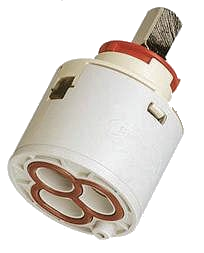
Companies that use good-quality valve cartridges in their faucets usually disclose the cartridge source on their websites. Those that don't will happily identify the cartridge in a call to customer service.
If the company declines to disclose the sources of its cartridges (because it is a "trade secret"), you can confidently assume it is not one of the better brands.
Replacement Cartridges: If a company no longer stocks the cartridge for your very old faucet, don't panic. The company's cartridges are universal-fit cartridges that are probably available from one of the replacement parts sellers, such as Faucet Parts Plus or Chicago Faucet Shoppe.
For more information about faucet valves and cartridges and the companies that make cartridges known to be reliable, see Faucet Valves & Cartridges.
Penalties for deception, at minimum, include civil fines and payment of a buyer's legal fees. Many states and provinces award triple damages for willful deception in a consumer warranty.
Of even more consequence is that deception exposes the company to prosecution under Section 5 of the Federal Trade Commission Act or the Canadian Competition Act and the deceptive trade practices acts of every state and Canadian province.
Even criminal sanctions are possible in some jurisdictions for intentional and repeated deception and at the federal level, deception may involve mail or wire fraud, which includes deception carried out over the internet.
Deceptive Caption
The warranties' deception starts right at the top, with the captions. Both captions identify their respective warranties as a "Limited Lifetime Warranty."
The actual warranty period, however, is not even close to a lifetime.
Here is the provision that establishes the actual duration of the warranty, word for word:
"VIGO warrants all faucet parts and the finish of the Product to be free from defects in workmanship and materials under normal household use for the period of FIVE (5) years from the initial date of purchase by the purchaser/end-user, contractors, or builder from VIGO or an authorized VIGO Dealer." (Emphasis supplied)
Here, on the Great Plains, we simple-minded folk call this a 5-year warranty. We suspect that in every other part of North America, it is also a 5-year warranty.
So, where is the lifetime warranty?
These isn't one. Absolutely nothing in the warranty is guaranteed for a lifetime. Other than in the caption, the word "lifetime" does not appear anywhere.
Deceptive Disclaimer of State Warranty Law
The warranties attempt to exclude Vigo faucets from coverage by state law warranties of merchantability and fitness for a particular purpose. Here is that provision (written in all caps in the warranties so you won't miss it):
"EXCEPT AS OTHERWISE PROVIDED ABOVE, VIGO MAKES NO WARRANTIES, EXPRESSED OR IMPLIED, INCLUDING WARRANTIES OF MERCHANTABILITY AND FITNESS FOR A PARTICULAR PURCHASE [sic] OR COMPLIANCE WITH ANY CODE." (Emphasis supplied)
There are three problems with this provision.
"… COMPLIANCE WITH ANY CODE."
The first is that there is no state law warranty of fitness for a particular "PURCHASE."
The he word is "PURPOSE." The state law warranty is a guarantee of fitness for a particular PURPOSE.
The second is that it is illegal under Magnuson-Moss.
A written warranty is absolutely prohibited from attempting to exclude coverage by state-law implied warranties.
It is intended to supplement state law warranties, not replace them. A consumer product is always protected by state law warranties.
Any attempt to cancel, deny, exclude, or disclaim state-law warranty coverage is simply ignored as if the attempt does not exist. (15 U.S.C. § 2308(a)) [7]
The third problem is that it is a …
"… statement, representation, or omission … that has the tendency, capacity, or likelihood to mislead or deceive a reasonable consumer.
What Are Consequential & Incidental Damages?
In other words, it is deceptive.
The provision would almost certainly lead …
"… a reasonable consumer to reasonably believe" that a defective faucet would be excluded from state law warranty coverage.
And that is the very definition of deception under the law.
We don't know if the company is being deliberately deceptive or is simply ignorant. Perhaps the writer saw the language in some other warranty and copied it (more or less), unaware that it is absolutely forbidden.
But intentional or accidental, it makes no difference. It is still misleading.
Understanding Finish Warranties
A finish warranty does not protect against anything that can go wrong with a faucet finish. It protects against defects caused by faulty materials or errors in the finishing process, generally subsumed under the rubric "manufacturing defects."
Delaminating, peeling, blistering, and spalling are the usual manufacturing defects. These are extremely rare and rarely leave the factory.
Except for a few finishes like chrome, nickel, and stainless steel, expect slow but almost certain color changes over the years from exposure to the environment, particularly UV rays. This is normal and not a defect. Chrome and nickel have become the favored finishes in part because they do not change color over time.
If the color change is sudden, however, the problem is usually with the finishing process.
Most problems are caused by overzealous cleaning and ordinary wear and tear, neither of which is covered by a finish warranty.
Under Magnuson-Moss, deliberate deception is not required to incur liability. It is sufficient that the company has not taken reasonable care "to make the warranty not misleading." (15 U.S. Code § 2310(c)(2))
The very presence of the provision in the Vigo warranties, however, evidences a lack of reasonable care.
Omitted Mandatory Disclosure
Magnuson-Moss requires every consumer warranty to include the following disclosure:
"This warranty gives you specific legal rights, and you may also have other rights which vary from state to state."
Without that statement, a consumer warranty is not a legal warranty in the U.S. (16 CFR § 701.3(a)(9)).
The Federal Trade Commission views the omission of this required statement as a deceptive business practice, exposing the company to regulatory penalties under the Federal Trade Commission Act.
Deceptive Disclaimers of Liability
The Vigo warranties provide as follows:
"VIGO is not liable for personal injuries or deaths to any persons or for any direct, special, incidental, or consequential damage … (Emphasis supplied)
Buying Rule for
Smart Faucet Buyers:
Warranty
Never buy a faucet unless you have carefully read and understand the faucet's warranty. It tells you more than the company wants you to know about management's true opinion of the durability and life expectancy of the faucet it sells.
Learn how to interpret faucet warranties at Faucet Basics, Part 6: Understanding faucet Warranties.
Learn how to enforce your warranty with step-by-step instructions at The Warranty Game: Enforcing Your Product Warranty.
Model Lifetime Warranty: For an example of a warranty that avoids Vigo's drafting problems and complies with the Magnuson-Moss Warranty Act, download and read our Model Limited Lifetime Warranty.
Let's take these claims one at a time.
"personal injuries or deaths to any person"
Death or injury by faucet seems highly implausible, and it is rare indeed but not impossible.
Reported instances include scalding by a defective valve cartridge, poisoning by lead and other toxic substances, and slip-and-fall accidents caused by leaks.
A company absolutely cannot avoid liability for death or bodily injury caused by a defective consumer product.
State and provincial laws in North America specifically prohibit any wording in a warranty that seeks to extinguish a company's responsibility for physical harm to a person caused by a consumer product. (See e.g., UCC § 2-719(3))
Courts will usually strike any such provision on sight as against public policy.
"special, incidental, or consequential damage"
The language also seeks to exclude liability for consequential and incidental damages, also called "special" or "indirect" damages.
Vigo is allowed to exclude such damages from warranty coverage if and only if it is done in the right way by adding this required disclosure to its warranty:
"Some States do not allow the exclusion or limitation of incidental or consequential damages, so the above limitation or exclusion may not apply to you." (16 CFR § 701.3(a)(8))
The Vigo warranties do not contain this language. Without it, any attempted exclusion is void and without effect.
The language is also deceptive since it can lead a reasonable person to reasonably conclude that remedies for these types of damages are not available.
"not liable for … direct … damages…"
The direct damage is the cost of repairing or replacing a defective faucet.
Vigo's attempt to avoid liability for these damages effectively turns the warranties into non-warranties—what is known in legal circles as an "illusory warranty."
An illusory warranty …
"… is a promise of product or service coverage that sounds like a guarantee on paper but contains so many hidden fees, extreme restrictions, or fine-print exclusions that it provides no real protection or value to the buyer.
While Vigo guarantees a faucet for five years, under the terms of its warranties, it excuses itself from the duty to do anything about it.
So, are these even warranties?
They say they are a warranty. They certainly look like a warranty. But, in the end, they promise nothing, and that makes them "illusory warranties."
Illusory warranties have been illegal for most of the history of consumer warranties.
The Consumer Sales Practices Act (CSPA), enacted in many states, the Uniform Commercial Code (UCC), enacted in all states except Louisiana, and similar statutes in Canadian provinces penalize deceptive warranty marketing as an "unlawful business practice" that is usually treated as civil fraud.
The Vigo Warranty, in Conclusion
So, what do you think? Are these the
"Best Warranty on the Market for Bathroom & Kitchen Fixtures"
or are they documents pretending to be warranties?
We lean toward the latter.
Every Vigo faucet arrives with an imposing card labeled
"IMPORTANT"
in very large type that instructs you to register your product in order to "activate your warranty."
The implication is that unless you activate it, your warranty is not in effect. This is yet another bit of misdirection.
Registration is completely voluntary. It has two legitimate purposes. (1) It proves ownership and date of purchase in case you lose your receipt and (2) it facilitates notification of a recall.
It does not "activate" your warranty. The warranty was activated the very second you purchased the faucet.
The federal Magnuson-Moss Warranty Act (15 U.S.C. §2301) specifically prohibits companies from requiring product or warranty registration as a condition of providing warranty services. (16 CFR § 700.7)
Vigo's warranties are make-believe, wholesale deceptions so overwhelmingly defective that if they ever reach a courtroom, the company will have a serious problem keeping the judge from laughing out loud.
Is the deception intentional? Probably not.
it is more likely the product of a misguided attempt to save a few dollars by not hiring a competent lawyer to write a decent warranty.
Companies that would not dream of letting a junior VP write a simple sales contract somehow feel that this same VP is fully qualified to write one of the most complex documents in the legal lexicon, one that must cope with a tidal wave of state and federal laws and regulations.
The Vigo warranties are an unfortunate product of this misplaced parsimony.
Vigo would do itself a very great favor by having an actual lawyer rewrite its warranties as soon as possible before an enterprising attorney decides on a class action that could net a class judgment approaching seven figures.
For an example of a lifetime faucet warranty that protects the company from spurious warranty claims yet avoids the problems of the Vigo warranties and complies with the Magnuson-Moss Warranty Act, read the Model Limited Lifetime Faucet Warranty.
None of this should suggest that Vigo does not actually handle warranty claims. It does.
Our warranty analysis, however, does not look at what the company actually does to resolve warranty issues. We examine what it must do or, in this case, what it may avoid doing, under the terms of its written warranty.
Vigo provides "lifetime" warranties that actually last just five years and do not require it to do anything to fix a defective faucet. That is a very serious legal problem, and the problem does no go away merely because many warranty claims are satisfactorily resolved.
Its exposure to legal liability still exists and will continue to exist as long as its current warranties are in effect.
Replacement Parts
Traditional faucet companies like keep an ample stock of replacement parts for the faucets they sell, even years after a faucet has been discontinued.
It is not uncommon for a company like Delta to still have parts on hand for faucets they have not sold since JFK was president.
Stocking, inventorying, storing, and distributing such a deep well of spare parts is, however, an expensive undertaking and one that small companies like Vigo can often ill afford.
They may keep a small stock of basic components like valve cartridges, aerators, hoses, or faucet sprays on hand, but not much beyond these few. Vigo fits this model. It keeps a stock of common replacement parts such as cartridges, hoses, and sprayers but not much else.
If a part not in stock is needed to resolve a warranty claim, the usual course is to scavenge the part from a faucet still in inventory.
This usually works for faucets still being sold, but not for discontinued faucets. Some companies keep a limited supply of parts for a time, but for most, the limit is two or three years.
In consequence, the chance that Vigo will have a replacement part available for a faucet after a decade or so is extremely remote.
Reports that Vigo has failed to provide replacement parts are fairly frequent, as are instances of the company denying warranty claims for lack of parts.
After-Sale Customer and Warranty Service
Pre-sale customer service is good. Agents are well versed in the basic details of the company's faucets and able to answer most common customer inquiries. It does not have a technical service to handle more esoteric inquiries from contractors and plumbers.
Post-sale service is not as competent.
A Typical BBB Complaint
I bought a kitchen faucet from (redacted). After installation, we noticed the plastic retainer for the detachable sprayer head was defective, which would not allow the head to fully retract into the faucet.
I have been in contact with Vigo since the day it was installed with no resolution.
They said they do not stock the plastic part and will not order a replacement from their China supplier, and my only hope is if they get a return faucet so they can take the part from the returned product.
This has been going on for over 6 months with no resolution. I don't want to pay a plumber to remove the faucet and cost me even more money now. Just very poor customer service and it appears they don't care about their customers after the product is purchased.
Vigo has had problems with providing adequate post-sale customer support ever since its founding, resulting in an unusually high number of complaints to the Better Business Bureau.
The situation appeared to be turning around a few years ago under the direction of a new technical support manager.
The company applied for and received accreditation by the BBB and brought its rating up from an F to an "A-" on a scale of "A+" to "F," quite an astounding reversal.
But then it all fell apart. Its accreditation lapsed, and its BBB rating took a nosedive.
Vigo is back down to an "F" due to a large number of unanswered and unresolved complaints from customers.
Typical complaints about Vigo's after-sales service include delays in responding to claims, demands for excessive documentation, and claim denials based on discontinued parts or policy changes.
The BBB estimates that fewer than 1% of disatisfied customers file a formal BBB complaint. That level of escalation suggests that nearly 2,000 customer issues received by Vigo over the past three years were unresolved to some degree.
Moen's Constant Marketing Warranty Service
For a small business, that is a lot of customer dissatisfaction and many lost chances for good word-of-mouth advertising.
The problem is not with Vigo's customer service agents. They try to be as helpful as they can be. The problem is systemic.
Agents cannot provide replacement parts if there are no replacement parts to provide. They cannot tell you the source of Vigo's faucet valve cartridges if they don't know the source. Agents who have been told that the Vigo faucet warranty is the best in the business have no means of confirming the claim and repeat it, unaware that it is simply not true.
Agents can be better trained and better informed. But the real problem is the lack of a forthright approach to customer relations. Customer satisfaction is simply not a priority at Vigo.
Without a major attitude change, any palliative measures are likely doomed to fail.
We grade the company's after-sales support as "very unsatisfactory," our lowest rating. [8]
To learn how to enforce your warranty, go to The Warranty Game: Enforcing Your Product Warranty.
Testing & Certification
Every Vigo faucet is certified as of the date of this report.
Federal law is pretty clear about the sale of faucets "in commerce." They cannot be sold in the U.S. until they are certified by an independent laboratory to all three of the required standards for sink faucets.
Below are the links to the latest listing certificates for Vigo Industries. Use these to confirm a faucet's certifications.
- Plumbing Fixture Fittings: Certificate 8022: Basic standards of performance, durability, and ease of repair.
- Lead-Free Plumbing Products: Certificate 8164: Conformity to North American lead-free standard of less than 0.25% lead in the waterway of a faucet.
- Drinking Water System Components - Health Effects: Certificate N-8023: Confirmation that water flowing from a faucet contains no harmful pathogens, chemicals, or minerals in amounts above established safe levels.
Only faucets certified to comply with all three North American standards may be legally used in a drinking water system in any state or territory of the U.S. or any Canadian province. Legal penalties in some jurisdictions may include fines and possible jail time—not for Vigo—for you. You are legally responsible under the law for installing a legal faucet.
If your choice is a bathroom faucet and you want to see if it qualifies under the WaterSense standards, go to the WaterSense Product Search, click on "Bathroom Sink Faucets/Accessories," and in the Keyword slot on the left side of the screen, enter "Vigo."
Required Registrations and Certifications
 CalGreen®: Vigo Kitchen faucets, according to the company, comply with the energy-saving requirements of the California Green Building Standards Code.
Where to Buy
Vigo sells at Ferguson plumbing supply showrooms throughout the U.S.
Its principal outlets, however, are online. These include big-box home improvement websites, like Home Depot, Lowe's, and Menard's, as well as general merchandise outlets such as Amazon, Costco, Overstock, and Wayfair.
The faucets can also be found at online sellers specializing in building and plumbing products, including Ferguson Home (formerly Build.com), eFaucets.com (another Ferguson online outlet), Decor Planet, Home Hardware, Houzz.com, Kitchen & Bath Authority, and KitchenSource.com.
In Canada, the faucets are available at Amazon.ca and Rona stores.
Minimum Advertised Pricing
No matter where you buy a Vigo faucet, do not expect a deep discount. For almost any Vigo faucet, every retailer advertises exactly the same selling price.
The identical pricing is no accident.
VIGO enforces a strict Minimum Advertised Price (MAP) policy to keep online and showroom pricing consistent across authorized sellers. MAP is a form of price fixing that has been legal since the 2007 U.S. Supreme Court decision in Leegin Creative Leather Products, Inc. v. PSKS, Inc.
Vigo sets the minimum price at which a U.S. retailer can advertise Vigo faucets. Typically the MAP price is 20% below Vigo's "suggested" retail price (MSRP), but can be as much as 45% on faucets that are being discontinued.
See Price in Cart
"See price in cart" is a common online retail practice to get around a MAP restriction.
A product's price is not displayed on the product page. Customers must add the item to their shopping carts to see the price.
A retailer can't publish a lower price, even on its website, but it can sell at a lower price. It just has to be a little cagey about it.
The policy has a legitimate purpose. It protects brick-and-mortar showrooms from deep discounting by online sellers that enjoy a much lower overhead. (Most likely, Ferguson requires the policy as a condition of its agreeing to sell Vigo products in its showrooms.)
MAP is not rigid. It allows flexibility in the final sale price.
Retailers will often discount below the minimum price when a customer buys a whole bathroom suite, for example. It is also customary to offer a discount to the building trades, especially regular customers. But the retailer cannot advertise the discounted price to the general public.
Since selling below the minimum price is usually more trouble than it's worth, most retailers take the easy route and sell at the minimum allowed price.
Hence the price identity among all or almost all online retailers of Vigo faucets.
Legal Actions
The California Energy Commission brought an action against Vigo Industries, LLC, for illegally selling unapproved showerhead panels in California from July 2015 to February 2018. The company paid a penalty of $86,287 to settle the suit in 2019. Its products now comply with California law.
In Kraus USA, Inc. v. Magarik et al., Vigo Industries and Leonid Valdberg, individually, among others, were sued by a competitor, for colluding with a former Kraus employee to misappropriate trade secrets and divert funds from the company for a private venture.
The case was settled in 2021 with no admission of wrongdoing by any party.
Comparable Faucets
Chinese-made faucets comparable to Vigo with a better warranty and often better post-sale customer service, but not necessarily in the same price or quality range, include:
In Conclusion
Vigo sells well-made faucets for the right price, well within the "golden zone" under $500.00 for mid-priced faucets.
Its faucets are fully certified and, therefore, legal to sell and safe to install.
If the company offered a reasonable (and legal) warranty and adequate post-sale services, it would almost certainly score much higher than its current rating of "Average to Above Average."
But it is precisely after the sale that Vigo falls apart.
Its warranty would be laughable if it weren't so illegal. Its post-sale product support is poor and has been poor for most of the years the company has existed.
Even with the company's favorable pricing, most members of our rating panel would not buy the faucets, specifically citing the lack of a legal written warranty and deficient post-sale support as their reasons for avoiding the company's products.
Weighing its warranty and post-sale services against its pricing and quality, its price-to-value rating scores at merely "fair."
It has the potential to be a "very good" or even an "excellent" value. It is squandering that potential on issues that could be readily fixed.
Vigo knows how to select, price, and market its products. Now it needs to learn how to take care of its customers.
Continuing Research
We are continuing to research the company. If you have experience with Vigo faucets, good, bad, or indifferent, we would like to hear about it, so please email us at starcraftreviews@yahoo.com or post a comment below.
Please note: we do not answer questions posted in the comments unless they are of general interest. If you have a specific question, email us at starcraftreviews@yahoo.com.
Footnotes:
A disclaimer, modification, or limitation made in violation of this limitation shall be ineffective for purposes of this chapter and State law." (15 U.S. Code § 2308)