Foster Faucets Review & Rating Updated: December 18, 2025


Law Requirements
Warranty Footnotes:
1. The faucet is guaranteed not to "leak of drip" for as long as the buyer "owns their [sic] home," but not more than 20 years.
- Read the the Foster Faucet warranty.
- Learn more about faucet warranties.
- Download and read our Model Limited Lifetime Warranty
- To learn how to enforce your faucet warranty, visit The Warranty Game: Enforcing Your Product Warranty.
This Company In Brief
Foster S.p.A. is an Italian company that manufactures innovative kitchen cooking appliances and sinks in Italy, including some well-appointed work station sinks.
It also sells faucets as an adjunct to its sinks. Faucets are not its primary business.
The faucets are made in Italy by a reputable manufacturer. They are of good quality, but the designs, while appealing, are somewhat bland for Italian designs.
Pricing in the U.S. and Canada is considerably higher than prices for the same faucets selling in Europe. However,they are generally competitive with brands selling similar faucets imported from Italy.
The Foster faucet warranty is substantially below the standard for North American faucet warranties.
Most of Foster's faucet models are not certified to North American standards.
The Company
Foster SPA, an Italian company, was founded in 1973. It is known for its kitchen appliances and stainless steel sinks. Itt makes and sells a wide variety, including workstations that are very well-appointed. One station, the Happy Hour, received an Archiproducts design award in 2021.
The company is based in the historic Terranova Palace in Brescello, Italy, formerly a Franciscan convent, which the company has renovated. It owns manufacturing units located near its headquarters in Italy, but the precise number is a minor mystery.
A contact at Foster in Florida confidently informed us that the company has seven factories in Italy. The Foster website, however, claims four factories. The only one we can positively identify, however, is Bautek S.R.L., which manufactures Foster's stainless steel cooktops, dishwashers, and outdoor appliances.
Foster is represented in North America by a subsidiary, Foster Milano, Inc., a Florida corporation formed in 2016 and headed by Kevin Nasello.
It has a similar subsidiary in China, Foster Shanghai Co., that handles sales in the Asian market.
Foster sells faucets as an adjunct to its sinks in order to offer its customers one-stop kitchen shopping: cooktops, ovens, dishwashers, sinks, and faucets.
Only seven of the fifty or so faucet models available to Europeans are sold in North America. Of these, only the Capri faucet is available in an applied finish other than Chrome.
The Manufacturer
According to a source at Foster U.S., the company manufactures its faucets. Our research, however, determined that the statement is not true.
Foster does not now, and never has, as far as we can determine, manufactured the faucets it sells in North America.
In the recent past, they were manufactured by both Italian and Chinese suppliers. At present, however, they are made by Nobili Rubinetterie, an Italian manufacturer.
The faucets are not custom products made just for Foster. They are straight out of Nobili's . Nobili sells the same faucets under its own model names and numbers.
We doubt that the company, for all its skill at manufacturing sinks and appliances, makes faucets. Faucet manufacturing requires very different machinery, equipment, and manufacturing skills not usually found in an appliance manufacturer.
It is certainly possible, but our research found it to be unlikely.
All of the Foster faucets are manufactured by other companies. In the past, at least one Chinese manufacturer made the faucets. At present, however, they are all made by Carlo Nobili S.p.A. is an Italian manufacturer and part of Nobili Group that also includes Rubinetterie Stella, a faucet company established in 1832, and C.G.S. S.r.l., an Italian manufacturer of good quality, well-designed drains and overflows..
Nobili is one of Italy's largest faucet manufacturers with a modern one million square foot factory in Novara. In addition to the faucets it manufactures for Foster, it supplies faucets to
Nobili is an company.
We asked the company by email to confirm our conclusions about its faucet manufacturers or, if we are incorrect, to provide the correct manufacturer information. So far, have been waiting days for a response.
Foster Faucet Designs
Foster sells only single-handle faucets. It does not have a two-handle faucet in its inventory. It offers only contemporary designs. For traditional or transitional faucets, you will need to look elsewhere.
Some of its European designs are very interesting, but the seven styles available in North America are on the more prosaic side of Italian faucet design that draws much of its inspiration from the spare lines of the quasi-industrial styles of Northern Europen companies like
There is, however, a reason Foster has limited its North American selections: Bringing European faucets into North America is both expensive and complicated.
Metric Conversion
They first have to be converted to the North American inch-based measurements.
The rest of the civilized world has adopted the metric system. But, despite the Carter Administration's best efforts, we still stubbornly cling to our quaint and woefully outdated customary units in inches and fractions thereof.
This means that European faucets will not connect to American plumbing without modification, which requires retooling and the manufacture of special faucet versions just for the North American market.
Certification
The faucets have to be tested and certified to North American standards, which differ from and are somewhat more stringent than European standards.
The North American standards, for example, require an endurance test of a full half-million on/off cycles to confirm a faucet's longevity. The test, conducted by a robotic machine, runs nonstop for nearly six days.
The Euro-zone test is just 70,000 cycles (China requires a mere 30,000 cycles). Faucets that pass the European test with flying colors may not survive the American test.
Then, after passing the North American universal tests and being certified compliant with those standards, faucets have to be tested against state and provincial standards. California and Massachusetts have their own, more stringent standards, for example, and so does Quebec.
Registration
Finally, after all the testing and certifying, the faucets have to be registered.
In the U.S., registration with the Department of Energy is required to legally sell faucets. California, with a market larger than most European countries, has separate testing and registration requirements that it enforces aggressively with large fines for violators.
Selected Models
In consequence, European companies tend to limit their North American offerings to just those faucets that they believe will sell well in North America.
Cutting-edge Italian faucets may win design awards and generate publicity for the company, but they usually do not sell in great numbers. Only the design gitterati buy them.
The rest of us prefer something a little less outré. And, while we generally like European styling, we prefer that it not be too European.
Our preferences limit the styles that will do well in the North American market, leading Foster to select just the seven faucets from its collections that it believes will sell in the U.S. and Canada.
Buying Rule for Smart Faucet Buyers
The Faucet Cartridge
Never buy a faucet unless you know who made the valve cartridge.
Its valve is the most critical part of a faucet. It is the component that controls water flow. Without a working valve, a faucet is no longer a faucet.
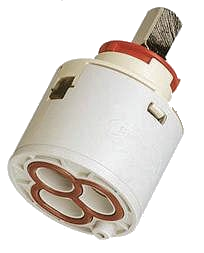
Companies that use good-quality valve cartridges in their faucets usually disclose the cartridge source on their websites. Those that don't will happily identify the cartridge in a call to customer service.
If the company declines to disclose the sources of its cartridges (because it is a "trade secret"), you can confidently assume (1) it is not one of the better brands or (2) the company is trying to create a sole-source monopoly on replacement cartridges.
Replacement Cartridges: If Foster no longer stocks the cartridge for your very old faucet, don't panic. It is probably available from one of the replacement parts sellers, such as Faucets Parts Plus or Chicago Faucet Shoppe.
For more information about faucet valves and cartridges and the companies that make cartridges that are known to be reliable, see Faucet Valves & Cartridges.
Foster Faucet Construction
The construction of Foster faucets is conventional.
The body and spout do double duty: direct water flow inside the faucet and give the faucet its outward appearance.
None of the faucets we examined was made using modern core and shell construction in which function and appearance are divorced.
The core elements direct water through internal tubing, which is concealed by a separate shell. The shell is solely decorative. It gives the faucet its outward appearance, but plays no part in channeling the water flow of the faucet.
Since water does not touch the shell, it does not need to be lead-free brass, and since it does not have to withstand water pressure, it can be much thinner, both of which save fabrication costs.
Core and shell is so far a largely American technology that has yet to reach Europe or Asia to any great extent. For more information about core and shell and its many advantages over conventional construction, including material and cost savings, see Faucet Basics, Part 1: How Are Faucets Made. For an example of how a major facet company is converting to core and shell, see our review of Delta faucets.
Foster Valve Cartridges
The critical component in a faucet is its valve.
The valve controls water flow, turning it on and off, and in single-handle faucets, adjusting the water temperature.
Foster identifies its valves only as ceramic disc valves, a type of valve that almost all modern faucets use, so that description is not much help in determining the quality of the valves. Some are lifetime products, some last just a few years.
Our research identified cartridges from Galatron Plast S.p.A., an Italian technical ceramics company that is credited with developing the standardized designs used in most modern ceramic faucet cartridges, and from Kerox KFT, a technical ceramics company in Hungary that makes what many believe is the best European ceramic cartridge. However, we also found cartridges that we could not identify.
Foster's Response: We have asked the company to identify the sources of its valve cartridges and have been waiting days for a response. If we get a response, we will amend this section accordingly.
The company guarantees the valves against leaking for up to twenty years, so it must have reasonable confidence in their quality, but it does not identify their manufacturer. Knowing the manufacturer is the best guide to their quality.
Foster Faucet Finishes
Foster offers 12 in North America: Black, Chrome, Copper, Gold, Gun Metal, Satin Chrome, Satin Copper, Satin Gold, Satin Gun Metal, Polished Stainless Steel, and Satin Stainless Steel.
How to Clean a Ceramic Valve Cartridge
If your faucet starts to drip after several years, the problem is most likely in the valve cartridge.

The cartridge is probably not defective. It is just clogged up with mineral deposits accumulated over the years from hard water.
The two ceramic discs that shut the water off no longer mesh perfectly, allowing a few drops of water to slip through.
To return it to full functionality, removing the lime scale deposits is all that is required.
Here is how that can be done:
- Remove the cartridge following the instructions in your faucet manual. (If you did not keep the instructions, go to YouTube for any of several videos on how to remove a cartridge.)
- Soak the cartridge for up to 30 minutes in a solution of 50% household vinegar and 50% water.

- While you are waiting, take a toothbrush soaked in the vinegar/water mixture and clean the cavity in the faucet that holds the cartridge. Wipe it dry with a clean cloth.
- Rinse the cartridge thoroughly in clean, cold water.
- Lubricate the O-ring(s) and rubber washers, if any, with silicon plumber's grease.
- Reinstall the cartridge.
If the mineral build-up is substantial, you may have to do this more than once.
View a good video by Fluid on how to clean a ceramic cartridge.
Chrome is Foster's default applied finish. The other finishes are intended to match Foster stainless steel sinks, available in the same finishes.
Stainless Steel Finishes
Foster's two stainless steel finishes are not applied, they are the stainless steel material of the faucets polished or brushed to create a pleasing finish.
They may then be protected with an applied clear coat of a a high-performance, durable polymer coating to further protect the finish.
Electroplating
Chrome is an electroplated finish.
is the oldest process used to finish brass faucets. It involves immersing the faucet and the metal to be used as plating in an acid bath, then applying an electrical charge to both objects so metallic ions are drawn from the plating metal to the faucet.
Chrome is the most commonly used plating metal and by far the most popular faucet finish, outselling all other finishes combined. It works well with all décor choices. It is durable, scratch-resistant, and easy to keep clean.
The Foster Chrome finish is highly polished. The faucets we examined for this report were free of even the tiniest flaw in their sparkling Chrome finishes. Keep in mind, however, the shinier the chrome, the more likely it is to show even minor scratches, so care in both use and cleaning is required.
Physical Vapor Deposition
All other Foster finishes are, according to the company, produced using (PVD).
Only one Foster faucet sold in North America is available in these PVD finishes, the Capri. All other faucets are finished in Chrome and only in Chrome. Foster offers no other finish options for these faucets.
PVD is one of the more advanced finish technologies. Foster claims it has mastered the process since 2010. It is, however, far behind other companies such as which has been using PVD technologies developed by its sister company, Vapor Technologies Inc., since 1996.
PVD finishes are applied in a vacuum chamber loaded with unfinished faucet parts. All the air is replaced with a carefully calculated mix of inert and reactive gases.
A rod of the metal used for the coating is heated to a temperature so high that it dissolves into individual atoms, creating a plasma that is bombarded onto the faucet parts to create a very thin (2 to 5 microns) but very dense coating.
PVD finishes are very hard (Rockwell HRC-80+, Vickers HV-2600+) and bonded to the faucet at a molecular level, essentially becoming an integral part of the fabric of the faucet, which makes them very durable.
Independent Laboratory testing has found them to be 10 to 20 times more scratch-resistant than polished chrome.
In our admittedly less-than-scientific durability tests, a Brillo® pad left no mark on a PVD finish. A Scotch-Brite® green pad could scratch it, but it took some effort. (Nevertheless, keep all scouring pads far, far away from your faucet. Modern finishes do not require scouring.)
Foster Faucet Warranty
Foster guarantees its faucets against "leaks and drips" for "as long as the original consumer owns their home," expiring at the end of 20 years.
Some faucet components, however, are guaranteed for shorter terms: chrome finishes for 5 years, PVD Finishes, spare parts, gaskets, and O-rings for 2 years.
Many of the ills that can befall a faucet are not guaranteed at all.
If the defect does not cause a leak or does not involve a finish, gasket, O-ring, or spare part, it is not covered by the warranty.
Admittedly, such defects are rare, but in the event your Foster faucet handle loosens and cannot be tightened, the aerator just dribbles a little, or the faucet spray stops working entirely, the problem is not covered (unless the defect also causes a leak or drip).
The warranty's protection is substantially below that provided by the standard North American lifetime faucet warranty pioneered by more than half a century ago, which covers all defects (except and electronics) for a lifetime.
A Guide to True Faucet Quality?
Any time we encounter a less-than-lifetime faucet warranty, our immediate question is whether something is wrong with the faucets. Why is the company offering a less-than-lifetime warranty on a product that most buyers believe is a lifetime investment?
The question arises because a faucet warranty is usually a very good indicator of what the company really thinks about its faucets. It cuts through the dense cloud of marketing puffery surrounding faucets, giving a potential buyer a true insight into management's actual opinion about the durability and longevity of its products.
Foster's warranty suggests that the company does not have a great deal of faith in its finishes. The five-year warranty on Chrome finishes does not inspire confidence in the long-term viability of the finish.
However, with Italian imports, the short term warranty may indicate nothing more than the company has imported its European warranty along with its Italian faucets.
Some Italian manufacturers, such as have converted their European warranties into the North American sstandard lifetime warranty. They understand that to compete successfully in this market, a strong warranty is required if, for no other reason, than to show confidence in the longevity of the product.
Foster has not yet arrived at this realization. It still thinks it is competing only with other Italian companies, so its European-style warranty is sufficient.
It's not.
Ambiguous Provisions
The Foster written warranty document is best described as "unskilled." We very much doubt it was written by a lawyer.
All states and provinces in North America have laws requiring that consumer products be fit for their ordinary purposes and conform to an ordinary buyer's expectations.
This is the implied warranty of merchantability. It derives from English Common Law and is the law in both Canada and the U.S. It automatically attaches to every sale of a consumer product by a merchant that provides a written warranty.
A product is merchantable if it serves its ordinary purpose. A faucet, for example, is merchantable if it may be legally installed in a drinking water system and dispenses controlled amounts of water.
A merchantable product must remain merchantable for a reasonable amount of time. How much time varies with the product. A faucet that leaks after one or two years is probably not merchantable. One that doesn't leak until its 20th anniversary probably is – a faucet is not expected to be leak-free forever.
Magnuson-Moss refines state warranties of merchantability by providing uniform national standards for form and content, but it does not supersede them and does not allow a merchant that offers a written warranty to waive them.
Learn more about merchantability at The Warranty Game: Enforcing Your Product Warranty.
Most likely, one of the company's business school graduates (who would never even dream of writing any other commercial contract) fancied himself fully qualified to write one of the most complex of all business contracts and one of the very few contracts with content closely regulated by federal law.
| Company | Score | Notes |
|---|---|---|
| * | Far Below Standard | |
| *** | Standard | |
| Foster Milano | * | Far Below Standard |
| *** | Standard | |
| *** | Standard | |
| To read the review of these faucets, click on the name. | ||
The warranty is full of ambiguities and misstatements, and does not comply with the minimum requirements for consumer product warranties specified in the federal Magnuson-Moss Warranty Act (15 U.S.C. §2301).
Foster faucets are guaranteed not to leak or drip for "as long as the original consumer owns their home," but not for more than 20 years.
If the buyer ceases to own "their home" during the twenty-year period, the warranty ends. It also ends after 20 years, even if the buyer still owns "their home."
Owns Their Home
The problem with this definition is "owns their home."
Apart from the poor grammar, the expression iss ambiguous.
Does "their home" refer to just the home that the buyer owned when he bought the faucet, or any home he may own now or in the future? We don't know. Under a legal interpretation rule called contra preferentum, dating to 16th-century English Common Law, any ambiguity in a contract must be interpreted against the profferer (i.e., the writer) of the contract.
So, the correct answer here is that "their home" means "any home, now or in the future" that can be reasonably described as "their home." The owner can move the faucet from home to home indefinitely and as long is he or she owns the home in which the faucet is installed and the 20-year warranty duration has not been reached, the warranty remains in effect.
If the writer of the warranty wanted to limit "their home" to just the home the buyer owned when he bought the faucet, he should have said so. He didn't. (Why "their home" and not "his or her home," we have no idea.)
The second problem with the term "owns their home" is it excludes from warranty coverage all of the buyers who are not homeowners.
Renters, tenants, and other non-homeowners are out of luck. The Foster warranty ends the instant it begins due to a lack of home ownership.
Why Foster would want to exclude non-homeowners from warranty protection is not clear. Maybe it figures that they simply cannot afford its relatively costly faucets. But, in fact, many well-to-do households do not live in a home they own.
Placing home ownership in a trust to protect the asset and ensure its orderly transfer on death without the bother and expense of probate has become relatively common practice. The trust is the legal owner, not the dweller(s) therein, so the Foster warranty would not apply.
Omitted Ownership Requirement
Just as problematic as the warranty's definition is what's missing from that definition.
A home-owning buyer is not required to continue to own the faucet for the warranty to remain in force. He or she only needs to continue to own "their home." This omission has lots of interesting consequences.
Here's one:
Buyer sells the Foster faucet to Neighbor. Does Neighbor get any rights under the warranty?
Yes, he does. The warranty stays in force for as long as Buyer continues to own a home that fits the description of "their home" (up to 20 years), no matter who owns the faucet.
Understanding Finish Warranties
A finish warranty does not protect against anything that can go wrong with a faucet finish. It protects against defects caused by faulty materials or errors in the finishing process, generally subsumed under the rubric "manufacturing defects."
Delaminating, peeling, blistering, and spalling are the usual manufacturing defects. These are extremely rare. Most problems are caused by overzealous cleaning and ordinary wear and tear, neither of which is covered by a finish warranty.
If it peels, the company pays, but if you scratch it or it turns a funny color after you clean with Wham-X All Purpose Miracle Cleaner – well, you should have been more careful.
Buyer can make a warranty claim on Neighbor's behalf that Foster would be legally obligated to honor, and in some states, Neighbor can bring his own claim.
Inappropriate "Voiding"
Another problem is the inappropriate use of the word "void" in this expression:
"… damage caused by improper care and cleaning will void the warranty on the treatment."
Undoubtedly, what the writer meant to say is that the warranty does not cover damage caused by improper care and cleaning. But that's not what he said. What he did say is that such damage voids the warranty.
Void means exactly what you think it does: the warranty is over, done with, finished, ended, terminated, gone, and kaput the very instant the finish is damaged – the whole warranty, not just the part that applies to finishes.
If you clean the finish with Wham-X Miracle Cleaner on Monday, damaging the finish, and the faucet starts leaking on Tuesday, the leak is not under warranty. The warranty no longer exists. It was voided on Monday.
The word "void" should never be used in a warranty.
Improper Captioning
To qualify a warranty as a limited warranty, Magnuson-Moss requires Foster to clearly designate
its warranty as limited by including the word "limited" in its caption or title. This designation is required to give an immediate warning to potential buyers that Foster intends its warranty protection to be less than complete. (15 U.S.C. §2303(a), 16 CFR §700.6)
The Foster warranty is captioned just "Warranty on Foster Faucets". The word "Limited" is nowhere to be found.
Even if the text in the body of the warranty makes it clear that Foster intends to provide only a limited warranty. the missing "limited" automatically converts the warranty to a full warranty, irrespective of Foster's intentions.
A full warranty gives a buyer many more rights, voiding or vitiating many of the restrictions and limitations written into the Fost warranty, including any exclusion of installation costs and labor charges from warranty coverage.
Where the repair or replacement of a product (like a faucet) requires the product to be uninstalled and reinstalled, a full warranty requires installation labor to be free of any cost to the consumer. (16 CFR § 700.9)
Deceptive Disclaimer
Of much more consequence than the inexpert wording, however, are the several violations of federal warranty law. The most serious of these is the attempted disclaimer of state law implied warranties of merchantability and fitness for a particular purpose.
Buying Rule for
Smart Faucet Buyers:
Warranty
Never buy a faucet unless you have carefully read and understand the faucet's warranty. It tells you more than the company wants you to know about management's true opinion of the durability and life expectancy of the faucet it sells.
Learn how to interpret faucet warranties at Faucet Basics, Part 6: Understanding faucet Warranties.
Learn how to enforce your warranty with step-by-step instructions at The Warranty Game: Enforcing Your Product Warranty.
Model Lifetime Warranty: For an example of a warranty that avoids Kohler's drafting problems and complies with the Magnuson-Moss Warranty Act, download and read our Model Limited Lifetime Warranty.
A company providing a written warranty cannot legally exclude coverage under state law warranties. Foster attempts to do so, however, with this provision:
"… this warranty in lieu of all other warranties, expressed or implied, including but not limited to the implied warranties of merchantability and fitness for particular purpose."
It's an attempt that will go nowhere.
Under federal law, a company's written warranty is intended to supplement state law warranties, not replace them. It is "in addition to" and not "in lieu of." Implied warranties cannot be disclaimed in a written warranty, and any attempt at a disclaimer is void and simply ignored.(15 U.S.C. § 2308(a)) (And that's a proper use of the word "void.")
However, there is a second problem with the attempted exclusion, and it can be much more serious.
The language is deceptive, and one of the cardinal rules of Magnuson-Moss is that consumer warranty language must never be deceptive.
This provision would almost certainly lead a reasonable consumer to reasonably believe that a defective Foster faucet would not be covered by state-law implied warranties – and that is the very definition of deception under the law.
We don't think that the writer intended deliberate deception. No doubt he saw the language in some other warranty and copied it, unaware of its illegality. (Many faucet warranties include similar language. We are not sure where it first appeared, but it has been widely copied by unschooled faucet warranty writers.)
Under Magnuson-Moss, however, deliberate deception is not required to incur liability for deception. It is sufficient that the company has not taken reasonable care "to make the warranty not misleading." (15 U.S. Code § 2310(c)(2))
The very presence of this language in the warranty, however, rather convincingly evidences a lack of the required reasonable care.
Deception in a consumer warranty can result in an award of punitive damages at trial in amounts that may far exceed any actual damages.
For an example of a faucet warranty that avoids all of these problems, download and read our Model Limited Lifetime Warranty.
Customer Service
The Better Business Bureau has no record for Foster Milano, indicating that in the nearly ten years it has been in business, it has never had a customer issue escalated to the BBB, an impressive record.
However, apart from handling returns and warranty claims adriotly and with relative celerity, agents actually know very little about Foster faucets.
Agents provided incorrect information about the source of Foster faucets, their valve cartridges, and general inquiries about the company. Several emails to the company seeking information that a customer service agent should know have not been answered.
We believe the service is "satisfactory" when handling customer issues, but is woefully lacking in accurate information about the company's faucet products and cannot be relied on to provide correct information.
The Foster-US Website
Foster has two websites accessible from North America.
It has a worldwide site, fosterspa.com, and a dedicated North American website, foster-us.com, which is the one you want (not fosterusa.com, a wholesale food company in North Carolina).
Site Navigation
Navigation is menu-driven and intuitive, starting with the menu icon (☰) at the top left of the main page. Click "Products," then "Faucets" to display the Foster faucets available in North America.
Website Search
The site search function is limited and imprecise.
A search on "Capri faucets,' for example, returned all of the Capri faucets, but also page after page after page of sinks (nine pages in total) and two soap dispensers.
Then, on a hunch, we tried "Capri Taps" and got a more precise result: the nine Capri faucets along with one sink from the Michelangeo collection.
| Specification, Property, or Document | Score | Notes |
|---|---|---|
| ADA Compliance Stated | 0 | Not stated |
| Aerator Manufacturer Identified | 0 | Not identified |
| Baseplate Included, Yes or No | 5 | Identified as "strengthening plate" |
| Certifications Identified | 0 | Not identified |
| Maximum Countertop Thickness | 5 | |
| Dimensions/Dimensioned Drawing | 5 | |
| Flow Rate Maximum Stated | 5 | Always |
| Installation Instructions | 5 | Separate ,PDF document |
| Material, Primary (Brass, Stainless, Aluminum, Zinc, etc.) | 5 | |
| Materials, Secondary (Zinc, Plastic, etc.) | 0 | Not specified |
| Mounting Holes, Diameter | 5 | |
| Multiple Faucet Images, 360° Display, or Video Link | 0 | Single 3/4 image |
| Parts Diagram | 0 | Not provided |
| Spray Head Material Identified | 0 | Not specified |
| Spray Hose Type Identified | 0 | Not specified |
| Supply Hose Included. Yes or No | 0 | Not specified |
| Valve/Cartridge Type Identified | 5 | Identified only as "with ceramic discs" |
| Valve/Cartridge Manufacturer Identified | 0 | Not identified |
| Finish Process Identified | 2.5 | For PVD finishes only |
| Finish Images Provided | 2.5 | As a general finish chart |
| Warranty Link Provided | 0 | Not linked from faucet listings |
|
SCALE:
90+ A Excellent, 80+ B Good, 70+ C Average, 60+ D Poor, 59- F Fail
| ||
| Download/Read/Print the minimum content required in an online faucet listing to permit an informed buying decision. | ||
Evidently, the search algorithm does not understand "faucets" but does understand the British term, "taps."
Searching on a particular finish was also largely futile. "Copper," for example, displayed
- every sink available in copper,
- every sink not available in copper,
- every cooktop available in copper along with
- every cooktop not available in copper,
- but missed
- the only faucet with a copper finish, the Capri.
Obviously, the website search needs some fine-tuning.
Faucet Visualization
Once you find an interesting faucet, the information provided about the faucet becomes important for a fully informed buying decision. Unfortunately, however, the website's faucet specifications are sparse and woefully incomplete.
Certainly, one of the first things a buyer will want to know is how the faucet will look in his or her kitchen. Since the buyer cannot examine the faucet directly, clear images must be relied upon for adequate visualization.
A Foster faucet is illustrated with a single 3/4 profile image, insufficient to fully visualize the faucet. Several additional images, some showing the faucet installed, are the absolute minimum needed for adequate visualization.
Better still would be a 360° display function, such as those provided by faucets. Click on the 360° icon to display the faucet in a box that can be rotated using the mouse to view the faucet from any angle.
Best of all would be a video showing the faucet installed and in action, showcasing all of its features.
Specifications and Documentation
Below the single 1/4 profile image of the faucet is "Find a Dealer." To do so, however, you first have to select your location, which is odd since Foster-US sells only in the U.S.
Out of curiosity, we selected Tajikistan and clicked "Proceed." The site displayed a form allowing us to "Contact the Reseller," without an indication of who the reselling Tajikistani might be.
Our second attempt, in which we selected "United States," also did not lead to a showroom locator, but to the same contact form.
Fortunately, the site has a second option for locating a seller, discussed below.
Below "Find a dealer" is the heading, "Details," which contains basic information about the faucet.
Below "Details" is a dimension drawing, dimensioned in inches and fractions of inches, positioned on the left side of the page.
Below "Details" is a section headed "Features" which graphically highlights with icons what Foster believes are the most important characteristics of the faucet. From a marketing standpoint, they may well be the faucet's best features, but as an aid to fully informed buying, they are not very helpful.
To the right of the dimensioned drawing are three links: Technical Sheet
, User Manual
, both .PDF documents, and a 3D Model
of the faucet.
The link to the PDF document entitled "Technical Sheet" is where we expected to find very detailed specifications for the faucet. We were sorely disappointed. It contained almost exactly the same information already displayed in "Details" along with a repeat of the measured drawing.
A second link, "User Manual," calls up installation instructions, usually a single page (which is a few pages short of what we normally think of as a "manual.")
The instructions are language-independent, in pictorial form without any text. We would prefer written instructions, but our plumbers found the pictographs fairly easy to follow after a little initial head-scratching.
Finally, there is a link to a 3D CAD model of the faucet, rarely of any use to a typical faucet buyer, but of great help to professionals like architects and kitchen planners who use computer-aided drafting.
You cannot just download the model, however. You first have to register. Only then does Foster display a link that allows the model to be downloaded as a .zip file.
All of the models seem to be in .stl or .igs formats, older formats which, fortunately, most modern CAD programs can still read. A better choice would be the universal .dxf format.
Language Oddities
There are a few linguistic anomalies resulting from the translation from Italian and British to North American English.
The website's text uses the term "faucet," but the background coding still prefers the word "tap," hence the odd search results detailed above. Tap is correct in most English-speaking countries from Australia to Nigeria, and even in Canada, but not in the U.S.
Each faucet is available with a "strengthening plate." We had never heard of a strengthening plate. But it soon dawned on us that the term referred to a base plate or escutcheon designed to hide unused sink holes. It is a very good idea to include one, and we wish more faucet companies would do so, but why not just call it a base plate to avoid misunderstanding?
The showroom locator expresses distance in kilometers rather than miles.
Required Faucet Listing Information
Over the 20 years we have been reviewing faucets, we have identified 30 specifications that are important to an informed faucet buying decision, everything from a faucet's certifications to the minimum diameter of the hole in the sink needed to install the faucet.
These need to be presented in each faucet's listing as essential information. However, not every specification applies to every faucet.
Foster, for example, does not sell bathroom faucets, so specifications that apply only to bathroom faucets (e.g., "Drain Included Yes/No") are not needed.
However, of the 20 specifications that do apply to Foster faucets, the website fully or partly satisfies only half of them, for an overall failing score. (See the Minimum Website Listing Table, elsewhere on this page.)
Faucet Testing, Certification, & Registration
As of the date of this report, just three of the seven Foster faucet models ( Capri, Ponza, and Stromboli), have been certified by an independent testing laboratory to the North American standards that ensure the safety and reliability of faucets and ensure that faucets are toxin-free and drinking-water safe.
The other four models (Elba, Salina, Sicilia, and Volcano), are not certified and, as a consequence, not legal to install in a drinking water system in either the U.S. or Canada.
In addition, none of Foster's faucets complies with the U.S. Energy Policy & Conservation Act (EPCA). This Act prohibits the distribution of a faucet in commerce in the U.S. unless the faucet has been registered with the Department of Energy, certifying that it meets federal water conservation standards.
Foster faucets not in the registry may not be lawfully "imported, advertised, offered for sale, sold, or delivered" in the U.S. Violation risks very substantial financial penalties. (Canadian sales are not affected by EPCA rules. However, similar laws have been enacted by most Provinces. See more information below.)
Where to Buy
Foster sells in North America through brick-and-mortar plumbing supply houses and showrooms. A store locator on the website will identify the retail outlets closest to a zip code.
Most faucet websites have a "Where to Buy" section that is front and center. After all, the purpose of the site is to encourage users to buy something, and it is wise to make it very easy to find out where they can do so.
Resellers
On the Foster site, however, the user must know to select "Contacts" on the main menu, then "Reseller." We discovered it purely by accident.
"Reseller" is a descriptive term, but more appropriate in the U.K.
A better choice is "Retailers" or "Showrooms." An even better option would be to add "Where to Buy" to the drop-down main menu.
Some retail outlets, such as General Plumbing Supply, maintain websites at which the faucets may be purchased, but you will have to contact the store to get prices.
Pricing
Foster tries very hard to keep its pricing a mystery. It does not list suggested retail prices on its website, and we found no published street prices.
Street Price Comparison
Italian Mid-Priced Faucets
In U.S. Dollars
The Street Price Range quoted above was obtained by polling a dozen retail dealers across the U.S. We found that street prices varied as much as 50% among retailers, so it is best to shop around.
Generally, Foster's prices are on the high side of the middle range for Italian faucets, not as pricey as upscale faucets from a company like one of our Best Value faucet companies.
Prices for Foster faucets in North America are generally four times the price for which the same Nobili faucet can be bought in Italy. For example, the Foster Capri faucet in Chrome for lists for $818.00. The same faucet sold as the Nobili LV00133CR is priced in Italy at an average of $208.00.
A slightly higher price on this side of the Atlantic for Italian-made faucets is to be expected for two reasons.
• Testing and certification to North American standards is expensive.
Our standards differ from and are often more stringent than their European counterparts, so certifications to European standards are not transferrable.
Testing ad certification must be done all over again.
• Faucets have to be modified from metric to fit North American standard threading and fitting sizes. This requires retooling and often short production runs, both of which add to the price of a faucet.
Nonetheless, these factors account for only a portion of the price difference between the two continents, suggesting that Foster's markup on its American faucets is more than a little generous.
Comparable Faucets
Faucets made in Italy, comparable to Foster faucets in quality with the same or a better warranty, but not necessarily comparable for design or price, include
In Conclusion
Foster faucets are treated by the company as adjuncts to its sinks. The company's many stainless steel sink finishes are complemented by its many faucet finishes.
Faucet choicess will be limited, however. As of the date of this report, only one faucet, the Capri, iis available in all of the finishes that match the company's sinks.
Foster faucet designs are not unique. Very similar, if not identical, faucets are available from dozens of companies selling faucets in North America. However, if you want the finish on your faucet to exactly match that of your stainless steel sink, Foster may be the place to buy.
The majority of our rating panel would buy any of the three fully certified faucets with "some reservation" related to its relatively weak warranty and the fact that the faucets are not registered. It would not buy any of the four uncertified faucets simply because they are illegal to us anywhere in North America.
The Foster warranty is, at best, maladroit, the faucet prices are relatively high, and none of the faucets are registered with the U.S. Department of Energy as required by law.
Admittedly, the laws and regulations governing faucets in North America are complex and overlapping, but after nearly a decade in the faucet business on this continent, Foster should understand and be compliant with all regulations. That it is not suggests deliverate ignorance, and is somewhat alarming.
If the company wants to be considered a serious player in the North American faucet industry, it needs to start acting like a professional: getting legal and adopting a serious warranty. At the moment, it seems very tentative about its faucet business.
Continuing Research
We are continuing to research the company. If you have experience with Foster faucets, good, bad, or indifferent, we would like to hear about it, so please email us at starcraftreviews@yahoo.com or post a comment below.
Please note: we do not answer questions posted in the comments unless they are of general interest. If you have a question, please email us.