E2 Stainless Faucets Review & Rating Updated: October 10, 2026


Law Requirements
Read the the E2 Stainless Faucet warranty.
☆ Learn more about faucet warranties.☆ See how we determine warranty scores.☆ Understanding the federal Magnuson Moss Warranty Act.☆ Find out how to enforce your product warranty at The Warranty Game: Enforcing Your Product Warranty..Download/Read/Print the Model Limited Lifetime Warranty.
This Company In Brief
International Concepts in Cabinetry, Inc. (ICCI) is an importer and distributor of sinks and the accessories that accompany sinks, including faucets.
Its faucets are made from stainless steel rather than the usual faucet material, brass.
They are imported from China, where they are made by a very well-respected manufacturer that specializes in stainless steel products.
The Pros:
• The faucets are well made and include top-of-the-line ceramic valve cartridges and aerators.
• All but four E2 faucets have been tested by an independent laboratory and found to comply with all of the laws and regulations governing the installation of drinking water faucets in North America.
These include the very strict North American lead-free and drinking-water safety standards.
Only the faucets certified to comply with all North American standards may be legally used in a drinking water system in any state or territory of the U.S. or any Canadian province.
The Cons:
• The registration requirement of the U.S. Energy Policy & Conservation Act (EPCA) has not been met.
Federal law prohibits the sale of a faucet in the U.S. unless the faucet has been registered with the Department of Energy, certifying that it meets federal water conservation standards, and appears in the CCMS database of registered products. Violation risks very substantial financial penalties.
• The faucets are not legal for sale or installation in California or Massachusetts.. Bathroom sink faucets are not legal for use in Colorado.
• Just two faucet finishes are available: Brushed Stainless Steel and Mirrow Polished Stainless Steel.
• The faucets are not well supported after the sale. The two-year faucet warranty is far weaker than the standard North American lifetime faucet warranty. And, as written, there is some question whether the current warranty even includes E2 Stainless-branded faucets.
The Company
International Concepts in Cabinetry, Inc. (ICCI) is an importer and distributor of sinks, faucets, and related hardware made in China, Malaysia, Vietnam, and South Korea. It is a distributor, not a retailer, and sells primarily through small, local contractors.
On its website, the company claims to be a certified manufacturer …
"… in control of every step of our production process."
We have found no evidence to support the claims.
Certified Manufacturer
A certified manufacturer is …
… "a company whose production facilities, processes, and quality management systems have been independently audited and verified by an accredited third-party organization to meet specific, recognized industry or regulatory standards."
An example is the ISO family of certifications for good management, including quality control, health & safety, and environmental impact.
We have found no indication that ICCI has been certified by anyone for anything.
Our research did not discover any product identified in the company's catalogue that it manufactures.
This conclusion specifically excludes the manufacture of sinks and faucets, all of which have been traced to known overseas suppliers.
Formation and Early Years
ICCI was formed in 1995 as a California corporation by Brent Cohn, its current CEO.
Its early years are a bit of a mystery, but it appears that it initially sold supplies to local contractors.
Whether these products included sinks is unknown, but they probably did not include faucets.
In 2004, ICCI applied for "Eclipse Stainless" as a registered U.S. trademark, but the application was allowed to lapse and was deemed abandoned by the Patent and Trademark Office in 2006.
By that year, the company had expanded its operations, selling online as Eclipse Stainless, a common law trademark, and distributing stainless steel sinks and faucets to business customers in the building trades. (View the Eclipse Stainless website as of June 6, 2013.)
In 2013, the company changed its sink supplier—a move that led to years of problems and an eventual shift in product branding from Eclipse Stainless to E-Stainless and finally to the current E2 Stainless.
What is the ICCI Brand Name?
Chinese Sinks
The company initially imported its sinks from Jiangmen Jin Ke Ying Stainless Steel Wares Co., Ltd., a Chinese manufacturer of die-drawn stainless steel sinks.
That relationship changed in 2013 after the U.S. International Trade Commission (USITC), in response to complaints by domestic sink manufacturers, including determined that Chinese-made stainless steel sinks …
"… were sold below fair value and subsidized [by the Chinese government], with dumping margins up to 76.53%, which materially injured domestic industries."
Based on that finding, the U.S. Commerce Department issued anti-dumping (AD) and countervailing duty (CVD) orders on April 22, 2013, imposing import penalties of as much as 98% on Chinese-made, die-drawn, stainless steel sinks.
Unwilling to pay the substantial penalty surcharge, ICCI cast about for a new sink supplier outside of China.
Fortunately, it did not have to look far.
Just weeks before the USITC ruling, its Chinese sink supplier had formed a new Malaysian subsidiary, JKY Sink Sdn. Bhd., to manufacture drawn stainless steel sinks.
JKY Sink's status as a non-Chinese manufacturer protects it from the U.S. anti-dumping sanctions that are still in effect as of the date of this report.
ICCI switched its sink supplier to the Malaysian subsidiary.
Malaysian Sinks
The switch caused problems for ICCI, including a lawsuit involving one of its major distributors that was not resolved for nearly a decade.
As a fledgling die-cast steel sink producer with little or no stainless steel manufacturing experience, JKY Sink had teething troubles that resulted in quality issues.
JKY Sink Sdn. Bhd.
JKY Sink Sdn. Bhd. is an international manufacturing company that specializes in producing and exporting stainless steel kitchen sinks.
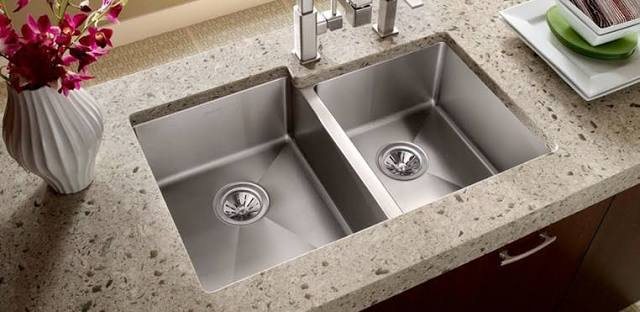
It traces its roots to Jiangmen Jin Ke Ying Stainless Steel Wares Co., Ltd., located in Guangdong Province—a major Chinese manufacturing hub for hardware and kitchenware. Jin Ke Ying has established itself as a professional manufacturer focused on high-quality, pressed, and handmade stainless steel sinks.
In 2013, to avoid sanctions imposed by the U.S. International Trade Commission on Chinese sink manufacturers, Jin Ke Ying established a subsidiary in Selangor, Malaysia, operating as JKY Sink Sdn. Bhd., to manufacture sinks.
Most of these were cosmetic, including visible welds, scratches, and grinding marks that had not been polished out, and surface rust resulting from improper handling and packaging.
Some, however, affected the sinks' functioning.
Identified defects included excessive flexing, structural stress due to corners thinner than the nominal gauge, and sinks lacking effective anti-condensation coatings or sound-deadening pads.
From Eclipse to E2 Stainless
ICCI did not change suppliers a second time. It rode out the storm, and the quality issues with the sinks were eventually fixed.
What it did change, however, was its brand name. Eclipse Stainless became E-Stainless, then E2 Stainless to avoid confusion with other companies selling under some variation of eStainless.
The earlier brand names have not gone away completely, however.
At least one of the company's retailers sells ICCI's products as Eclipse Stainless. Another sells them as E-Stainless, and the company's warranty guarantees E-Stainless faucets but does not mention E2 Stainless faucets. (See more below.)
The Faucet Manufacturer
ICCI has had much better luck with its faucet manufacturer.
It's sink faucets are made by Hunan Sento Stainless Steel Sanitary Ware Co., Ltd., a Chinese manufacturing conglomerate trading as SENTO. It has been ICCI's faucet manufacturer since the beginning.
Founded in 1999 as the Qinglian Hardware Machinery Factory, it initially manufactured medical hand-washing devices.
In 2003 it produced China's first stainless steel faucet after nearly a year of development to overcome the complex forming, welding, and machining hurdles involved in working with stainless steel materials.
It changed its name to Sento Stainless in 2004 and registered SENTO® as a trademark in China and the U.S.
By 2008 its faucets had been certified to joint U.S./Canadian standards and were legal to sell in North America.
In 2009, Sento formed a coalition with Changde Tianlun Precision Casting Co., Ltd. and started construction of the first phase of a new joint production facility in Anfu Industrial Park.
In 2018, Sento further expanded its operations by establishing a Jiangmen production base (operating as Tinto Co., Ltd). to manufacture its stainless steel faucets.
In addition to producing faucets for ICCI, Sento supplies stainless steel faucets to Bristol Sinks in Canada, (However, Alliable appers to have discontinued selling Cygnet faucets as of the date of this report.)
Business Model
The ICCI website is for information only. The company does not sell on its website. It does not even publish MSRP (list) prices on the site.
It does not sell directly to consumers.
It sells at wholesale only, and only to the trades: contractors, plumbers, and countertop fabricators. To buy a faucet, you will have to go through an authorized retail seller.
The faucets are not distributed by major national supply houses like Ferguson, Briggs, or HaJoCa, but they are available from some regional plumbing and hardware suppliers, most of which do not advertise the products. These are primarily on the West Coast. The two we found that will sell to consumers are:
- PACE Supply Corporation, a wholesale plumbing distributor operating across California, Oregon, and Hawaii.
- Ashby Lumber, a structural building materials and hardware supplier with kitchen and bath showrooms in the San Francisco Bay Area.
E2 faucets are also available online to consumers from a few suppliers of outdoor kitchen products and countertop companies.
These include but are certainly not limited to the following:
- Barbecue and Grills: A supplier of outdoor kitchen ware, including stoves, grills, cabinets, sinks, and faucets. It also sells ICCI faucets under the E-Stainless brand.
- Dellco Commercial: A commercial and outdoor kitchen specialist providing commercial-grade equipment for outdoor cooking.
- Grillscapes: Another supplier of outdoor kitchen ware, sells ICCI faucets under the E2 Stainless brand.
- Lakeside Surfaces: Sells countertop supplies and accessories, including ICCI sinks and faucets under the Eclipse stainless brand.
- Outdora: A retailer with a showroom in Sonoma, California, that sells just about anything needed for outdoor cooking, including grills, smokers, ovens, fire pits, and whole kitchens, including outdoor cabinets, sinks, and faucets. It sells ICCI faucets under the E-Stainless brand.
Faucet Construction & Materials
E2 faucets are made from SUS304 18/10 stainless steel, an alloy developed in Germany in 1912 that is commonly used for cookware and kitchen implements. It provides very good corrosion resistance and exceptional durability.
SUS304 18/10 contains 10% nickel compared to the more common SUS304 18/8 with 8% nickel. The additional nickel in the alloy improves its ability to resist rust.
Sento also manufactures in a higher grade SUS316 stainless steel, commonly called "marine grade" stainless. Its alloy includes 2% molybdenum for additional resistance to salts and harsh chemicals.
SUS316 is usually specified for outdoor faucets, faucets used on seagoing vessels, and those installed along coastlines where salt-laden air is common.
Although E2 faucets are sold for outdoor use, as far as we can determine, none of the faucets are made from 316 stainless.
Stainless Steel vs Brass
ICCI is quite effusive about the qualities of its stainless steel faucets, especially when compared to brass, the normal material from which faucets are made. Unfortunately, in its enthusiasm, it gets more than a little carried away.
• The registration requirement of the U.S. Energy Policy & Conservation Act (EPCA) has not been met.
Federal law prohibits the sale of a faucet in the U.S. unless the faucet has been registered with the Department of Energy, certifying that it meets federal water conservation standards, and appears in the CCMS database of registered products. Violation risks very substantial financial penalties.
(Canadian sales are not affected by EPCA rules. However, similar laws apply to most of Canada. See more information below.)
"… built into the part you can't see—the interior.Unlike E2's solid stainless construction, a faucet lined with rough, corrosive materials such as copper, brass, or even plastic collects all the impurities in your water and can cause lead emissions …No matter their exterior finish, brass-lined faucets contain up to 8% lead and have a rough water channel that can trap and build up impurities.
This claim has a very small grain of truth, but it is mostly false.
"8% Lead"
Let's start with the easy part.
No brass faucet that has been fully certified for use in a drinking water system in the U.S. or Canada contains 8% lead in its brass alloy.
That much lead in faucet brass has been outlawed for nearly two decades. The maximum allowance today under federal, state, and provincial law is 0.25% (that's 1/4 of 1%)—barely a trace.
"Lead Emissions"
The real concern, however, is not how much lead is in your brass faucet, but how much lead migrates from the faucet into your drinking water.
This is what we think ICCI means by "lead emissions."
Lead, however, does not actually emit anything. But water passing through a faucet could extract small amounts of lead from brass through a chemical process is called leaching.
There is, however, a standard for that too, and certified faucets meet or exceed the standard.
The maximum allowed amount of lead in faucet water is 5 parts per billion. That's billion with a "b." There is likely to be more lead in the air you breathe than you are ever going to get from your certified brass faucet.
How a Faucet Is Tested for Lead Leaching
"Trap Impurities"
ICCI suggests that the rough interior of brass faucets captures harmful impurities.
This is what logicians call a sophism—an argument that may seem superficially correct, but is factually invalid.
In this instance it is invalid on at least two levels.
- First, most brass faucets do not have rough interiors. Whether they do or not depends on how they are cast.
- While an exact global statistical percentage is not universally tracked or published, die-casting dominates modern high-volume faucet manufacturing. The best guess is that about 80-85% of cast brass faucet components are die-cast, and die-casting leaves a smooth interior.
- Sand casting, which does leave a rough interior, is limited to boutique and one-off faucet production where the expense of a metal die ($3,000-$5,000) would not be cost-justified.
- Second, the "impurities" that build up over time inside both brass and stainless steel faucets are usually just the minerals naturally present in hard water.
Manufacturing Faucets in Stainless Steel
- These are not "impurities" in the sense of a foreign substance that "polutes or contaminates."
- Mineral accumulations are unavoidable in the 85% of households in North America that have hard water.
- They are rarely harmful (but if you are concerned with accumulations, a water softener usually takes care of the problem.)
- Water treatment has already removed any dangerous substances from the water, so there is nothing hazardous to accumulate.
- The deposits shown in ICCI's illustration look awful but are most likely oxidized manganese and iron, accumulated over many years of use.
- These are harmless in the small amounts that are deposited inside a faucet. In fact, both iron and manganese are essential trace minerals needed for good health.
The Actual Advantages of Stainless Steel
Stainless steel has genuine advantages over brass as a faucet material—advantages don't have to be invented for marketing purposes.
- Absolute Lead-Free Safety: The stainless steel alloys used to make faucets contain no lead. A stainless steel faucet cannot possibly leach lead into your drinking water. It does not have any lead to leach.
- It could still contain other contaminants, however, such as cadmium in unsafe amounts. Stainless steel has also been linked to Legionnaires Disease. So stainless steel faucets are still subject to the same rigorous safety tests as brass faucets in order to be certified.
- Hygienic Surface: Stainless steel is less porous than unprotected brass, making it harder for microorganisms to stick to the surface. Some are protect by an antimicrobial coating that does not last forever, but can be easily renewed periodically.
- Low Maintenance: Properly alloyed SUS304 stainless cannot possibly rust and naturally resists tarnishing and oxidation. It does not require special treatments, protective coatings, or polishes to maintain its appearance—just simple wiping with mild detergent and water.
- Some of the finishes used on brass faucets, including unprotected native brass, require considerable care almost daily to keep them looking fresh and new.
- Modern Aesthetic: Stainless steel provides a sleek, minimalist look that fits well in contemporary spaces.
The Antimicrobial Property of Brass
One characteristic of brass that ICCI neglects to mention is that brass is antimicrobial. This effect exists even if the brass is heavily tarnished.
Brass is an alloy of copper, zinc, and a few additives, but mostly copper. The copper in brass kills microbes on contact, eliminating 99% of bacteria within two hours using a process called the oligodynamic effect. And not just bacteria, but also viruses, mold (and other fungi), and yeasts.
Stainless steel does not harm or even seriously inconvenience microbes. They can thrive inside a stainless steel faucet for days or weeks.
Faucet Design & Styling
ICCi does not design its own faucets. They are purchased from Sento's and routinely sold to other companies. They are not exclusive to ICCI.
The designs are original with Sento but are greatly influenced by existing American and European styles.
They are overwhelmingly contemporary, inspired by the minimalist school that has dominated Northern European faucet styling for decades.
Not coincidently, they are also the designs easiest to manufacture using stainless steel.
Sento retained two noted Scandinavian product designers to help develop its designs. Anders Kristiansen, now the head of the upscale Danish design company, Gubi A/S, consulted on the development of the entire line. Jacob Jensen designed the ultra-contemporary Fontein and Fontein Alta faucets.
Only a few E2 faucets will fit into any décor other than contemporary modern.
These include the KPS3034 Poseidon, KPS3035 Sacramento, and KPS3036 Cygnus that display the flowing, gentle curves of traditional American design pioneered by in the years following the Second World War.
Otherwise, the styles are ruthlessly contemporary, minimalist, and somewhat industrial. Nothing in the collection is suitable for an Arts & Crafts, Victorian, or Edwardian décor.
Faucet Components
Most of a faucet is static. It consists of tubes, sometimes very fancy tubes, but still just tubes through which water passes and one or two-handles to operate the device.
Buying Rule for Smart Faucet Buyers
The Faucet Cartridge
Never buy a faucet unless you know who made the valve cartridge.
Its valve is the most critical part of a faucet. It is the component that controls water flow. Without a working valve, a faucet is no longer a faucet.
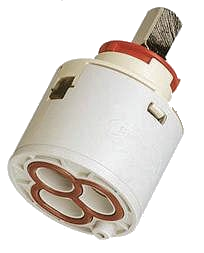
Companies that use good-quality valve cartridges in their faucets usually disclose the cartridge source on their websites. Those that don't will happily identify the cartridge in a call to customer service.
If the company declines to disclose the sources of its cartridges (because it is a "trade secret"), you can confidently assume it is not one of the better brands.
For more information about faucet valves and cartridges and the companies that make cartridges that are known to be reliable, see Faucet Valves & Cartridges.Just two of its components are critical—the aerator and valve cartridge. If a faucet fails, most likely the fault is in one of these units. It is important for the longevity of the faucet that these are the best available.
Valve Cartridges
All E2 faucets are controlled by modern valve cartridges—self-contained units that can be replaced if they fail without disturbing any other part of the faucet. Slip the old one out and the new one in.
The flow of water is controlled by nearly indestructible ceramic discs rather than rubber washers that wear out rather quickly and need to be replaced often.
The discs are absolutely flat and highly polished. When pressed together, the gap between them is smaller than a water molecule, so water cannot flow.
Invented in the 1970s by two American faucet companies, ceramic disc valve cartridges have become the worldwide standard in the faucet industry for their durability and minimum maintenance.
Two-handle faucets are controlled by "stem cartridges." These turn the water on and off and regulate the flow. They do not directly control water temperature.
The left cartridge controls hot water, the right cartridge, cold water. The two streams are mixed in the faucet's spout to the desired temperature.
The cartridges used in single-handle faucets are more complex.
They control water flow and temperature. When the water leaves the cartridge, it is already mixed to the desired blend of hot and cold.
These are called "mixing cartridges" or just "mixers."
E2 Stainless Valve Cartridges
The mixing cartridge installed by default in a Sento faucet is made by Kerox Kft, a Hungarian company that is generally acknowledged to manufacture one of the best, if not the best, mixing cartridges in the world.
Moen Motion
invented the first cartridge that allowed single-handle operation of a faucet, and, along with the cartridge, invented the handle movements needed to operate the faucet.
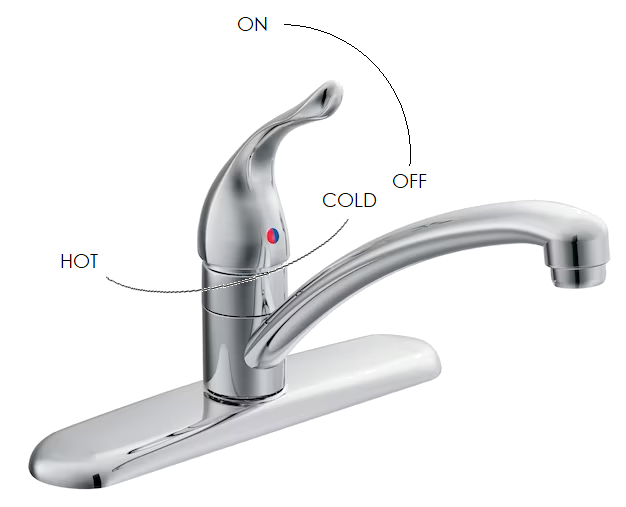
When the handle is rotated left (clockwise), the cartridge's hot water inlet is aligned so hot water flows; when rotated right (anti-clockwise), the cold water inlet is aligned, and cold water flows.
In any position other than far left or far right, the hot and cold water are blended to varying degrees of warm water.
This is "Moen Motion," which has become the standard for all single-handle faucets.
No matter the style, source, brand, or manufacturer of a single-handle faucet, moving the handle up or back turns the water on. Down or forward turns it off. Right delivers cold water and left supplies hot water.
No one has to relearn how to operate a new single-handle faucet each time they buy a new one. They all operate the exact same (Moen) way.
The default ceramic stem cartridges in Sento's two-handle faucets are manufactured by Flühs Drehtechnik, GmbH in Lüdenscheid, Germany.
Flühs (often spelled Fluehs for English speakers) is well known for its precision machining and is generally regarded as the manufacturer of the world's best stem cartridge for two-handle faucets.
 is missing a major marketing opportunity by not identifying Kerox and Flühs as its default faucet cartridges.
 remodeling contractors, kitchen and bath designers, and interior decorators—knows these cartridges to be the cream of the crop.
We don't know, however, whether Flühs or Kerox products are used in all E2 Stainless faucets. The company is silent about its valve cartridges except to identify them as "ceramic," which is not very helpful. Virtually all modern faucet valves are "ceramic."
What we do know is that all of the faucets we inspected had either Flühs or Kerox cartridges. However, we did not inspect every faucet in the ICCI inventory.
Before you buy any E2 faucet, confirm both the cartridge and the aerator with customer service.
Cartridges in all of the company's certified faucets have been tested and approved for use in North America, meaning that they are lifetime components with reasonable routine maintenance.
Life Cycle Testing
Valve cartridges are tested for durability and longevity by cycling the faucet on and off 500,000 times in a robotic testing chamber.
That is not a misprint. The test requires a full half-million test cycles without a single failure. At one cycle per second, twenty-four hours per day, the test takes almost six days to complete.
In other countries, the standard is much less rigorous.
The European longevity standard (EN 817) requires 70,000 cycles, and the Chinese test (GB18145-2014) is a mere 30,000 cycles.
A half million cycles are probably far more than the faucet would ever go through in a lifetime, equivalent to about 70 years of use in a typical kitchen or bath. [1]
"Burst" Testing
A second test—formally a "hydrostatic pressure test" and informally the "burst test"—confirms the valve's resistance to sudden surges in household water pressure.
Every time you abruptly turn off a faucet, a momentary wave of high pressure pulses through your water pipes. Sometimes you can hear it as a soft knock.
To test resistance to these transitory high-pressure surges, a valve cartridge is subjected to water pressure ten times the average household pressure for one minute to see if it will deform or leak. [2]
If it does, it fails and is not certified for use in North America. (Some failures can be spectacular, hence the sobriquet, "burst test".)
Ten Times Household Water Pressure
E2 Stainless Aerators
The second most important faucet component in a modern faucet is the faucet's , the device installed at the end of the spout that softens, shapes, and directs the stream of water emerging from the faucet.
Neoperl AG, then a division of invented the modern engineered aerator and supplies the used in E2 Stainless faucets.
These are a far cry from the aerators in your grandmother's faucets. They are no longer a few layers of window screen used to infuse a little air into the stream of water to reduce splashing.
Today's aerators are precision devices used to shape the stream of water, limit water volume to the lower flows required by federal and state water conservation laws, and, for faucets with pull-out sprays, prevent backflow that could contaminate household drinking water.
It is important that these be the best available, and with Neoperl, ICCI has what is arguably the best, supplying aerators to almost all better faucet brands sold in North America.
Faucet Finishes
Sento offers six finishes on its stainless steel faucets, E2 faucets are available in just two of the six: Brushed Stainless and Mirror Polished Stainless.
As primarily a seller of sinks, ICCI regards faucets as sink accessories that need to match its primary products, bushed and polished stainless steel sinks.
Since ICCI does not sell sinks in Brushed Rose Gold or Matte Black, it does not sell faucets in those finishes.
Brushed and Mirror Polished finishes, unlike other finishes such as Gun Metal or Brushed Gold, are not finishes applied over the stainless steel of the faucet. They are the stainless steel of the faucet buffed and polished or brushed to a pleasing appearance.
Stainless steel has a hard surface (150-240 HV), but not as hard as the most common faucet finish, electroplated chrome (800-1200 HV). It will scratch more easily, and the mirror polish will show every scratch, ding, mar, and fingerprint.
For everyday use, a brushed finish—which better conceals minor scratches and fingerprints—is usually a better choice.
The E2 Stainless Website
The E2 Stainless website is menu-driven, making navigation simple and almost intuitive.
| Specification, Property, or Document | Score | Notes |
|---|---|---|
| ADA Compliance Stated | 5 | See note 1. below |
| Aerator Manufacturer Identified | 3 | For some faucets |
| Baseplate Included, ((Y/N)) | 0 | Not specified |
| Certifications Identified | 0 | Not in the faucet listing |
| Dimensions/Dimensioned Drawing | 5 | Included with installation instructions |
| Drain Included, (Y/N) | 5 | Lavatory Faucets Only) |
| Flow Rate Maximum Stated | 5 | |
| Installation Instructions | 5 | |
| Material, Primary (Brass, Stainless, Aluminum, Zinc etc) | 5 | |
| Materials, Secondary (Zinc, Plastic etc) | 0 | Never identified. |
| Mounting Holes, Number | 3 | Usually but not always |
| Multiple Faucet Images, 360° Display, or Video Link | 0 | Side or 3/4 view. |
| Parts Diagram | 5 | Part of installation instructions |
| Spray Head Material Identified | 0 | |
| Spray Hose Type Identified | 0 | |
| Supply Connection Size/Type Identified | 3 | Sometimes |
| Supply Hose Included. (Y/N) | 5 | |
| Supply Hose Type Identified | 0 | |
| Valve/Cartridge Type Identified | 5 | |
| Valve/Cartridge Source Identified | 0 | |
| Finish Type Identified | N/A | |
| Finish Images Provided | N/A | |
| Warranty Link Provided | 2 | See note 2. below |
| Watersense, (Y/N) | 0 | |
|
TABLE NOTES:
1. Some faucets have been tested and confirmed to comply with ICC A-117.1, the ADA standards.
2. The warranty is online but not linked from faucet listings.
SCALE:
90+ A Excellent, 80+ B Good
70+ C Average, 60+ D Poor, 59- F Fail |
||
|
Download/Read/Print the minimum content required in an online faucet listing to permit an informed buying decision.
|
||
Site Search
The website has a site search feature, but it is limited to products. A search on a faucet model name or number will usually produce a result. But the search is not "fuzzy;" it requires knowing the exact model name or number. A search on "JJ 7" will not pull up a JJ-7 faucet, and vice-versa.
If all you know is a desired characteristic (such as two-handle or pulldown), you get 'Sorry, no content matched your criteria' unless you happen to hit on the exact term used in a faucet's description.
"Spray," for example, will retrieve a list of all faucets having "spray" in their description. "Single handle" produces nothing, but "single lever" displays eight faucets.
So, while the site does have a search function, it is not a very smart search function and, consequently, not very helpful.
Add-on search functions are widely available that perform intelligent keyword searches so that searching for "JJ 7" will find "JJ-7."
Detailed Specifications
Each listing details the features of the faucet, some of which are actual specifications such as the height and reach of a faucet, but the specifications are inconsistent.
The specifications provided are inconsistent from faucet to faucet. One listing will disclose the height and reach dimensions but not the diameter of the required mounting hole. The next will reveal the mounting hole diameter but not the height and reach.
There is no downloadable detailed specification sheet for any faucet.
Installation Instructions
A listing links to installation instructions, which, for most faucets, include a parts diagram and dimensioned drawing as well as detailed and well-illustrated directions for installing the faucet. The drawing shows dimensions in metric and inches.
Most also have a download described only as a "Diagram," which is usually nothing more than the dimensioned drawing already contained in the installation instructions.
Installation instructions are well-illustrated, detailed, and easy to follow. Our plumbers rated the faucets "very easy" to install—our highest rating on a scale from "very easy" to "very hard."
Faucet Images
Faucets are illustrated with a single image—typically a 3/4 or side view—which makes it difficult to fully visualize the product. Multiple views, including some showing the faucet installed, are preferred for complete visualization.
Better still would be a 360° visualization feature such as those provided by faucets. Click on the 360° icon, and the faucet is displayed in a box that allows you to rotate the image with your mouse to view it from any angle.
Inadequate Information
In total, the information provided on the website about E2 faucets is not even close to sufficient for a fully informed buying decision. (See the Minimum Specifications Table for more detail.)
E2 Faucet Warranty
ICCI does some things well, but its faucet warranty is not one of them.
The Iron Rule of Warranty
The Iron Rule of Warranty is very simple and, if you think about it, fairly obvious.
The longer and stronger a faucet's warranty, the more confidence company management has in the durability and longevity of its faucets.
A warranty discloses management's true and unvarnished opinion about the quality of the faucet.
The company may promote its faucets as the greatest things since water was invented, but to find out what management really thinks, look to the company's warranty.
A warranty requires a company to stand behind its faucets with its own dollars.
How long management is willing to bet the company's cash is the most reliable indication of how long it truly expects its faucets to last without developing problems that can cost money to fix.
From ICCI's warranty, we surmise that management expects the mechanical elements of its faucets to last about five years before something fails, three years on spray heads. Why that should be, we just don't know.
The first problem we came across is that there is no warranty on E2 Stainless faucets. The only faucet warranty we could find on the company website guarantees E-Stainless faucets. ICCI no longer sells E-Stainless faucets, although it supplies faucets to outlets that do.
We are not at all certain that the E-Stainless warranty includes E2Stainless faucets, nor are the attorneys we consulted. About half said "Yes," and the other half, "No."
This warranty is fairly well written, but clearly not by a lawyer. Even a very new lawyer would not have made so many mistakes.
And it has mistakes; plenty of them. Some are serious enough to get the company into real legal trouble.
We have always found it somewhat astounding that a faucet company executive who would not trust himself to write a simple sales contract feels completely comfortable trying his hand at a consumer product warranty, one of the most complex of all legal documents.
It not only has to pass muster under state or territorial law, it has to meet the complex requirements of federal consumer law embodied in the Magnuson-Moss Warranty Act (15 U.S.C. § 2301) and page after page of regulations promulgated under the Act by the Federal Trade Commission. (16 CFR Part 700 et seq.)
Amateur warranty writing rarely works out well—and it certainly doesn't for ICCI.
Very Short Warranty Duration
The ICCI faucet warranty period is very short: three years on kitchen faucet spray heads and five years on everything else.
This term is much shorter than the standard North American lifetime warranty, which guarantees a faucet for either the lifetime of the faucet or the lifetime of the owner (often with some restrictions).
For an example of a exceptional faucet warranty, read the In2aqua Warranty.
Illegal Disclaimer
ICCI attempts to avoid any liability under state law warranties of merchantability or fitness for purpose with this language (in all caps and bold type so a reader won't miss it):
The problem with this disclaimer is that it is absolutely forbidden by federal warranty law.
A company providing a consumer warranty may not exclude, disclaim, or deny the coverage of state-law implied warranties.
A company's written warranty is intended to supplement state law warranties, not replace them. Any attempt to exclude state-law warranty coverage altogether can be safely ignored. It has no legal validity whatsoever. (15 U.S.C. § 2308(a))
Deceptive Language
A potentially much worse problem with the illegal disclaimer, however, is that it is deceptive.
An average consumer (and even an average lawyer not familiar with Magnuson-Moss) could easily be misled into believing that he or she does not have the protection of state-law implied warranties, and that is the very essence of deception under the law.
Deception in consumer warranty is expressly prohibited by Magnuson-Moss, which requires a company's warranty be written in
"… words or phrases that would not mislead a reasonable, average consumer as to the nature or scope of the warranty." (15 U.S.C. § 2302 (a) (13)) (Emphasis supplied)
We doubt the misrepresentation is deliberate or intended to deceive.
Whoever wrote the provision simply copied it from somewhere without understanding its consequences. But deception does not need to be deliberate to have major consequences under the Magnuson-Moss Act.
The Act imposes a duty of reasonable care on a company providing a written warranty …
"… to make the warranty not misleading." (15 U.S.C. §2310(c)(2))
Although the statutory language is awkward, its meaning is crystal clear.
Consequential & Incidental Damages
The very presence of the provision in the ICCI warranty evidences a lack of reasonable care and, therefore, culpable deception that in any lawsuit could result in exemplary or punitive damages.
Invalid Disclaimer of Consequential and Incidental Damages
Federal law permits a company to disclaim any responsibility for consequential and incidental damages resulting from a defect in a consumer product, and ICCI does so with this language—again in all caps and bold type so you won't miss it:
"ICCI AND/OR SELLER DISCLAIM ANY LIABILITY FOR SPECIAL, INCIDENTAL, OR CONSEQUENTIAL DAMAGES."
The problem is that federal law also requires any such disclaimer to be accompanied by specific qualifying language, which this warranty does not have. Here is the language:
"Some states do not allow the exclusion or limitation of incidental or consequential damages, so the above limitation or exclusion may not apply to you."
Without the qualifying statement, any attempt to exclude consequential or incidental damages is without effect. (16 CFR § 701.3(8))
Inappropriate Voiding
Here is another provision that can only cause trouble:
"Any part or product repaired or altered in any manner without written authorization from ICCI will void the warranty." (Emphasis Supplied)
This seems at first glance to be entirely reasonable. ICCI does not want to pay for any damage caused by something you altered on the faucet.
We have no quarrel with the objective. The problem is with the wording.
Consider this situation:
The spray lever on Buyer's faucet stops working after three months. Buyer contacts his retailer, who contacts ICCI, which mails out a new spray head that a plumber installs, removing the defective spray in the process.
The warranty is now void.
Why?
Because Buyer did not get a "written authorization from ICCI" to replace the spray head. In fact, we are willing to bet real dollars that ICCI has never, ever provided any such authorization at any time to any person.
Yet, replacing the spray head is legally an "alteration" in that it "changes a physical property" of the faucet.
The reasonable objective is undone by some very sloppy legal drafting—language that fails to take into account all of the possible unintended consequences.
Would ICCI ever consider a warranty terminated under these circumstances? Almost certainly not. But warranty analysis is not a survey of what the company actually does. It looks at what it could legally do under the terms of its warranty, and what it could do is consider the warranty cancelled as of the moment the replacement part is installed.
Any warranty lawyer worth his or her fee has learned long, long ago to never use the word "void" in a consumer product warranty. It almost always ends up causing trouble.
Testing and Certification
Drinking water faucet certification is not just something that is nice to have or recommended; it is the law everywhere in North America.
E2 faucets cannot be offered for sale, sold, delivered, or installed in a household water system in the U.S. or Canada until they are tested and fully certified to all applicable standards.
There are no exceptions.
Certification—The Law of the Land
Testing and certification is so critical that the law does not allow a company to test and certify its own faucets; they must be tested and certified by an accredited independent laboratory.
Civil fines under the U.S. Safe Drinking Water Act for the sale of uncertified faucets can be as much as $71,545 per day for each day the violation continues, and repeated or flagrant violations can lead to criminal prosecution.
As far as we can tell from the outside looking in, ICCI has met the universal certification requirements required throughout North America with the exception of four faucets for which no certifications are on file as of the date of this report: XC0020 Modera, XC0030 Cotati, XC0460 Tomales, and XC0720 Greenbrae.
| Certifications & Approvals | |||||
|---|---|---|---|---|---|
| Universal | State | ||||
| Faucet Model Number & Name | Basic Standards A112.18.1 |
Lead Free NSF 372 |
Drining Water Safe NSF 61 |
California | Massachusetts |
| CW 118 Belvedere | 5840 | 6870 | N-5839 | Yes | No |
| F-7A Tara | 5840 | 6870 | N-5839 | No | No |
| JJ-1 Fontein Alta | 5840 | 6870 | N-5839 | No | No |
| JJ-2 Fontein* | 5840 | 6870 | N-5839 | No | No |
| KPS3029C Shasta | 5840 | 6870 | N-5839 | No | No |
| KPS3030 Cascade KPS3030M Hampton |
5840 | 6870 | N-5839 | No | No |
| KPS3031 Niagara | 5840 | 6870 | N-5839 | Yes | No |
| KPS3032C May | 5840 | 6870 | N-5839 | Yes | No |
| KPS3033 Sebastopol KPS3033C Clarkson |
5840 | 6870 | N-5839 | Yes | No |
| KPS3034 Poseidon | 5840 | 6870 | N-5839 | No | No |
| KPS3035 Sacramento | 5840 | 6870 | N-5839 | Yes | No |
| KPS3036 Cygnus | 5840 | 6870 | N-5839 | Yes | No |
| KS2930 Atlantic | 5840 | 6870 | N-5839 | No | No |
| KS2936 Hammond | 5840 | 6870 | N-5839 | No | No |
| LAV704 Capri | 5840 | 6870 | N-5839 | No | No |
| LAV-726 Rhone | 5840 | 6870 | N-5839 | No | No |
| LAV-726H Rhone Alta | 5840 | 6870 | N-5839 | No | No |
| MA-100 Medina | 5840 | 6870 | N-5839 | No | No |
| XC0020 Modera | No | No | No | Yes † | No |
| XC0030 Cotati | No | No | No | Yes † | No |
| XC0460 Tomales | No | No | No | Yes † | No |
| XC0720 Greenbrae | No | No | No | Yes † | No |
|
Compliance with standards certified By IAPMO-RT. File numbers identify the certificates in which the faucets are listed.
The stated compliance is as of the date of this report. It may, and probably has changed by the time your read this. So always obtain a listing certificate from customer serivice showing compliance before buying a faucet, or contact us at starcraftreviews@yahoo.com.
Only faucets certified to all three required standards are legal for sale and installation in North America. Only state approved faucets may be legally sold or installed in California or Massachsetts
* The faucet is no llonger for sale on the company website and may have been discontinued.
† Although these faucets meet California requirements, they have not been certified to universal standards and are not legal in California until certified.
|
|||||
State and Provincial Approvals
Some U.S. states have their own standards and, in addition to universal certification, require state approval before a faucet can be sold or installed.
Just six E2 faucets have been approved for sale in California, for example. None are approved for sale by Massachusetts, and ICCI's bathroom sink faucets cannot be sold or installed in Colorado for lack of WaterSense approval.
Selling an unapproved faucet can result in some hefty fines. In California the company risks a $2,100 fine for each sale. In Colorado it is $2,000, and in Massachusetts it varies but can reach $1,000.
In addition, Georgia, Maryland, and Louisiana may impose criminal penalties, including up to 12 months in jail and a fine of $1,000.00 for installing an unapproved faucet.
Faucet Registration
Faucets held for sale in the U.S. must also be registered with the Department of Energy and appear in its CCMS Compliance Certification Database of registered products using the brand and model name or number under which they are offered for sale.
The company may not "distribute in commerce" a faucet not in the registry, meaning it cannot lawfully "sell, offer for sale, import, introduce, deliver for introduction, or hold for sale or distribution" an unregistered faucet.
The U.S. Department of Energy has no record of E2 faucets being registered.
The penalty for distributing unregistered faucets in commerce is $560.00 per day for each day a faucet is in violation. The company currently offers 24 unregistered faucets for sale. The daily penalty is $13,440.
The Department can look back to when an unregistered faucet was first presented for sale to accumulate daily penalties. Six-figure levies are not uncommon.
The puzzling thing about failing to register is that it is reasonably simple and absolutely free. A few hours at a computer and it's done.
Certification Report Card
Here are the results of our certification survey of E2 Stainless faucets:
Universal Requirements
These certifications are the minimum required by state law. Some are also required by federal statutes.
Comparable Faucets
The following faucet brands, all made in China, are comparable to E2 Stainless faucets in quality—most with a much stronger written warranty. Some offer faucets made from stainless steel, while others feature finishes on brass faucets indistinguishable from stainless steel and usually produced using , a finish that is much harder and more durable than a native stainless steel finish.
They are not, however, necessarily comparable in design or price.
MAP Pricing
No matter where you buy an E2 faucet, do not expect a deep discount. For almost any E2 faucet, every retailer advertises exactly the same selling price.
The identical pricing is no accident.
ICCI enforces a strict Minimum Advertised Price (MAP) policy to keep online and showroom pricing consistent across authorized sellers. MAP is a form of price fixing that has been legal since the 2007 U.S. Supreme Court decision in Leegin Creative Leather Products, Inc. v. PSKS, Inc.
See Price in Cart
"See price in cart" is a common online retail practice to get around a MAP restriction.

A product's selling price is not displayed on the product page.
Online customers must add the item to their shopping carts to see the actual selling price.
A retailer can't publish a lower price, even on its website, but it can sell at a lower price. It just has to be a little cagey about it.
The company sets the minimum price at which a retailer can advertise E2 faucets.
The policy has a legitimate purpose. It protects brick-and-mortar outlets from deep discounting by online sellers that enjoy a much lower overhead.
MAP is not rigid. It allows flexibility in the final sale price.
Retailers will often discount below the minimum price when a customer buys a whole bathroom suite, for example, as part of a bath remodel.
It is also customary to offer a discount to designers, architects, and the building trades, especially regular customers. But the retailer cannot advertise the discounted price to the general public.
Since selling below the minimum price is usually more trouble than it's worth, most online retailers take the easy route and sell at the allowed price. Hence, the price identity among all or almost all online retailers of E2 Stainless faucets.
We found a few exceptions, however, so it is worth checking the price at more than one outlet.
In Conclusion
The bottom line on these faucets is that they cannot be legally sold in the U.S. until they are registered with the Department of Energy.
You can, however, legally buy them.
If ICCI wants to risk some staggering penalties by illegally selling a faucet to you, that's the company's problem, not yours. No large, humorless gentleman in a federal-blue blazer will come knocking on your door to confiscate your faucet.
Whether you should encourage illegal behavior by buying an unapproved faucet is up to your personal moral compass.
With the exception of the four faucets identified above, you can legally install ICCI's faucets in most states. Do not, however, install a faucet in a state in which it is prohibited. If caught with an illegal faucet, you will, at minimum, be required to replace it at your expense, and in some states you can be fined and jailed.
The company guarantees the faucets to last, at most, five years without a defect.
We have a much higher opinion of the faucets.
The quality is good, the manufacturer has an excellent reputation, and the valve cartridges and aerators are some of the best available. We see no reason that a fully certified E2 Stainless faucet will not last several lifetimes with reasonable care and regular maintenance.
On the other hand, the company may know something about the faucets that we do not and never will. This something may be the reason for its warranty timidity. We don't think that's the case, but you just never know.
Old Plumber's Trick

The list pricing is a little on the high side but still inside the range that we would expect to see for good-quality stainless steel faucets. the actual selling prices are typically quite a bit less.
Our concern is not with the faucets. Our concern is with the company that sells the faucets.
ICCI has been in business for over 30 years, long enough to know the rules.
Its casual disregard for laws and regulations designed to protect consumers is a staggering issue for us.
Nor do we care for its marketing practices.
They go well beyond the expected product puffery, making claims about the company and its faucets that it must know are false and misleading.
Its faucet warranty is a wholesale violation of federal warranty law awaiting a class action lawsuit by an enterprising attorney that will very likely end up with the company paying actual damages, punitive damages, and the plaintiff's attorney fees.
If you are considering buying an E2 faucet, be more than a little cautious.
- Buy only a fully certified faucet.
- If it is to be installed in California, buy only a faucet approved for California. The same is true for Colorado—only buy a bathroom faucet approved under state law.
- If your home is in Massachusetts, you are out of luck. No ICCI faucet is approved in that state.
- Get the source of the valve cartridge and aerator from customer support. If it is anything but Kerox and Neoperl, you may want to reconsider your choice (or email us at starcraftreviews@yahoo.com and someone here will let you know if the valve and aerator are worth having.)
- Get confirmation in writing by email that the company's E-Stainless warranty, such as it is, also applies to E2 Stainless faucets. Print and save the email along with the paperwork that came with the faucet.
Continuing Research
We are continuing to research the company. If you have experience with E2 Stainless faucets—good, bad, or indifferent—we would like to hear about it, so please contact us at starcraftreviews@yahoo.com or post a comment below.
Please note: we do not answer questions posted in the comments unless they are of general interest. If you have a specific question, email us at starcraftreviews@yahoo.com. We generally respond within one business day.