Akicon Faucets Review & Rating Updated: November 15, 2026


Law Requirements
Warranty Footnotes1. The warranty is not made non-transferable to subsequent owners. Consequently it is transferable by default.2. The warranty violates several provisions of the U.S. Magnuson Moss Warranty Act.Read the Akicon Faucet warranty.
☆ Learn more about faucet warranties.☆ See how we determine warranty scores.☆ Understanding the federal Magnuson Moss Warranty Act.☆ Find out how to enforce your product warranty at The Warranty Game: Enforcing Your Product Warranty..Download/Read/Print the Model Limited Lifetime Warranty.
This Company In Brief
Akicon. Inc. is an importer of bathtubs, sinks, disposers, cookstoves, range hoods, cabinet hardware, wine coolers, kitchen accessories, bathroom fans, and faucets made in China.
The faucets are made by a reputable Chinese manufacturer. The quality is good to very good. The faucets are reasonably priced, supported by a warranty, and capable customer support.
The warranty, however, has serious drafting problems making it difficult to determine with any certainty how long the warranty lasts.
Styles vary from contemporary to Victorian, suitable for almost any modern or traditional décor.
The Company
Akicon, Inc. is a corporation initially founded in Texas in 2012 by Shoufeng Xuan, its current CEO, and reorganised as a Delaware corporation (#6756392) in 2018. Its principal business address is in the City of Industry, California.
It is an importer and distributor of Chinese and South Korean merchandise, including
- Gas ranges, range hoods, and range vent inserts;
- Copper, stainless steel, and zinc kitchen sinks in farmhouse (apron front), undermount, drop-in, and workstation styles;
- Bathtubs;
- Kitchen Accessories: including garbage disposal air switches, soap and lotion dispensers, sink drains, and cabinet hardware; and
- Kitchen, bathroom, prep station, and bar faucets.
Faucet sales constitute just a small part of its overall business.
In addition to selling in the U.S., it offers many of its products in Canada
Akicon, Inc. is is the registered owner several graphic representations of the Akicon name as trademarks in the U.S. and Canada. These and several unregistered graphics are used a logos.
Akicon describes itself as a manufacturer, promising that
"… in a world of choices, Akicon stands as a beacon of distinction. As manufacturers, we bridge the gap between your vision and reality, crafting designs that transcend mere products. We are not merely a retailer; we are the architects of your aspirations, transforming spaces and enriching lives."
Only part of that statement is true. Akicon, Inc. is not "merely a retailer." It is also an importer, distributer, and wholesaler. It is not, however, a manufacturer.
All Akicon products are made in and imported from the People's Republic of (mainland) China and South Korea.
We have identified it suppliers, some of which are manufacturers but most are trading companies that epecialize in exporting goods. [1]
Akicon may prform some minor final assembly (what the Federal Trade Commission calls "screwdriver assembly") but nothing that rises to the level of actual manufacturing.
The manufacturer of its sink faucets is Ningbo Yida Kitchen and Bath Technology Co., Ltd. based in Zhejiang province.
Yida is a faucet manufacturer with an international reputation, specializing in brass faucets. It has received certification for its product quality management system.
At one time Yida also manufactured faucets for , but that relationship appears to have ended. At present, Akicon, Inc. appears to be its sold North American customer.
Trading as YidaBath, the company sells faucets under its own YIDA brand and supplies faucets sold under various brand names to eight countries on three continents.
Faucet Designs
Yida is not a designer company pumping out eye-catching, original designs never before seen anywhere.
Its designs are fairly pedestrian, attractive enough, but exhibiting no particular design distinction or innovation.
They are not the dramatic designs produced regularly by design companies like but they also do not have the dramatic prices charged by these upscale companies.
The goal of most Chinese faucet manufacturers, like Yida, is to keep margins low but profitable by selling as many faucets as possible, which means keeping styles well within the design mainstream to appeal to a broad range of potential buyers.
Although a few Chinese manufacturers have begun producing original designs, some of which have won awards in international competitions, styling adventures in the Chinese faucet industry are still not very common.
Faucet styles are usually borrowed from Europe and North America.
A design that sells well in these major markets will often be imitated by Asian factories (with minor changes to avoid patent infringement). The lag time is usually 3 to 5 years, so by the time a design appears in a Chinese faucet, it is no longer new.
Faucets exported by YIDA fit this pattern. The designs are pleasant and often smartly styled, but most are over a decade old, some are well past voting age, and a few are eligible for Medicare.
Faucet Manufacturing
Although Akicon promotes its products as "handmade," its faucets are anything but.
Yida is is a high-volume producer. Its faucets are made in an 86,000-square-foot technologically advanced automated factory in Foshan, using to perform the tasks formerly done by hand.
Everything that can be automated is automated.
There is none of the hand forging, sand casting, or meticulous, multi-layerd finishing that is characteristic of true artisanal faucets produced one at a time by botique producers like
Yida produces high-quality, well-crafted faucets that are machine-made as efficiently as possible. Extensive automation is how it keeps its prices low.
Faucet Materials
The primary material from which the faucets are made is certified lead-free brass. Secondary materials include zinc/aluminum alloys and plastics.
Brass
Brass is the traditional material for faucets for two good reasons:
- Brass is strong but easy to work with. It casts, forges, and machines with relative ease.
- Brass is naturally antimicrobial. The copper in brass kills bacteria, retarding the build-up of potentially hazardous microbes inside a faucet.
But brass has one serious drawback.
Small amounts (1.5-3.5%) of lead are added to standard duplex (alpha-beta) brass. The added lead makes the brass more malleable, less brittle, and easier to form and machine.
Brass containing lead, however, is a problem in drinking water faucets.
Water passing through brass channels can pick up small amounts of lead, and lead, even in small amounts, is a known neurotoxin that disrupts, damages, and kills nerve cells.
The metal is especially dangerous to children. According to the U.S. Environmental Protection Agency (EPA), it causes brain damage, slowed development, and speech and hearing problems.
Brass in lavatory, bar, and kitchen faucets must now be essentially lead-free, and the current North American lead-free faucet standards are the strictest in the world, so strict that lead in faucet brass has effectively been banned.
It has been replaced by substitute materials for faucet manufacturing, the most common being bismuth and silicon.
Bismuth is next to lead on the periodic table, but unlike lead, it is harmless. Also, unlike lead, which is plentiful, bismuth is a rare element, rarer than silver, and priced accordingly.
Raw silicon is plentiful and cheap. It comes from common sand. But for use in manufacturing it must be highly refined through a high-temperature industrial reduction, making it very expensive.
Do These Faucets Look Familiar?
Chances are one of them does. You probably owned one, or, depending on your age, your parents or grandparents did.
Lead-free brass costs as much as 50% more than leaded brass, a cost that has motivated faucet companies to search for ways to minimize its use.
Zinc & Zinc/Aluminum Alloys
Although Akicon advertises its faucets as "100% solid brass," the claim is an exaggeration.
Like most other faucet manufacturers, it uses brass only for a faucet's primary components, essentially the body and spout. Otherwise, some other material is used, the most common of which is a zinc/aluminum alloy.
The use of zinc in non-pressurized parts of a brass faucet, such as base-plates, wall-plates, handles, and , does no harm and may save consumers a few dollars.
Plastics
Plastic is another matter.
Acrylonitrile Butadiene Styrene (ABS) and Polyoxymethylene (POM), the most common plastics used in faucet manufacturing, are low-cost, easily manufactured, non-toxic, and impact-resistant.
Plastic base plates, aerators, and casings for ceramic cartridges have been largely trouble-free, but otherwise, their use is suspect, especially if under constant water pressure.
Among those suspect uses is in the spray heads (the industry term is "wands") of Akicon's kitchen faucets. [2]
Proponents of the material give three reasons for preferring plastic wands:
- Plastic does not get uncomfortably hot in use like metal wands.
- Plastic is lightweight and is more comfortable to hold for long periods.
- Plastic is less costly than brass or stainless steel, even cheaper than zinc.
However, unlike brass or zinc, plastics degrade over time from exposure to ultraviolet (UV) and chlorine, a regular purification additive to tap water.
Chlorine (especially in hot water) or ultraviolet radiation will cause the material to become brittle and eventually break down. When this happens, the component usually fails.
Nor are plastics as dimensionally stable as metal.
They are significantly more sensitive to temperature fluctuations, moisture absorption, and a type of mechanical stress called that can result in component failure over time.
These characteristics make plastic wands suspect for long-term use in faucets—products that most consumers consider lifetime products.
Although materials chemists and product engineers have made significant improvements to their reliability over the past decade, the problems with plastics have not been entirely resolved.
They are known to fail more often than metal wands. According to industry statistics, plastic wands typically last 5 to 8 years, while metal wands have a useful lifetime of 10 to 15 years and longer.
Faucet Valve Cartridges
A faucet is a simple and mostly static device, a tube through which water flows. It may be a stylish tube, but it is still just a tube. What turns it into a faucet rather than a pipe is its valve.
The valve is the device that actually controls the water, turning it on and off and governing the volume of water flow.
Akicon does not disclose the sources of its ceramic faucet valve cartridges. However, we are pretty sure they are not made by companies that produce what are generally recognised in the industry as the best ceramic valves.
Companies that equip their faucets with name-brand cartridges, like those made by Kerox Kft of Hungary, Flühs GmbH from Germany, or Taiwan's Geann Industrial, broadcast the fact all over the internet.
Akicon identifies its faucet cartridges only as ceramic cartridges
with no indication of the manufacturer.
Yida does not manufacture its cartridges. Very few faucet companies do. Faucet manufacturers work in metal. Cartridge companies work in ceramics, which requires wholly different technologies and very different skills.
The earliest faucet valve, invented by the Guest & Chrimes foundry in England in 1845, was just a spindle operated by a handle that screwed a stack of leather washers against a "seat" to stop the flow of water.
The Faucet Cartridge
Never buy a faucet unless you know who made the cartridge.
Its cartridge is the most critical part of a faucet. It is the component that actually controls water flow. Without a working cartridge, a faucet is no longer a faucet.
Companies that use good-quality cartridges in their faucets usually disclose the cartridge source on their websites. Those that don't will usually identify the cartridge in a call to customer service.
If the company refuses to reveal the sources of its cartridges (because it is a "trade secret" doncha know), you can confidently assume it is not one of the better brands.
Universal Standard vs. Proprietary Cartridges
Some faucet brads still use proprietary valve cartridges, and most are very good cartridges.
However, if the cartridge ever needs replacement, the company has a monopoly on the cartridges and controls the price. Expect it to be expensive.
By contrast, universal standard cartridges are widely available from after-market parts suppliers and usually cost just a few dollars.
For more information about faucet valves and cartridges and the companies that make cartridges known to be reliable, see faucet Valves & Cartridges.
The leather stack was soon replaced by a rubber "seat washer" and became known as a compression valve.
It served the industry well for over 100 years but had one inherent problem. The constant twisting action of screwing and unscrewing the seat washer wore it out over time, requiring its replacement every year or so.
Mixing Faucets
Faucets were initially sold in pairs, one faucet for the hot (left) side of the sink and another for the cold (right) side. These "pillar faucets" are still sold as replacement faucets for vintage bathrooms and kitchens.
These could be dangerous. The hot water was often very hot, and scalding accidents, especially among small children, were not uncommon.
It took forty years for someone to come up with a faucet that mixed hot and cold water safely inside the faucet. This "mixing faucet" was first patented in 1880 by a Canadian, Thomas Campbell of New Brunswick, whose "double basin cock" completely changed the faucet industry within a very few years.
Mixing faucets kept the traditional handle arrangement: hot (left) and cold (right), which has become the standard in North America, but still had separate handles for hot and cold water.
Single-Handle Faucets and Washerless Valves
Single-handle faucets had to await the invention of a new kind of valve that allowed mixing inside the valve rather than inside the faucet. This "Washerless Valve" was invented by Al Moen in the late 1930s.
He tinkered with the design during a tour in the Navy during World War II. After the war, it was manufactured by Ravenna Metal Products. (Moen did not become its own company until 1989.)
Delta Faucet introduced its own washerless cartridge, the famous Delta Ball cartridge, in 1954.
The ceramic material is one of the hardest substances known to chemistry and does not wear out ater a few years like rubber O-rings and washers used to control water in earlier faucet valve systems.
The Valve in a Cartridge
Washerless valves not only made the single-handle faucet possible but also introduced the idea of a valve inside a replaceable cartridge separate from the body of the faucet.
They controlled water with rubber O-rings rather than washers. The rings wore out very slowly compared to seat washers, but they did eventually need to be replaced.
Ceramic Disc Valves
The modern ceramic disc valve was invented independently by two American faucet companies:
The stem cartridge replaced the compression valve in two-handle faucets, and the mixing cartridge replaced the washerless cartridge in single-handle faucets.
Both cartridges use indestructible ceramic discs rather than rubber rings or washers to control water flow.
Water passes between two ceramic discs polished so smooth that, when pressed together, the gap between them is smaller than a molecule of water, so water flow stops. Ceramic is one of the hardest of man-made materials and does not wear out over time.
Universal Standard Cartridge Valves
Early cartridges were proprietary designs. Each company had its own cartridges, and one company's cartridges were not interchangeable with those of another company.
That began to change in the 1980s when an Italian technical ceramics company, Galatron Plast S.p.A., introduced ceramic cartridge designs that were relatively simple, inexpensive to manufacture, and highly reliable.
Universal Standard Mixing Cartridges
Faucet companies began moving away from proprietary cartridges to the Galatron designs, and over the intervening decades, they became nearly universal—the de facto world standard.
Universal standard cartridges are an attractive alternative to proprietary designs because they are cheaper to produce.
Proprietary cartridges are made in relatively small quantities and require special tooling. Universal standard cartridges, used by hundreds of different faucet brands, are made in the millions by dozens of companies. Wholesale costs range from $0.20 to $1.50 per unit (in minimum orders of 1,000 to 5,000 units.)
The advantage to you, the buyer, is that replacement cartridges are widely available from aftermarket faucet parts suppliers, most for $5.00-$20.00.
Yida Valve Cartridges
Yida equips it single-handle faucets with universal standard cartridges made in China. We did not inspect every Akicon faucet, so we don't know for certain that a model here and there is not still wedded to a proprietary cartridge, but it seems unlikely.
Chinese-made universal standard cartridges are a favorite of Chinese manufacturers exporting faucets to Europe and North America.
These may not be the best mixing cartridges made, but having survived the testing and certification process, they are, at the very least, adequate and Chinese ceramic technology is getting better year on year.
Still, we would be much more comfortable purchasing an Akicon faucet knowing the actual identity of its cartridge suppliers.
Faucet Finishes
Akicon offers eight standard faucet finishes. We did not find, however, any faucet available in all eight. Most are available in five or six, with Gun Black and Antique Bronze as the most omitted finishes. Just four faucets are available in these finishes.
Four kitchen faucets are available in a (which the company calls a "Two-Tone" finish.) All have a base finish of Matte Black paired with Gold or Rose Gold as an accent. The Gold is described as just "Gold" and not "Brushed Gold" and appears to be a polished or bright gold.
These faucets are the only ones that have a polished gold or rose gold finish. These are outliers, not in the company's standard finishes.
Likewise, the company's Black finish is variously referred to as Matte Black or just Black. We have been unable to determine whether these represent two different finishes or alternate names for the same finish.
A spokesperson for the company, in response to our inquiry, identified Copper, Antique Bronze, Antique Copper, Brushed Nickel, Oir-rubbed Bronze, and Matte Black as . Brushed Bold and Gun Black are produced using (PVD). He did not mention black, rose gold, or polished gold.
The faucet finish pallette does not include chrome. Some Akicon products—including tub fillers and a clawfoot drain kit—come in a polished chrome, but its sink faucets do not.
Chrome remains the historic best-seller of all faucet finishes in North America, though its primacy is being challenged by black and a resurgence in the popularity of nickel.
Custom finishes are available for an extra charge.
Electroplating
Electroplating is a technique that uses an electric current to coat a metal surface with a thin layer of another metal via an electrolyte solution.
Finish Durability
Some finishes are more durable than others. Here are the Moen faucet finishes and their durability from most to least durable.
- is the old standby. It is a tough finish that will stand up to most abuse. but its durability depends on the metal used.
- Chrome is durable, nickel less so because it is inherently a softer metal (the reason chrome replaced nickel as the faucet finish of choice in the early 20th century.)
- (PVD) finishes are 10 to 20 times more scratch-resistant than electroplated chrome. They are also not affected by most household chemicals. In our experience, they are largely invulnerable to harm.
The process has been used to finish faucets since early in the 19th century.
It can produce a tough finish that will stand up to most abuse, but its durability depends on the metal used.
Chrome is durable (8.5 on the Mohs scale). The black nickel commonly used to electroplate a black finish on brass is less so because it is inherently a softer metal (Mohs 4.0)—the reason chrome replaced nickel as the faucet finish of choice in the early 20th century and the reason that most of today's nickel finishes are produced using PVD.
Plating almost always requires multiple coats: one or more undercoats, followed by two or more layers of the finish metal. Because many plating metals do not bond well directly to brass, undercoats are necessary. Applying a copper or nickel primer first ensures a strong bond to the brass and creates an excellent surface for the finish metal.
Transparent Overcoating
According to the company spokesperson, Akicon's plated finishes are protected by a transparent topcoat. We don't know what kind of topcoat. The usual formula is a polyurethane resin or acrylic polymer that may be applied using a spray apparatus or by electrophoresis, a painting method that uses direct electrical current to deposit suspended paint particles onto the surface to be coated.
Finish Care Instructions
Always read and follow the faucet seller's care instructions.
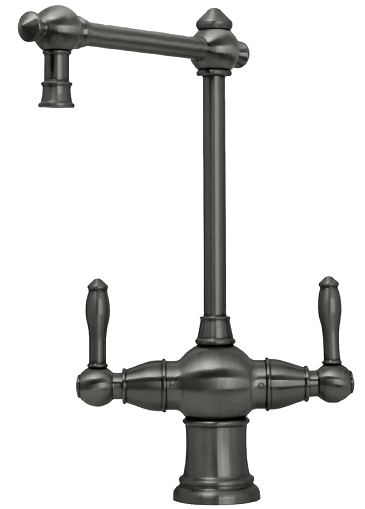
Careful cleaning and maintenance not only preserve the good looks of your faucet but also your finish warranty.
No faucet company guarantees its finishes against careless cleaning or lack of routine maintenance.
This topcoat seals the tiny gaps in the metal finish that may result from electroplating, adds a hard, sacrificial layer that protects the metal from scratch damage, and prevents localized discoloration from frequent contact with a user's hands.
The downside, however, is that the sealant coat is usually not as hard as the underlying plated metal and can be more easily damaged.
A polymer topcoat has a hardness rating of 2.5 to 3.0 on the Mohs scale, while nickel, considered a relatively soft metal, scores 3.5 to 4.0.
Of all the usual plating metals, only pure copper is as soft as or softer than transparent coatings. Chrome is the hardness king at 8.0.
The company website does not identify any of these top coats as (water-spot-resistant) or (fingerprint-ressistant).
Physical Vapor Deposition (PVD)
PVD is one of the latest space-age faucet finishing technologies, rapidly replacing electroplating as the finish process of choice.
Although the technology was discovered in the 19th century, it was not used in industry until the 1950s, and then only rarely due to its great expense. Today, PVD technology is everywhere, and the machinery required is getting smaller, faster, and cheaper all the time.
The PVD coating is applied in a sealed chamber that is loaded with unfinished faucet components. All the air is removed and replaced by a carefully calculated mix of nitrogen or argon and reactive gases.
A rod of the metal to be used for the finish is heated to a temperature so high that the metal dissolves into individual atoms.
The atoms mix with the various reactive gases to get the desired color and finish effects and are then deposited in a very thin film—2 to 5 —on the faucets.
Typical plating metals are nitrides of zirconium and titanium, both non-reactive metals that do not tarnish, corrode, rust, or change color.
Different finish effects are created by using different plating metals and varying the mix of reactive gases.
Titanium, an inert, dull gray metal in its natural state, can be used to create Akicon's Brushed Gold PVD finish by combining it with nitrogen gas. Adding a toucch of methane produces Rosse Gold. (We are not suggesting that thiese are the formulas used to produce the Akicon finishes. They are just an example of the methods that could be used.)
No doubt chemists and materials scientists can explain exactly how and why this magic works. We can't, but it is certainly amazing to watch.
To view faucet components being given their PVD finishes using a process called reactive sputtering, check out this brief video (after you skip past the inevitable YouTube advertisement). Be aware that it is very noisy, so you might want to turn down the volume on your player.
Despite being just microns thick, a PVD coating is extremely dense and, in consequence, very hard and durable. On the Vickers hardness scale, PVD scores between 1,500 HV and 3,000 HV compared to electroplated chrome in the range of 800 to 1,210 HV.
In our admittedly less scientific tests, a Scotch Brite® heavy-duty scouring pad was able to visibly damage a PVD finish slightly, and it took considerable effort. Brillo® pads had no effect at all.
Faucet Warranty
Akicon modestly entitles its warranty a "Limited 5-year Warranty."
By its terms, however, it is a lifetime warranty for buyers that own a home and a 5-year warranty only for buyers that do not own a home or who use the faucet in a business or commercial enterprise.The warranty is poorly written, ambiguous in places and outright illegal in others.
Writing a consumer warranty is not a job for amateurs. It requires someone who is familiar with the intricacies of legal drafting and the laws and regulations that govern consumer product warranties. That familiarity eluded whoever drafted the Akicon warranty.
Magnuson-Moss Warranty Act
The federal statute that governs the form and content of consumer product warranties in the U.S. is the Magnuson-Moss Warranty Act (15 U.S.C. §2301).
The Act is complex in its own right, but the explanatory rules issued by the Federal Trade Commission are even more intricate and they are written in "federalese"—a dialect similar to English, but not quite the same.
The federal law governs not only what must be included in a consumer warranty and what may not be included, but also when and how the warranty must be made available to the buying public.
Pre-Sale Warranty Availability Rule
An seller must make the complete text of the warranty readily available to customers before they purchase any warranted product costing more than $15.00. (16 CFR § 702)
Understanding Finish Warranties
No warranty protects against all of the hazards that can befall a faucet finish, and the Akicon finish warranty is no exception.
It protects against just those defects that result from errors in the finishing process: peeling, flaking, blistering, scaling, excessive discoloration, delamination, and, for other than living finishes, tarnishing.
These are extremely rare, and by "extremely rare" we mean "almost unheard of."
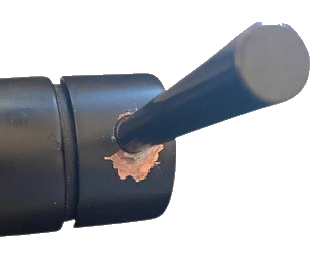
A peeling faucet finish
(Not an Akicon faucet.)
Most damage to faucet finishes results from over-zealous cleaning.
Modern finishes do not require scrubbing.
They need little more than a wipe-down with a mild detergent and soft cloth. Harsh chemical cleansers or scouring pads are not needed.
Finish damage caused by customers is never covered by a faucet warranty.
If it peels, flakes, or scales, Akicon pays.
But, if you scratch it or it turns a funny color after you polish it a few times with Wham-X All Purpose Miracle Cleaner, you are on your own. Sorry!
An online e-commerce seller like Akicon can satisfy the rule by displaying the warranty terms on the online product listing page—typically via a clearly labeled hyperlink such as
or similar phrasing.
The seller must also provide a contact method (phone number, email, or postal address) for requesting a free paper copy.
Akicon does not comply with either requirement.
It provides a brief summary of the Akicon warranty on the company website, but it is not linked to the product listings. Nor is their an option provided for requesting a pap;er copy.
A summary does not meet the requirements of the regulation. The full text of the warranty must be made available online and, if requessted, in a paper copy.
Pre-Sale Availability
An email to the company asking for a copy of the complete unabridged warranty prompted a response that directed us to the online warranty summary, which we had already found.
We never did get a hard copy of the complete warranty from the company—one of the few times Akicon's customer service failed to provide the information requested.
However, after a bit of poking around the web, we found what appears to be the current Akicon warranty on the Home Depot website and at thdststic.com.
The warranty Period
The caption of the Akicon warranty modestly identifies it as a "Limited 3-year Warranty". The text of the warray, however, describes it differently:
Limited 3-year Warranty
Akicon warrants to the original consumer purchaser for as long as the original consumer purchaser owns their [sic] home … that this faucet will be leak- and drip-free during normal use, and all parts and finishes of this faucet will be free from defects in material and manufacturing workmanship. All other purchasers (including purchasers for industrial, commercial and business use) are warranted for a period of five (3) years from the original date of purchase …
This paragraph does not describe a 3-year warranty.
Words-Over-Numbers Rule
The warranty period for homeowning buyers is for as long as the consumer "owns their [sic] home." This is what is usually identified as a "lifetime" warranty.
A 5-year warranty applies to buyers who don't own a home or who use the faucet in a business.
There is no three-year warranty. Akicon may have intended to provide a three-year warranty, but that intent is not given effect by the warranty's language.
The reasoning for denying lifetime warranty coverage for business and commercial use is fairly obvious.
Commercial faucets are subject to vastly different wear-and-tear dynamics, and Akicon's faucets are not designed for unmanaged handling, high water pressures, and harsh chemical cleaning agents that accelerate faucet failures in commercial settings.
The rational for denying lifetime coverage to consumers who don't own a home is much less evident.
Apartment dwellers are unlikely to buy a faucet for their apartment. It happens, but it's rare. The more likely buyers are consumers whose home is in a living trust— a very common estate management tool even among the modestly well-to-do. The trust owns the home, the consumer reserves a permanent right to live in it.
There is no obbvious reason why a faucet in a trust-owned home is more likely to fail than one in a buyer-owned home, nor why it deserves a lesser warranty.
Transferability
Only the original consumer buyer has rights under the lifetime warranty.
If the buyer sells the house in which the faucet is installed and the faucet goes with the house, the lifetime warranty does not transfer to the new owner.
All states and provinces in North America have laws requiring that consumer products be fit for their ordinary purposes and conform to an ordinary buyer's expectations.
This is the implied warranty of merchantability. It derives from English Common Law and is the law in both Canada and the U.S. It automatically attaches to every sale of a consumer product by a merchant.
A product is merchantable if it serves its ordinary purpose. A faucet, for example, is merchantable if it dispenses controlled amounts of water.
A merchantable product must remain merchantable for a reasonable amount of time. How much time varies with the product. A faucet that leaks after one or two years is probably not merchantable. One that doesn't leak until its 20th anniversary probably is – a faucet is not expected to be leak-free forever.
Magnuson-Moss refines state warranties of merchantability by providing uniform national standards for form and content, but it does not supersede them.
But it doesn't end either. It stays with the original buyer, and remains with the buyer for as long as he or she owns a home—not just the original home, but any home.
The buyer does not need to continue to own the faucet. By the terms of the warranty, the he or sshe only needs to own a home for the lifetime warranty to remain in effect.
Why does this matter?
Because as long as the buyer holds the warranty, he can make a claim under the warranty for the benefit of whoever owns the faucet—a claim that Akicon would be legally bound to honor.
The new owner is what is called an "incidental beneficiary" [3] of the warranty. He or she cannot make a claim, but can benefit from a claim made by the buyer.
If the new owner is a complete stranger, that claim is not likely. But what if the new owner is the buyer's daughter, and the next new owner is the buyer's granddaughter? Akicon may find itself dealing with what is in effect a multi-generational "forever warranty."
A warranty that is competently written eliminates this possibility by requiring the buyer to continue to own the faucet and live in the home in which it is originally installed for the warranty to remain in force. Here is an example of the needed language, taken from our Model Limited Lifetime Warranty:
Akicon, Inc. ("we, us, our") warrants our faucets to the original consumer owner of the faucet ("you, your") to be free of defects in materials and workmanship for as long as you own the faucet and live in the residence in which the faucet is first installed. Neither this warranty nor any benefit under this warranty is transferable or available to a subsequent owner of the faucet.
Prohibited Disclaimer
Another, more serious problem, arises from this provision:
"Except as provided by law, this warranty is in lieu of and excludes all other warranties, conditions, and guarantees, whether expressed or implied, statutory or otherwise, including without restriction those of merchantability or of fitness for use."
Magnuson-Moss absolutely forbids a company providing a written consumer warranty from denying coverage by state law implied warranties, including those of merchantability or fitness for use.
A company's written warranty is intended to supplement state-law warranties, not replace them. Any attempt to disclaim state-law warranty coverage is simply ignored and will not be enforced. (15 U.S.C. § 2308(a))
Deceptive Language
Of more import, however, is the fact that the language is misleading.
The language gives the impression that there are circumstances where state-law implied warranties would not apply. It would almost certainly lead a reasonable consumer to falsely believe that a defective Akicon faucet could be excluded from state-law warranty coverage—and that is the very definition of deception under the law.
There are no circumstances under which implied warranties would not apply, so the usual escape clause "except as provided by law" does not immunize Akicon from liability. [4]
We don't think Akicon is being deliberately misleading. Most likely, whoever wrote the warranty saw the provision somewhere, decided that it sounded lawyerly, and decided to include it.
Unfortunately, however, deception need not be intentional in order to be penalized.
Magnuson-Moss requires the company to take reasonable care to "make the warranty not misleading." (15 U.S. Code § 2310(c)(2))
Required Faucet Identification Marks
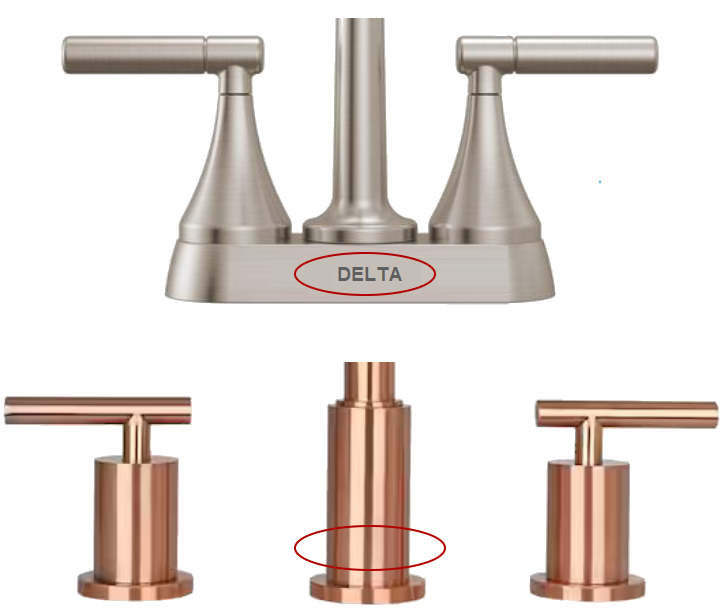
A Delta lavatory faucet (top) is permanently etched with the required brand identification mark positioned so it may be viewed after installation. The Akicon faucet bears no identification mark.
- Bear a permanent legible marking indicating the maximum low rate, expressed in gallons per minute (gpm), 16 CFR § 305.24(a)(1).
- Be marked with a permanent legible marking to identify the manufacturer* located where it can be viewed after installation. (16 CFR § 305.24(a)(2).
- Be marked asrequired by state law for sale in the requiring state. For California, for example, these include model number and date of manufacture.
The very presence of the provision in this warranty, however, evidences a lack of the required reasonable care and exposes the company not only to the penalties provided by federal law for deceptive practices—along with attorney fees and costs—but also to the punitive damages awarded by most states for deception under state consumer protection laws.
Deception, intended or not, is one of the easiest ways to turn a $500.00 warranty claim into a $15,000.00 court judgment.
For a warranty that avoids the issues of the Akicon warranty, see the Model Limited Lifetime Warranty.
Customer Support
Akicon's warranty may be amaturish, but its customer support is the opposite—professional, effective, and responsive.
The company takes care of its customers.
Our months-long evaluation of the company's customer service yielded positive results overall, with a score of 4.2 out of 5.0. While any score above 4.0 is considered good, relatively long wait times remain the company's primary weakness.
Akicon does not have a Better Business Bureau file, which means that in all of the years it has been in business, the BBB has never received a complaint about the company or its products. Had the BBB received even one complaint, the company would have a file.
That record is one to be admired. It is very hard to achieve.
However, the absence of a file also means that the company has not been accredited by the BBB, and it should take the steps needed for accreditation.
Legal Actions
Akicon was sued in California on September 26, 2026 in an action entitled Jack Gershfeld vs. Akicon, Inc. (TCN-956857).
The complaint alleges that Akicon sold dishwasher air gaps that lack approved agency listings, required flood-level markings, and manufacturer branding, making them unlawful to install in California and exposing a class consisting of all buyers of the product to code enforcement or penalties.
The complaint further claims violations of California's Unfair Competition Law (UCL) for deceptive business practices and overcharging consumers for unusable products.
The lawsuit is ongoing, and none of these allegations have been proven.
We suspect, however, that more lawsuits may be coming. Many, if not all, of Akicon's faucets are also missing required markings.
Akicon Website
The company's website is an e-commerce site and the company's principal retail outlet.
It caters to homeowners, interior designers, builders, and contractors. Its core purpose is to showcase, market, and sell kitchen and bath products.
Design professionals and those in the construction trades can take advantage of a dedicated trade partner program with special trade pricing.
Navigation
Navigation is mostly menu-driven and intuitive. We were able to move around the site without getting to any point at which it was not clear where to go next.
To find kitchen or bathroom faucets, simply click bathroom or kitchen on the main menu, then faucets on the resulting dropdown.
The faucets are nicely illustrated, most with images that change as you select different finishes so each finish can be visualized. Most faucets are also illustrated with images showing the faucet installed.
Site Search
The website's search algorithm is powerful and reasonably discriminating. It is a quick way to display exactly the faucets you may want to consider without wading through listings for items that do not meet your selection criteria.
If, for example, you are considering a faucet for a vessel lavatory sink, a search of "vessel faucet" displays the two available from Akicon. "Two-handle faucet" displays all faucets with two handles (but also a smattering of single-handle faucets.)
Unlike the site search function on most faucet websites, it is actually a useful tool. We found it particularly helpful when matching finishes.
To find all items available from the company in a "brushed gold" finish, for example, simply search on "brushed gold".
The algorithm will display every kitchen range, range vent, cabinet handle, showerhead, faucet, sink, air gap, lotion dispenser, paper towel holder, drain, base plate, and pot filler available in brushed gold or with brushed gold trim.
It's a quick way to assemble a well-coordinated kitchen or bath.
|
Minimum Faucet Specifications
Required for an Informed Buying Decision
Score: 53 out of 100 | Grade: F (Fail)
|
||
|---|---|---|
| Specification | Specified | Score |
| ADA/ACA qualitied1 | ✓ | 5 |
| Aerator (manufacturer) | – | 0 |
| Baseplate (included)2,3 | ✓ | 3 |
| Certifications | ✓ | 5 |
| Dimensions | ✓ | 5 |
| Finish chart | ✓ | 5 |
| Flow rate (maximum) | ✓ | 5 |
| Images (multiple) | ✓ | 5 |
| Installation instructions | ✓ | 5 |
| Material, primary (brass, stainless, etc.) | ✓ | 5 |
| Material, secondary (zinc, plastic etc.) | – | 0 |
| Mounting holes (number) | ✓ | 5 |
| Parts diagram | – | 0 |
| Spray head material2 | – | 0 |
| Spray hose material2 | – | 0 |
| Supply hoses (included)4 | ✓ | 3 |
| Supply hose manufacturer2 | – | 0 |
| Supply hose material2 | – | 0 |
| Valve/cartridge (type) | ✓ | 5 |
| Valve/cartridge manufacturer | – | 0 |
| Warranty link5 | – | 0 |
|
1. Suitable for use by persons with disabilities.
2. If applicable.
3. Base plates are usually, but not always, included.
4. Supply hoses are usually included.
5. A warranty summary is on the website but not the full warranty text as required by law.
| ||
Downloads
Faucet listings are linked to additional documentation to be downloaded.
These are not labeled consistently, but for most faucets they are "Downloads," "Specifications & Installation," and "UPC Certificate."
The Downloads and Specifications & Installation links led to the same document for the thirty or so faucet listings we tested.
The sheet does not include any actual specifications but may include a parts diagram, care and cleaning instructions, and a troubleshooting guide as well as directions for the installation of the faucet.
Installation instructions were complete and easy to follow. Our plumbers rated installation "Very Easy" on a four-point scale of "Very Easy" to "Very Hard."
Some, but not all, faucets link to a "UPC Certificate" showing compliance with the basic faucet standard, A112-18.1CSA 125.1. It is one of three required certificates, but, unless you know how to read a certificate, it is of little value.
Two other certificates are required. One that shows compliance with ANSI/NSF 372 (lead-free standard) and one for ANSI/NSF 61 (drinking water safety standard) are not shown. (Neither of these is referenced on the website. We have, however, confirmed that they exist and are currently valid.)
We recommend a clear statement rather than links to the actual certificates or mystery statement such as "Complies with ASME A112.18.1", which means nothing to the average buyer.
A statement such as the following can be easily understood by consumers with no background in the faucet industry.
"An accredited third-party testing organization has certified this faucet compliant with all applicable North American standards. it is safe to use and legal to install in a drinking water system anywhere in the U.S. [or Canada.] (For a copy of the applicable listing certificates, please contact us at [email, telephone, or both].)"
Minimum Required Faucet Specifications
Once a suitable faucet is found, however, the basic information about the faucet needed for a fully informed buying decision is woefully incomplete.
Valve Cartridges
Faucet cartridges, for example, are identified only as "ceramic."
Since all modern faucets include ceramic cartridges, that is not very helpful information. There are very good, and very poor ceramic cartridges in the world, and we would like to be assured that we are getting one of the better-made brands.
Aerators and Sprays
The same is true of aerators—the second critical component of a faucet.
The company is completely silent about the source of its aerators and spray mechanisms. We believe, based solely on a visual examination, that most faucets are fitted with aerators sourced in China.
Aerators and spray heads are not subject to rigorous testing like ceramic valves (see more below) during certification, so their durability and longevity are largely unknown. The only guide to quality is the reputation of the manufacturer.
We assume that the aerators and spray assemblies used in Akicon faucets are probably good enough, but that evaluation is based solely on the manufacturer's reputation for quality. We doubt Yida would use spray assemblies or aerators in its faucets that are not dependable.
It would be worth knowing, however, that brands like Neoperl or Amfag from Europe and Waternymph or jomoo from China are are used in Akicon faucets.
We would also like to know the material from which each kitchen faucet spray is made: brass, some other metal, or plastic.
Finishes
There is no finish chart on the company website, but the finishes in which a faucet is available are identified after a fashion, here and there with the various faucet listings.
What is not identified, however, is the process used to produce the finish. The process determines the durability of the finish and how much care and maintenance it needs, so knowing the process is very important to an informed finish choice.
Website Score
We can do with less marketing and more of the basic faucet specifications. The company has the information: it just needs to be willing to share.
Where to Buy
Akicon.com is the company's "Official" website and its primary retail venue. It also maintains a website devoted primarily to HVAC ("heating, ventilation, and air conditioning") systems, AkiconHVAC.com, which also sells stainless steel faucets for outdoor kitchen use. (These faucets are not included in this report.)
The faucets are also sold at
Bed Bath & Beyond,
Best Buy,
Farmhouse Kitchen & Bath,
Home Depot,
Lowe's,
Menards
Overstock
Target (via Target+),
Wayfair, and
Walmart.
Some retailers sell the faucets in physical stores, but most are online only. Generally, online prices are lower, but in-store sales allow you to examine the physical faucet before buying.
Faucet Pricing
Faucet prices can vary substantially.
Akicon does not seem to have adopted a Minimum Advertise Pricing (MAP) policy—a form of price fixing that has been legal since the 2007 U.S. Supreme Court decision in Leegin Creative Leather Products, Inc. v. PSKS, Inc.
We did not find a MAP agreement, but that's not unusual. Most distributors keep MAP agreements and dealer pricing schedules confidential inside their wholesale portals or distribution contracts—documents to which we do not have access.
MAP allows a manufacturer or distributor to set the minimum price at which a U.S. retailer may advertise a faucet. It can sell below the MAP price but cannot publish the sale price.
One result is that most retailers, whether online or in stores, simply sell at the same, lowest allowed, price. price competition is largely stiffled at the retail level.
Price competition for Akicon faucets, however, is vigorous, suggesting that if the company does have a MAP policy, it is not working all that well.
On the date of this report, Akicon's suggested retail (list) price for the AK455C pulldown spray kitchen faucet in Copper was $233.99. We found non-sale street prices ranging from $204.39 at Bed Bath & Beyond to $260.99 at Best Buy.
That pricing will certainly have changed by the time you read this report, but the difference of over 20% suggests that shopping around for the best price is probably a wise decision.
Testing & Certification
Drinking water faucet certification is not just something that is nice to have or recommended; it is the law everywhere in North America.
There are no exceptions. Every faucet for sal in North America must be certified.
Testing and certification are of such critical importance that compliance laws prohibit companies from self-certifying their faucets, requiring instead the oversight of an accredited independent laboratory.
The tests are rigorous, some of the most uncompromising in the world. To understand how tough, consider the following:
Life Cycle Testing
A faucet's valve is the heart of a faucet. It is the component that actually controls water delivery, turning the water on and off and regulating temperature.
Valves are tested for durability and longevity by cycling the faucet on and off 500,000 times in a robotic testing chamber.
That's not a misprint. The test requires a full half-million test cycles without a single failure. At one cycle per second, twenty-four hours per day, the test takes almost six days to complete.
In other countries, the standard is much less strenous.
The European durability standard (EN 817) requires 70,000 cycles, and the Chinese (GB18145-2014) test is a mere 30,000 cycles.
A half million cycles are probably far more than the faucet would ever go through in a lifetime, equivalent to about 70 years of use in a typical kitchen or bath. [5]
"Burst" Testing
A second test—formally a "hydrostatic pressure test" and informally the "burst test"—confirms the valve's resistance to sudden surges in household water pressure.
Every time you abruptly turn a faucet off, a momentary wave of high pressure pulses through your water pipes.
To test resistance to these transitory surges, a valve cartridge is subjected to water pressure ten times the average household water pressure for one minute to see if it will deform or leak.
If it does, it fails and is not certified for use in North America.
Ten Times Household Water Pressure
Other Standard Tests
Every legal faucet sold in North America has passed these two tests and dozens of others to ensure, among other things, that:
- The design of the faucet permits the repair of most common problems from "above the sink" without having to uninstall the faucet.
- Faucet finishes are durable enough to withstand moderate abrasion and contact with common household chemicals without damage.
- Flow rates do not exceed the maximum legal flow rate of 2.2 gallons per minute. It can be less—and in some states, like California, it must be less—but it cannot be more.
- Backflow protection is installed where needed to prevent drinking water contamination.
- Faucets do not contain harmful contaminants like lead, mercury, arsenic nor dangerous pathogens that can end up in the water flowing through the faucet.
Testing for Contaminants
Faucets are tested for the presence of harmful substances by filling them with water specially formulated to extract contaminants.
After 19 days, the water is removed and tested for the presence of toxins and harmful organisms in concentrations greater than safe limits.
If any are found, the faucet fails and is not certified for use in North America. The lack of certifications under these circumstances usually suggests an imminent discontinuation of the collection.
Lead is a special concern with faucets made in China, where leaded brass is commonly used, and there are no regulations banning or limiting lead in faucets.
It has been identified by both the Environmental Protection Agency (EPA) and the World Health Organization (WHO) as a neurotoxin that is very hazardous to health.
Neurotoxins specifically target and destroy the nervous system, disrupting critical communication between neurones.
Children younger than six years are especially vulnerable to the effects, which can severely affect mental and physical development, decreasing cognitive ability and, in extreme cases, retardation.
In the past, brass could include up to 8% lead and still be used in faucet construction. But that ended in 2014 with an amendment to the federal Safe Drinking Water Act and to similar legislation in Canada. (See, e.g., the Ontario Safe Drinking Water Act.)
Today's brass faucets must, by law, be made of an alloy that contains no more than a bare trace of lead, if any.
To ensure that a faucet is free of lead, it must pass two stringent tests.
- ANSI/NSF 372 ensures that material that touches water flowing through the faucet contains no more than 0.25% (1/4 of 1%) lead in its composition.
- ANSI/NSF 61 guarantees that water passing through the faucet does not pick up lead in a concentration greater than 5 parts per billion.
That's "billion" with a "b", almost no lead at all. The air you breathe probably contains more lead than the tap water you drink.
Safe, Durable Faucets
How successful are the safeguards provided by certification?
Very.
Safety
Certified faucets deliver drinking water that is just as safe as—and often safer than—bottled water, thanks to strict manufacturing standards and heavy infrastructure investments from the treatment plant to your home. Unlike uncertified fixtures, certified faucets are specifically engineered to eliminate toxic mineral leaching and prevent the growth of disease-causing biofilm.
The Basic Faucet Buying Rule
The basic buying rule for faucets is simple: never, ever buy a faucet unless it is certified and the seller can prove it is certified.
Established and well-known faucet brands like are safe bets.
But if the faucet is a brand you have never heard of, demand the listing certificates from the seller. If the certificates are not forthcoming or you are not sure they are valid, don't buy the faucet.
We can help you identify safe faucets.
Go to our Index to Faucet Reviews to find the 300+ most-sold brands in North America.
Our review will reveal whether the brand is certified and score its quality and reliability, the level of warranty protection, and whether it is an overall good value.
If it has not been reviewed, most likely it is a contraband faucet, but to be certain, send the brand name to us by email at starcraftreviews@yahoo.com.
We will check it out and respond within 1 business day, and there is no charge for this service.
Choosing tap water over bottled alternatives also reduces your exposure to hidden contaminants that may be present. A 2020 investigation by Consumer Reports, for example, revealed that multiple bottled water brands contained arsenic and "forever chemicals" (PFAS) well above safe thresholds.
PFAS (per- and polyfluoroalkyl substances) are man-made synthetic chemicals that do not break down easily in the environment or the human body and are linked to several adverse health effects including cancer, immune system suppression, pregnancy complications, and neurodevelopmental and cognitive impacts in children.
A four-year review by the Natural Resources Defense Council, published in 2025, comparing bottled versus tap water found that nearly one-quarter of tested bottled water brands exceeded state health limits for chemicals, warning that long-term consumption of these products could elevate the risk of cancer and other serious chronic health issues.
Durability
Certified faucets are not just safe; they are also incredibly durable.
If you have ever wondered why faucets seem to last forever, the answer is certification.
Certified faucets are beastly tough, unlikely to ever fail in a lifetime of use. Fewer than 5% develop a problem resulting from a design, manufacturing, or material defect.
In our day job of remodeling vintage kitchens and bathrooms, we encounter faucets that are well into their second century and still going strong.
How to Clean a Ceramic Valve Cartridge
If your faucet starts to drip after several years, the problem is most likely in the valve cartridge.

It is probably not defective. It is just clogged up with mineral deposits accumulated over the years from hard water.
The two ceramic discs that shut the water off no longer mesh perfectly, allowing a few drops of water to slip through.
To return it to full functionality, removing the limescale deposits is all that is required.
Here is how that can be done:
- Remove the cartridge following the instructions in your faucet manual. (If you did not keep the instructions, go to YouTube for any of several videos on how to remove a cartridge.)
- Soak the cartridge for up to 30 minutes in a solution of 50% household vinegar and 50% water.
- While you are waiting, take a toothbrush soaked in the vinegar/water mixture and clean the cavity in the faucet that holds the cartridge. Wipe it dry with a clean cloth.
- Rinse the cartridge thoroughly in clean, cold water.
- Lubricate the O-ring(s) and rubber washers, if any, with silicon plumber's grease.
- Reinstall the cartridge.
- If the mineral build-up is substantial, you may have to do this more than once.

View a video by Vigo on how to remove and replace a ceramic cartridge. in a single-handle faucet.
View a good video by Fluid on
how to clean a ceramic cartridge.
Faucets are usually replaced, not because they fail, but because tastes change and they simply go out of style. Newer, often more convenient, designs and novel finishes make that old faucet seem old indeed. But it's not old at all, not for a faucet, that is.
And the odds are very good that it still works.
Leaking is now very rare due to improved valve technology that no longer relies on rubber rings and washers to control water flow.
With the near-universal adoption of almost indestructible ceramic disc valves, the dreaded midnight drip, drip, drip is largely a thing of the past.
It is becoming even less common with the introduction of super-cartridges that use ceramic discs treated to prevent mineral deposits—accumulated minerals from "hard" water that are the usual suspects if a ceramic valve leaks.
To learn more about how consumers are protected by faucet regulation at all levels of government, go to Faucet Basics, Part 3: Keeping Faucets Safe & Reliable.
Listing Certificates
A faucet that passes all required tests and meets all North American standards is listed in a certificate issued by the testing authority called a "Certificate of Listing."
The certificate must be issued before the faucet is placed on the market, then reissued annually thereafter for as long as the faucet remains for sale.
In addition, the testing authority will periodically take faucets from the seller's inventory, and sometimes right off the production line, for random retesting.
A certified faucet must be identified by
- An indelible mark on the faucet itself indicating the certifying authority and standards to which the faucet is certified and
- By brand and model name (or number) on the certificate of listing.
If it is not marked, not listed, or the listing does not show the brand name and model under which the faucet is sold, it is not certified. And, no matter how long or loudly the seller insists that it is, it isn't.
The listing certificates are public documents, posted on the web.
Many traffickers of contraband faucets claim compliance with some or all North American faucet standards but sell faucets for which required certificates do not, in fact, appear in web databases.
We know because we check, and if a certificate is not in the database, it does not exist.
No one, not even the most experienced professional, can tell by looking at a faucet (or a picture of a faucet on a website) whether it is free of lead and other contaminants, that its valve is good for at least 500,000 on/off cycles, or that its finish won't fail in ordinary use.
Testing and certification is the only way to be sure that faucets are safe and reliable.
Akicon's Certification Report Card
 CalGreen® Certified: Akicon faucets comply with the energy-saving requirements of the California Green Building Standards Code. For a faucet to display the CalGreen label, it must have been tested for compliance with CALGreen Chapter 4, Residential Mandatory Measures, Section 4.303 Indoor Water Use, and certified by an independent testing organization.
Comparable Faucets
Faucets made in China, comparable to Akicon faucets in quality with the same or a better written warranty, but not necessarily comparable in design or price, include:
In Conclusion
We like the faucets. They are well-made using, as far as we can tell, quality components. Customer support is responsive. The faucets sell for a reasonable price, at the low end of the pricing chart for fully certified faucets and well below our $500.00 cut-off for mid-priced faucets.
Its manufacturer is completely reputable. The faucets and the components used in the faucets have passed all required certification testing and are both safe and legal for installation in any drinking water system in Canada or the U.S.
Faucet Street Price Comparison
In U.S. Dollars
Prices stated are as of the date of this report and may have changed. Hands-free faucets are not included.
We do not like the ambiguous faucet warranty or the dubious statements about the company found on the Akicon websites.
Akicon is not a manufacturer, and taking "immense pride in [its] distinct role as a manufacturer", is taking pride in something it is not.
The answer to Akicon's self-posed question:
…Are we manufacturers or retailers?…
…is simple.
The answer is a "retailer" along with importer and distributor", what we call a Marketeer.
What it is not is a manufacturer of faucets nor, as far as we can tell, a manufacturer of any of its products.
The company is smart enough to select reputable suppliers and sell quality faucets to a target market for a fair price. That should be enough approbation. Dubious kudos do not need to be invented.
Its warranty is anateurish, not at all reflective of an otherwise reputable company. It needs a nearly complete rewrite to take care of some of its legal defects.
Most of the members of our rating panel would buy the faucets "without reservation." A minority would wait until the company's warranty had a little more clarity. One member also wanted assurances that the valve cartridges were from a manufacturer known to make quality a product.
Overall, we rate the faucets a good value, with the prospect of becoming a best value with a few improvements.
Continuing Research
We are continuing to research the company. If you have experience with Akicon faucets, good, bad, or indifferent, we would like to hear about it, so please starcraftreviews@yahoo.com or post a comment below.
Please note: we do not answer questions posted in the comments unless they are of general interest. If you have a specific question, email us at starcraftreviews@yahoo.com.
Footnotes
-
Akicon's known suppliers are
• Ningbo Yida Kitchen and Bath Technology Co., Ltd.: faucets, faucet accessories.• Ningbo Akicon Import & Export Co., Ltd. (China): Gas Ranges, Range Accessories, Ventilation Fans, Faucet Accessories, Range Hoods, Range Hood Accessories.• Ningbo TS Import & Export Co. Ltd. (China): Range Hoods, Faucet Accessories, Gas Ranges, Range Hood Covers, Bath Fans.• Ningbo Orangewind Industry And Trade Co., Ltd. (China): Bathroom fans.• Honlake HK Limited (China): Wood furniture.• Ningbo Orangewind Industry and Trade Co., Ltd. Ltd. (China): Bathroom fans.• Ningbo Shell Cross-Border Trade Co., Ltd. (China): Range hoods, Faucet Accessories.• Roper Corporation (Haier) (China): Ovens, Bath fans. - The Akicon kitchen faucets we inspected had plastic wands. We did not, however, examine every kitchen faucet and cannot say whether all Akicon kitchen faucets are equipped with plastic wands. If you are considering a kitchen faucet with a spray, find out what the spray is made of before reaching your buying decision.
- Incidental beneficiary refers to a third party who benefits from a contract between two other parties, but is not necessarily an intended beneficiary..
- Akicon, as the issuer of a limited and not a full warranty, is legally allowed to limit the duration of implied warranties to match the exact duration of its written warranty (e.g., a 5-year limited warranty can limit implied warranties to 5 years). This limitation requires "clear and unmistakable language" to that effect, and the Akicon warranty does not have it. This limitation is the only changed Akicon is allowed to make to state-law warranties, and, while legal under Magnuson-Moss, it is not legal under state low in many states.
-
If ceramic valve cartridges are designed to last 70 years or longer in ordinary use, why did my valve fail after 5, 10, or 20 years? The answer is mineral buildup. Faucets are tested in mineral-free water. Unless you have a water softener installed, your household water is probably mineral-rich. Only 15% of the U.S. has naturally occurring soft water.
Ceramic valves control water with two ceramic discs that are polished to the point where, when closed, the space between them is smaller than a water molecule. The flow of water is blocked. When minerals accumulate on the polished surface, that gap can widen, allowing water to slip through the resulting gap.What distinguishes super-valve discs from others is their resistance to mineral accumulation.At present, two approaches are used to combat mineral buildup. Diamond Seal Technology® valve cartridges used in faucets from Masco are coated with diamond dust that constantly grinds away any minerals that adhere to the discs. The German company, uses a simpler approach. Its PVD+® cartridges are coated with diamond-like carbon. This material not only makes the discs super hard but also makes them super slick, preventing minerals from sticking.For more in-depth information about faucet valves and cartridges, read Faucet Basics: Part 2: Faucet Valves & Cartridges.